
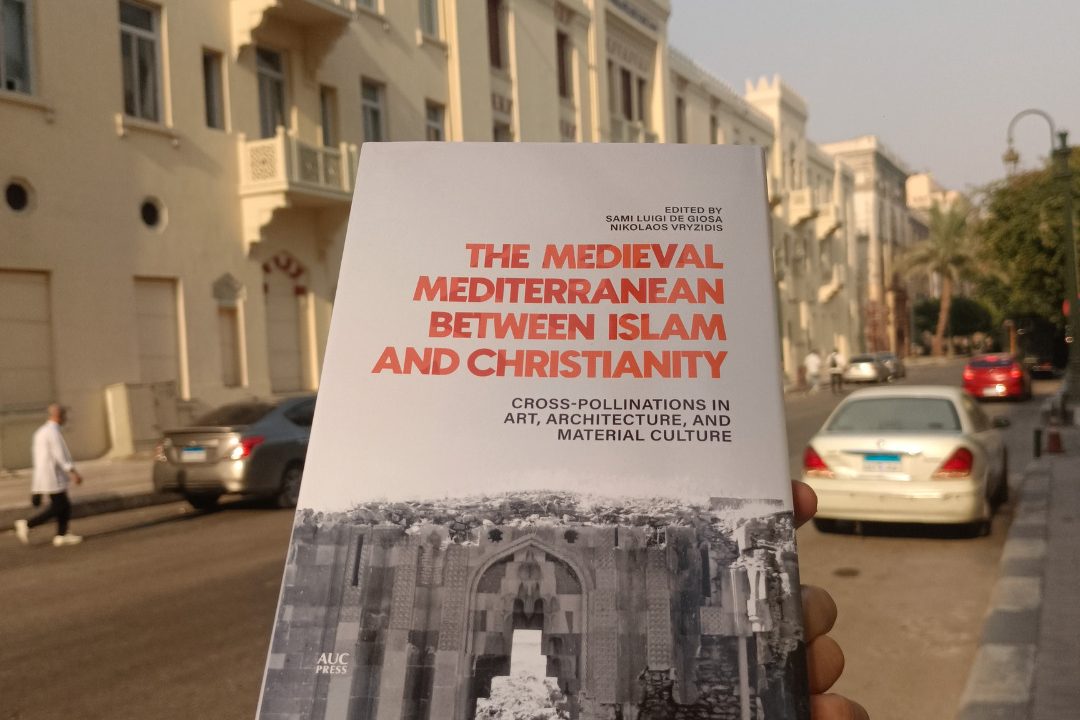
A liturgical object sitting quietly in an Orthodox monastery in Greece holds a secret that cuts across centuries of assumed religious division: part of it was made in Venice, and part of it was crafted in Seljuk lands. Two worlds, two faiths, one object.
That single artifact tells a story that a new academic volume argues has been hiding in plain sight for centuries. The Medieval Mediterranean between Islam and Christianity: Crosspollinations in Art, Architecture, and Material Culture, edited by Sami Luigi De Giosa and Nikolaos Vryzidis and published by The American University in Cairo Press, brings together ten essays that examine how Christian and Islamic cultures didn’t just coexist in the medieval Mediterranean — they borrowed from each other, built on each other, and left traces of that exchange in the objects that have survived to this day.
It’s a timely reminder that the medieval world was far more connected — and far more complicated — than the familiar narrative of clash and conflict tends to suggest.
What This Book Is Actually Arguing
The central claim isn’t subtle. The editors frame the medieval Mediterranean as a “new, fluid” space where Islam and Christianity “met, engaged, and intermingled.” The book’s primary focus is material culture — the physical stuff of daily and religious life — and what it reveals about interreligious contact that written records sometimes obscure or ignore.
Rather than sweeping historical arguments, the volume takes a deliberately granular approach. Each of the ten essays is what the editors describe as a “microhistorical case study” — a close examination of a specific object, technique, or artifact that carries evidence of cross-cultural exchange embedded in its very construction.
This is scholarship that asks you to look at things differently. Not at battles or treaties, but at bookbindings and monastery relics. The argument is that these objects, precisely because they were made to be used rather than to make political statements, often preserve a more honest record of how people actually interacted across religious lines.
The Medieval Mediterranean’s Hidden Exchanges
The essays span a wide geographic range. Most focus on the Mediterranean world, though a few extend further into the Middle East. Together, they build a picture of a region where goods, techniques, and artistic ideas moved across what we might assume were impermeable religious boundaries.
Several specific case studies are highlighted in the book’s framing material:
- A liturgical object preserved in a major Orthodox monastery in Greece combines a component made in Venice with another crafted in Seljuk lands — a physical fusion of Christian and Islamic craftsmanship in a single religious item.
- An essay examines the influence of Arabic bookbinding techniques in late medieval Italy, tracing how Islamic craft traditions shaped the way books were made and bound in a Christian European context.
- Additional essays examine other forms of material culture that blended both Christian and Islamic elements across the medieval Mediterranean and Middle East.
Each case study is designed to illuminate not just the object itself, but what its existence tells us about the people who made it, traded it, and used it — people living in a world where religious identity didn’t always determine who you learned your craft from.
Key Details at a Glance
| Detail | Information |
|---|---|
| Title | The Medieval Mediterranean between Islam and Christianity: Crosspollinations in Art, Architecture, and Material Culture |
| Editors | Sami Luigi De Giosa and Nikolaos Vryzidis |
| Publisher | The American University in Cairo Press |
| ISBN | 9781649031877 |
| Number of Essays | Ten |
| Geographic Focus | Mediterranean world, with some essays extending into the Middle East |
| Approach | Microhistorical case studies of art, artifacts, and material culture |
Why Material Culture Makes Such a Compelling Witness
There’s a reason scholars keep returning to objects when they want to understand cross-cultural exchange. Documents lie, or get destroyed, or were never created in the first place. Objects just exist. A bookbinding that uses Arabic techniques doesn’t need to explain itself — it simply is what it is, and what it is turns out to be evidence.
The editors of this volume make that case explicitly. By focusing on the arts of Islam and Christianity together, they argue the field can reveal things about interreligious encounters that other approaches miss. The “fluid Mediterranean” they describe wasn’t a place of permanent harmony — history is too complicated for that — but it was a place where craftsmen learned from each other, merchants carried techniques across sea routes, and religious institutions ended up with objects that don’t fit neatly into a single cultural category.
For readers interested in the medieval world, Islamic art history, Byzantine studies, or the history of the Mediterranean more broadly, this kind of granular, object-focused scholarship offers something genuinely different from the usual top-down political histories of the period.
Who Should Read This — and What They’ll Take Away
The book is clearly aimed at an academic audience — ten scholarly essays published by a university press isn’t casual beach reading. But the questions it raises are accessible to anyone curious about how cultures actually interact when they’re in close proximity over long periods of time.
The answer this volume offers, grounded in specific objects and specific places, is that interaction tends to be messier, more creative, and more human than the grand narratives of religious conflict usually allow. A monastery relic that fuses Venetian and Seljuk craftsmanship isn’t an anomaly. According to this scholarship, it’s a pattern.
For students of medieval history, art historians, and anyone interested in the real texture of Christian-Islamic relations in the pre-modern world, this collection represents a focused, evidence-driven contribution to a conversation that remains very much alive.
Frequently Asked Questions
What is the book about?
It is a collection of ten scholarly essays examining how Christian and Islamic cultures exchanged artistic techniques, objects, and material culture across the medieval Mediterranean world.
Who edited the book?
The volume was edited by Sami Luigi De Giosa and Nikolaos Vryzidis and published by The American University in Cairo Press.
What kind of objects does the book examine?
The essays cover a range of material culture, including a liturgical object in a Greek Orthodox monastery that combines Venetian and Seljuk components, and the influence of Arabic bookbinding techniques in late medieval Italy.
What geographic areas does the book cover?
Most essays focus on the Mediterranean world, with some extending into the Middle East.
What is the scholarly approach used in the book?
The editors describe the essays as microhistorical case studies — close, detailed examinations of specific objects and artifacts rather than broad historical arguments.
Is this book suitable for general readers?
The book is an academic publication aimed primarily at scholars and students, though its subject matter — how two major world religions interacted through art and craft — will interest anyone curious about medieval cross-cultural history.
Leave a Reply