
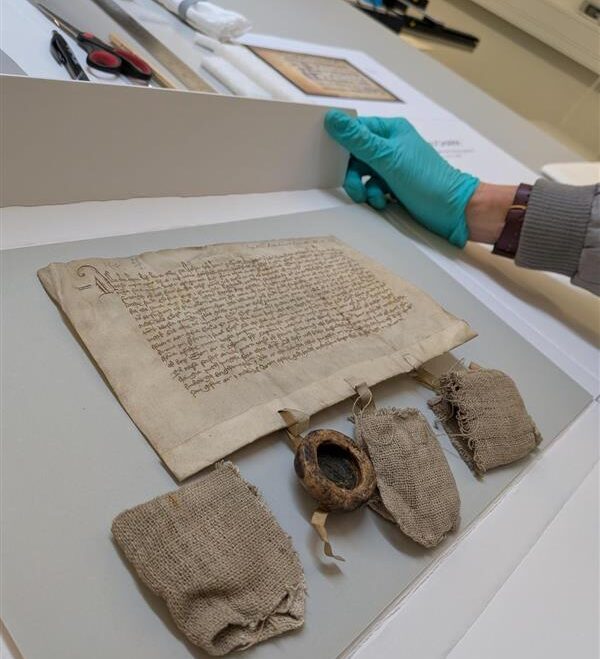
What did medieval writing actually look like — not just the words on the page, but the ink, the parchment, the pigments, and the hands that made it? A major research project based in Finland is trying to answer exactly that question, and the methods it’s using are as surprising as the history it’s uncovering.
The project is called CHARM — short for Combining Humanities And natural science Research — and it’s led by Tuomas Heikkilä at the University of Helsinki. Its focus is Finland’s oldest written culture, a subject that has remained poorly understood despite the country’s deep historical ties to the Christian and Latin cultural world of medieval Europe.
What makes CHARM stand out isn’t just the historical questions it asks. It’s the way it goes about answering them — by treating the physical document itself as evidence, not just the text written on it.
Why Medieval Writing in Finland Has Been So Hard to Study
Finland’s written culture during the Middle Ages developed within the broader Swedish realm and was shaped by the spread of Christianity and Latin literacy across northern Europe. And yet, despite those strong cultural connections, the local practices of writing — how scribes worked, what materials they used, how traditions were adapted to a northern context — remain surprisingly understudied.
That gap is what CHARM is designed to fill. The project centres on three major writing centres that were active in the 15th century: Turku, Naantali, and Viipuri. By examining material connected to all three sites — including charters and book fragments — researchers hope to map how writing practices were adopted, modified, and made local over time.
The core question driving the work is deceptively simple: how did writing actually take root in this region? The answer, researchers believe, is buried not just in what documents say, but in what they are physically made of.
Reading the Page Itself: The Science Behind the History
One of the most distinctive aspects of CHARM is its cross-disciplinary approach. Rather than relying solely on traditional methods like palaeography — the study of historical handwriting — or content analysis, the project deliberately brings together humanities scholarship and natural science techniques.
Researchers are using non-invasive methods to study the physical materials of historical documents. This includes analysis of inks, pigments, and parchment — the animal-skin writing surface used throughout the medieval period. One of the key tools being deployed is X-ray fluorescence (XRF), a technique that can reveal the chemical composition of materials without damaging the original object.
Silvia Russo and Helena Berg from the National Antiquities Board are among those working with XRF analysis as part of the project. Their work allows the team to ask questions that traditional document study simply cannot: What exactly was this ink made from? Where did these pigments originate? Can the materials tell us something about trade routes, local resources, or the specific workshop where a document was produced?
The combination of codicology — the study of manuscripts as physical objects — with cutting-edge scientific analysis gives CHARM a genuinely unusual toolkit for historical research.
What the Project Is Actually Examining
The research draws on a large-scale survey of material connected to the three writing centres identified as central to 15th-century Finnish written culture. The comparison of charters and book fragments side by side is particularly significant, because it allows researchers to look at both administrative and religious writing traditions together.
| Writing Centre | Location | Period of Focus | Material Examined |
|---|---|---|---|
| Turku | Southwest Finland | 15th century | Charters and book fragments |
| Naantali | Southwest Finland | 15th century | Charters and book fragments |
| Viipuri | Eastern Finland (historical) | 15th century | Charters and book fragments |
By looking at how writing practices varied — or stayed consistent — across these three centres, the team can begin to build a picture of how literacy spread through a region that was geographically and culturally distinct from the main centres of European learning.
Why This Research Matters Beyond the Archive
It might be tempting to see a project about medieval Finnish parchment as something of niche interest. But the questions CHARM raises touch on something much broader: how written culture spreads, how it adapts to local conditions, and what physical traces it leaves behind.
Understanding how writing took root in medieval Finland also sheds light on the administrative and social structures of the Swedish realm during this period — how institutions communicated, how land and power were recorded, and how communities were brought into a literate culture that was, for many people, entirely new.
The use of scientific techniques like XRF also has implications beyond this specific project. As researchers demonstrate what can be learned from the physical composition of historical documents, similar methods could be applied to manuscript collections across Europe and beyond — potentially reopening questions that scholars thought were already settled.
What Comes Next for the CHARM Project
CHARM is an ongoing research effort based at the University of Helsinki, with collaboration from institutions including the National Antiquities Board. The project continues to build its survey of material connected to the three identified writing centres, combining humanistic and scientific analysis in ways that are still relatively rare in medieval studies.
The researchers are working to understand not just individual documents, but the broader ecosystem of Finland’s oldest written culture — a term the project uses deliberately, suggesting that writing was never an isolated practice but always part of a wider network of people, materials, institutions, and ideas.
Whether that ecosystem can be fully reconstructed from surviving fragments of parchment and ink remains to be seen. But the attempt itself is already changing how scholars think about the medieval Nordic world.
Frequently Asked Questions
What does CHARM stand for?
CHARM stands for Combining Humanities And natural science Research. It is a project led by Tuomas Heikkilä at the University of Helsinki.
Which medieval writing centres is CHARM focused on?
The project focuses on three 15th-century writing centres: Turku, Naantali, and Viipuri, all of which were located in what is now Finland.
What scientific technique is being used to study the documents?
Researchers are using X-ray fluorescence (XRF) analysis, a non-invasive technique that reveals the chemical composition of inks, pigments, and parchment without damaging the original materials.
Who is involved in the XRF analysis work?
Silvia Russo and Helena Berg from the National Antiquities Board are among those conducting the XRF analysis as part of the CHARM project.
Why has medieval writing culture in Finland been poorly understood?
According to the project, local writing practices remain poorly understood despite Finland’s strong historical connections to the Christian and Latin cultural sphere — a gap CHARM is specifically designed to address.
What types of documents is the project examining?
Researchers are studying both charters and book fragments connected to the three identified writing centres, comparing them to understand how writing practices were adopted and adapted locally.
Leave a Reply