
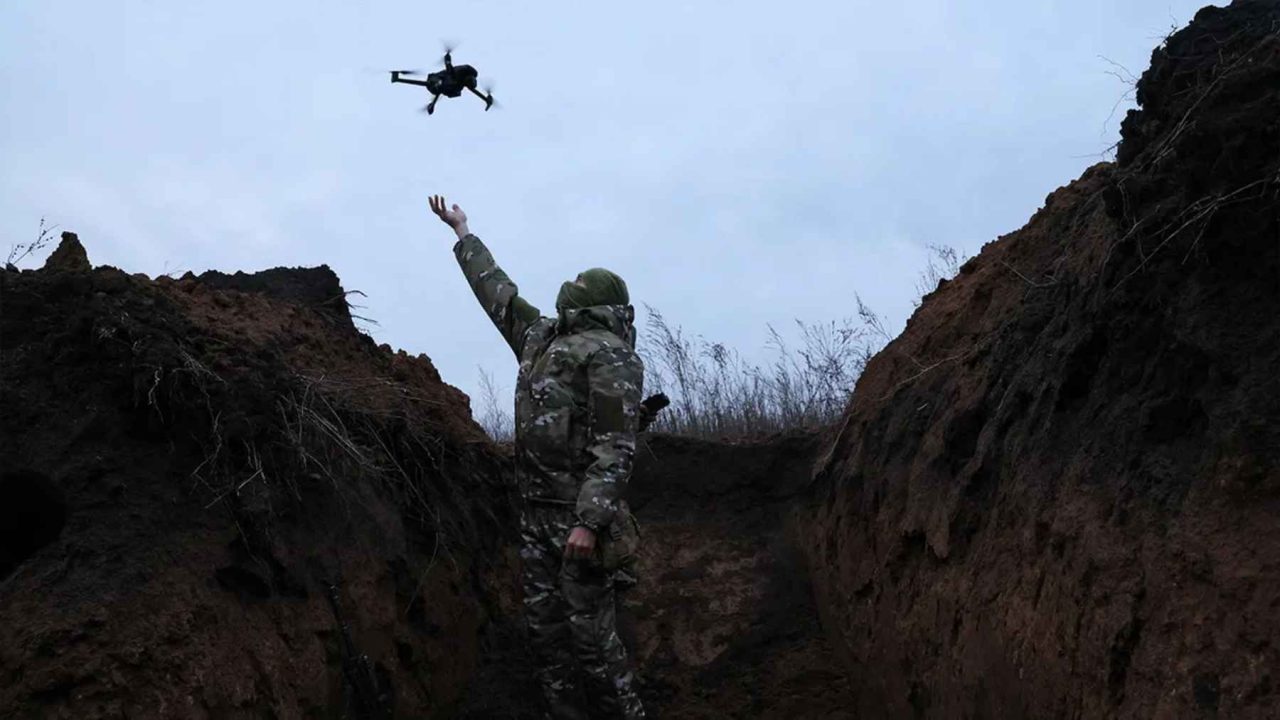
What looks like a fallen log or a dead tree on the edge of a treeline might be one of the most strategically important objects on the modern battlefield. Ukrainian officials have reported that Russian forces are concealing military communication antennas inside fake trees and artificial logs — not to fool soldiers on the ground, but to hide from the cameras of drones sweeping overhead.
It sounds almost absurd. But the logic behind it is sharp, and it speaks directly to how profoundly drone warfare has changed what it means to stay hidden on a front line.
The real target of this deception is not the human eye. It is the lens of an unmanned aerial vehicle — and the consequences of being spotted by one can arrive within minutes.
Why Antennas Have Become a Priority Target
On a modern battlefield, radio equipment can be as tactically valuable as ammunition. Antennas are the nervous system of military coordination — they relay orders, support electronic warfare systems, and help units communicate across contested terrain.
Electronic warfare, in this context, means using radio signals to jam or confuse enemy equipment. Signals intelligence means intercepting transmissions to determine who is operating where. Both capabilities depend entirely on antennas being in place and functioning.
That creates a fundamental tension. Antennas need to be exposed to work effectively. But exposure means visibility — and visibility on a drone-saturated battlefield is a serious liability.
Once an antenna position is identified, the clock starts ticking. A drone can flag the location, and the information can be passed to strike assets quickly. This has turned antenna concealment from a routine security measure into something closer to a survival requirement.
How Russia Is Using Fake Trees and Logs to Blind Ukrainian Drones
According to Ukrainian officials, Russian forces have developed a specific countermeasure: housing communication antennas inside structures designed to look like natural features of the landscape — fake trees, artificial logs, and similar camouflaged enclosures.
The goal is not to fool troops who might walk past. It is to defeat aerial observation. When a drone scans a position looking for military hardware, a convincing tree-shaped object does not register as a threat. The antenna inside it continues to operate, invisible to the camera above.
The approach is low-tech in materials but high-concept in application. It exploits the fact that drone operators and AI-assisted targeting systems are trained to look for specific signatures — metallic structures, geometric shapes, heat sources, radio emission patterns. A well-constructed fake log disrupts the visual part of that detection chain.
It is worth noting that this is not purely a Russian innovation. Militaries around the world have used camouflaged antenna masts and disguised relay stations for decades. What makes this deployment notable is the scale and the specific tactical context — a front line where drones are ubiquitous, persistent, and increasingly capable of autonomous target identification.
The Broader Picture: What This Tells Us About Drone Warfare
The fake log strategy is a direct response to a shift in battlefield reality. Drones have made overhead surveillance nearly constant in contested zones. Units that might once have relied on distance or terrain for protection now have to think about what they look like from above at all times.
That pressure has pushed both sides in the conflict toward increasingly creative concealment methods. The use of natural-looking decoys for antennas is one example of a broader pattern: when the sky becomes a persistent threat, everything on the ground gets rethought.
| Concept | What It Means in Practice |
|---|---|
| Electronic Warfare | Using radio signals to jam or confuse enemy equipment |
| Signals Intelligence | Intercepting transmissions to locate and identify enemy forces |
| Antenna Concealment | Hiding communication hardware to prevent detection by drones or aerial observation |
| Fake Tree / Log Decoy | Camouflaged enclosures designed to look like natural objects while housing active antennas |
| Aerial Target Identification | Drone-based systems that flag military hardware based on visual or signal signatures |
Who This Affects and Why It Matters Beyond the Front Line
For Ukrainian drone operators and the intelligence teams supporting them, this tactic introduces a meaningful complication. Visual sweeps of Russian positions become less reliable when natural-looking objects cannot be ruled out as concealed hardware. Detection has to rely more heavily on signal emissions and thermal data rather than optical identification alone.
For the broader conflict, the significance is in what this tactic represents: an arms race between concealment and detection that is playing out in real time, with both sides adapting rapidly. What works today as camouflage may be detectable tomorrow as drone sensor technology improves.
There is also a wider lesson here for defense analysts and military planners watching the conflict. The integration of commercial drone technology into front-line warfare has forced even basic infrastructure decisions — where to place an antenna, how to house it — to account for aerial surveillance in ways that were not standard practice a decade ago.
Camouflage has always been part of warfare. But disguising a radio antenna as a log to defeat a drone camera is a distinctly 21st-century problem with a distinctly old-fashioned solution.
What Happens as Detection Technology Advances
The effectiveness of fake-tree antenna concealment is not guaranteed to last. As drone sensor packages improve — incorporating better thermal imaging, radio frequency detection, and AI-assisted pattern recognition — the ability to identify disguised hardware will likely increase.
Ukrainian forces and their partners will be working to develop countermeasures that go beyond visual identification. Signal detection, for instance, does not care what an antenna looks like from above. If the device is transmitting, it can potentially be located regardless of its outer shell.
The fake log, in other words, may buy time — but it is not a permanent solution. It is one move in an ongoing exchange, and the next move is already being developed on the other side.
Frequently Asked Questions
Why are Russian forces hiding antennas inside fake trees and logs?
According to Ukrainian officials, the goal is to prevent Ukrainian drones from spotting and flagging the antenna positions during aerial surveillance sweeps.
What do these antennas actually do on the battlefield?
They relay battlefield orders and support systems used for electronic warfare — including jamming enemy signals — and signals intelligence operations.
Why are antennas such a high-value target?
Antennas are essential for military communication and electronic warfare, and once their position is identified, strike assets can be directed to that location quickly.
Does this tactic only work against visual drone detection?
The camouflage addresses visual identification, but antennas that are actively transmitting can still potentially be located through radio frequency detection, regardless of their physical appearance.
Is this kind of antenna camouflage unique to Russia?
Disguised antenna structures have been used by militaries globally for decades, but the specific deployment in response to persistent drone surveillance reflects the particular conditions of this conflict.</p




Leave a Reply