
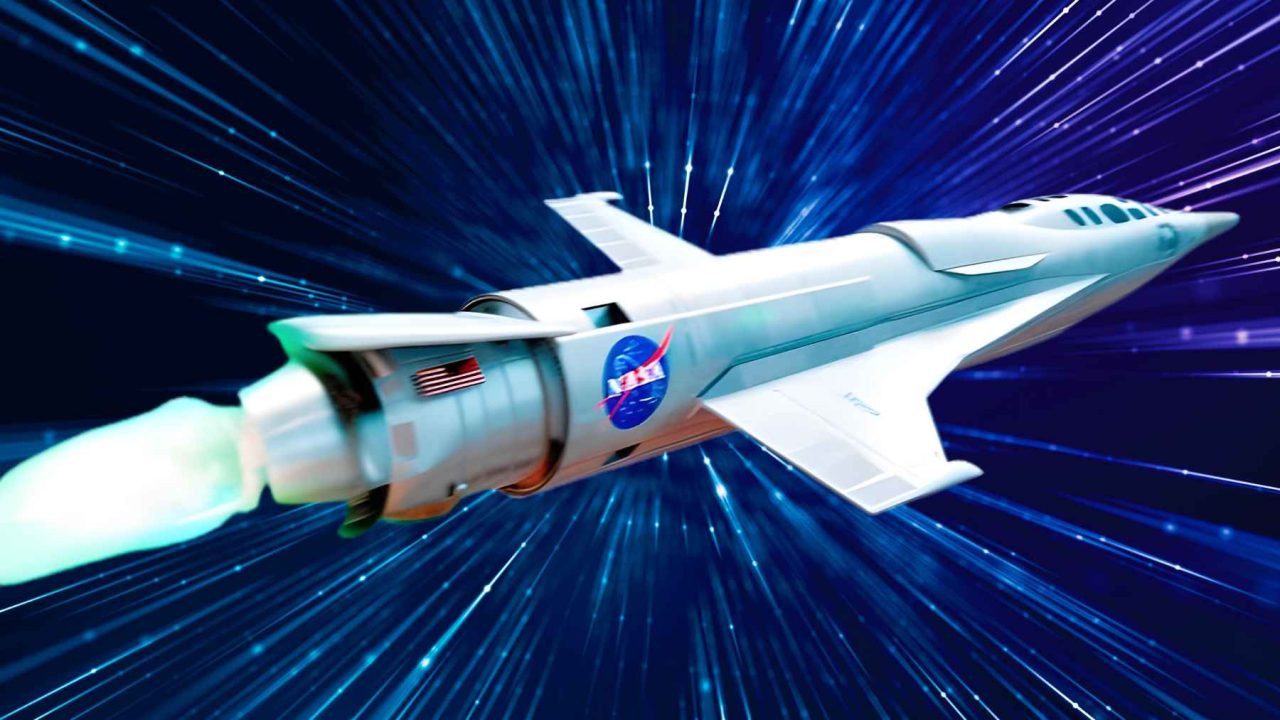
Humanity has dreamed about traveling to the stars for centuries. Now, a new scientific paper is claiming it may have found a way to make that dream mathematically possible — by reshaping one of the most famous and controversial concepts in theoretical physics: the warp drive. The catch? We would need to wait roughly 1,000 years just to test whether it could actually work.
That tension — between a genuinely intriguing scientific proposal and the staggering practical obstacles that surround it — is exactly what makes this story worth paying attention to.
The research comes from aerospace engineer Harold “Sonny” White and co-authors Jerry Vera, Andre Sylvester, and Leonard Dudzinski, all working at a company called Casimir, Inc. Their paper introduces what they describe as “interior-flat cylindrical nacelle warp bubbles,” a redesigned version of the warp bubble concept that has fascinated theoretical physicists for decades.
What a Warp Drive Actually Is — and Why It Keeps Coming Back
The idea of a warp drive is not purely science fiction, even if it sounds like it. The core concept involves warping the fabric of space-time itself around a spacecraft, rather than propelling the ship through space in the conventional sense. If space-time can be compressed in front of a vessel and expanded behind it, the ship would effectively be carried along inside a kind of bubble — without ever technically exceeding the speed of light on its own.
This matters because Einstein’s laws of physics do not prohibit space-time itself from moving faster than light. They only prohibit matter from doing so. A warp bubble exploits that distinction, at least in theory.
The concept has been around in serious scientific literature since physicist Miguel Alcubierre published his foundational paper on the subject in 1994. It resurfaces periodically as new researchers find fresh ways to approach the underlying mathematics — and this latest paper is one of those moments.
What the New Paper Actually Proposes
White and his colleagues are not claiming they have built a warp drive, or that one is coming soon. What they have done is propose a new geometric design for the warp bubble itself.
Their version is described as cylindrical in shape, with an interior that remains flat and undistorted while the exterior region of space-time does the warping work. The idea is that a calm, flat interior would be safer and more stable for any spacecraft or passengers inside, while the surrounding bubble handles the extreme physics.
Think of it like designing a better container before worrying about what you are going to put in it — or even whether you can manufacture the material the container requires.
That last part is the problem. The math behind the new design may be internally consistent, but building a real warp bubble still requires something physics has never been able to supply: large quantities of so-called negative energy. This is an exotic form of energy that would need to exist in amounts far beyond anything currently achievable or even clearly understood.
The Detail That Dampens the Excitement
Negative energy is not a fantasy — small effects related to it have been observed in quantum physics experiments. But harnessing it at the scale needed to warp space-time around a spacecraft is an entirely different matter. Scientists estimate that the technological capability required to test a real warp drive concept could be roughly 1,000 years away from where humanity stands today.
That is not a typo. One thousand years.
This is the central tension in the story: a paper that advances the theoretical blueprint in a meaningful way, while the engineering reality remains so distant it falls outside any reasonable planning horizon for our civilization.
| Element of the Proposal | Current Status |
|---|---|
| Warp bubble geometry (theoretical design) | New cylindrical model proposed by White et al. |
| Interior stability | Designed to remain flat and undistorted |
| Negative energy requirement | Still required; no known method to produce at scale |
| Research team affiliation | Casimir, Inc. |
| Estimated time to testable technology | Approximately 1,000 years |
Why Researchers Keep Working on Something So Far Away
It is a fair question. If testing this idea is a millennium away, why bother publishing papers about it now?
The answer has to do with how foundational science works. Theoretical frameworks have to exist before engineering can catch up to them. The mathematics of general relativity was developed decades before it became practically useful for GPS satellite systems. Quantum mechanics was considered abstract and untestable for years before it became the foundation of modern electronics.
Researchers who work on warp drive theory argue that refining the mathematical models now — making them more elegant, more stable, more physically plausible — is exactly the kind of long-horizon work that eventually pays off. Every paper that tightens the geometry or removes an inconsistency is a small step, even if the destination is impossibly far ahead.
The work by White, Vera, Sylvester, and Dudzinski at Casimir, Inc. fits into that tradition. They are not promising a working engine. They are proposing a cleaner blueprint for one — and doing so with full awareness that the materials to build it do not yet exist.
What This Means for the Future of Space Travel
For most people alive today — and for many generations to follow — warp drive travel will remain firmly in the realm of thought experiments and theoretical papers. The 1,000-year estimate is not a countdown so much as a reminder of how early in the story humanity currently is.
That said, papers like this one contribute to a broader scientific conversation about what faster-than-light or near-light-speed travel might eventually look like. As our understanding of quantum physics, exotic matter, and space-time geometry deepens over coming decades, the constraints that make warp drives seem impossible today may shift — even if slowly.
For now, the most honest summary is this: the blueprint just got a little better. The factory capable of building it has not been invented yet.
Frequently Asked Questions
Who wrote the new warp drive paper?
The paper was authored by aerospace engineer Harold “Sonny” White along with co-authors Jerry Vera, Andre Sylvester, and Leonard Dudzinski, all affiliated with Casimir, Inc.
What is an “interior-flat cylindrical nacelle warp bubble”?
It is a newly proposed design for a warp bubble in which the interior region remains geometrically flat and stable while the surrounding space-time does the warping — a refinement of earlier warp bubble concepts.
Why can’t we build a warp drive right now?
A functional warp drive requires large amounts of so-called negative energy, an exotic form of energy that has no known method of production at the scales required.
How long would humanity have to wait to test this?
According to
Does this paper prove that faster-than-light travel is possible?
No. The paper proposes a mathematically consistent design for a warp bubble, but it does not resolve the fundamental engineering barriers — particularly the negative energy requirement — that stand between theory and reality.
Is warp drive research considered legitimate science?
Serious theoretical physicists have engaged with warp drive concepts since at least 1994, when physicist Miguel Alcubierre published foundational work on the subject. It is considered speculative but not scientifically invalid as a theoretical exercise.


Leave a Reply