
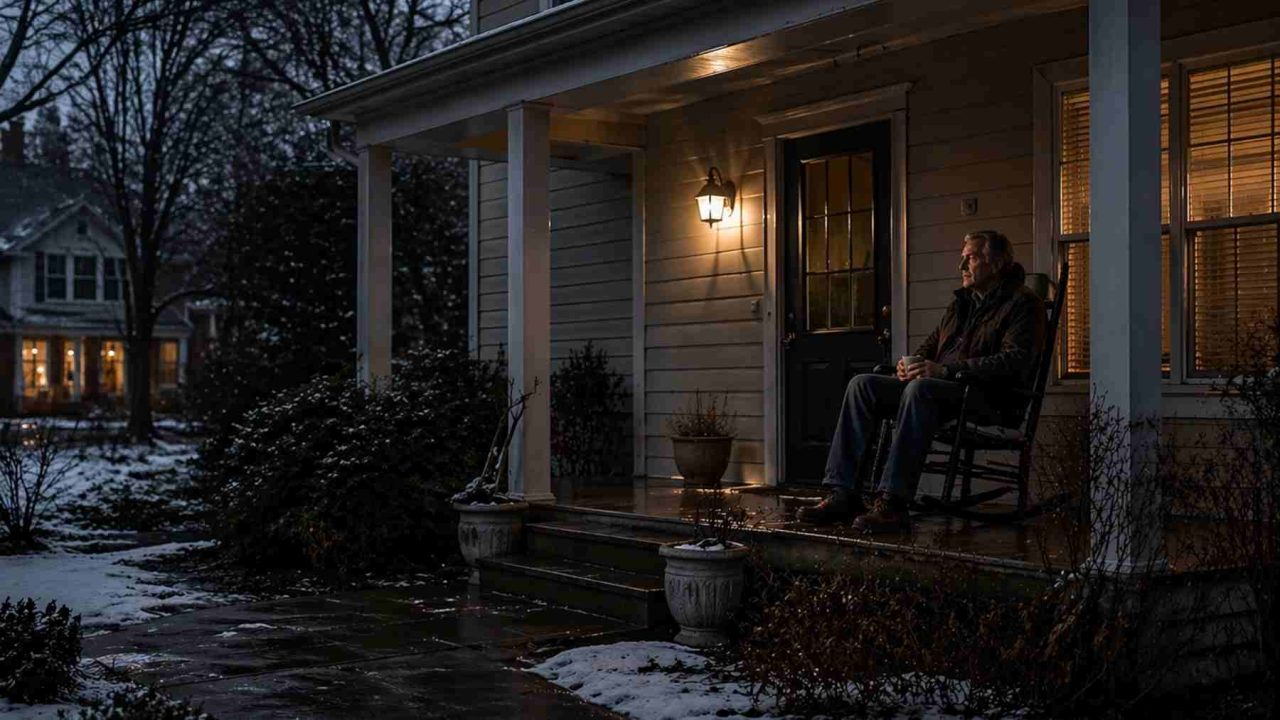
Walk down most suburban streets in December and you can spot the undecorated house from a block away. No lights strung along the roofline, no wreath on the door, no inflatable snowman on the lawn. Neighbors notice. Some quietly assume the residents are unfriendly, disconnected, or simply cold. But psychology suggests that assumption is almost always wrong.
Research into how people read homes as social signals — and separate research into what actually drives well-being — tells a more complicated story. Skipping the outdoor holiday display often has far less to do with a person’s warmth toward others than it does with their relationship to money, time, clutter, and personal authenticity.
The dark front porch in December, it turns out, may say a lot more about self-awareness than it does about indifference.
Why Holiday Lights Became a Social Signal in the First Place
The assumption that undecorated homes belong to unfriendly people isn’t entirely without foundation — it’s just incomplete. A study published in the Journal of Environmental Psychology found that strangers shown only photographs of homes used Christmas decorations as a cue to judge how friendly and socially connected the residents likely were. Lights, wreaths, and lawn displays function as a kind of visual shorthand, communicating warmth and neighborhood investment before anyone even knocks on the door.
That’s a powerful first impression. But first impressions built on a single visual cue are also, by definition, surface-level. They tell you what someone signals publicly — not who they actually are or what they genuinely value.
The more useful question isn’t what a decorated home looks like from the street. It’s what the research says about the people who consciously decide not to participate in that signaling — and why.
What Psychology Actually Says About People Who Skip the Decorations
The psychological research relevant here doesn’t focus specifically on Christmas lights. Instead, it covers a cluster of related topics: financial self-direction, authenticity, attitudes toward clutter, time pressure, minimalism, and the well-documented finding that people tend to get more lasting satisfaction from experiences than from material possessions or displays.
When you look at those findings together, a consistent picture emerges. People who opt out of outdoor holiday decorations are often making deliberate choices to protect things they value — and those things tend to be internal rather than performative.
- Financial self-direction: Choosing where money goes, rather than spending to meet social expectations, is consistently linked to higher financial well-being and lower stress.
- Authenticity: Research into personal values suggests that people who align their outward behavior with their actual inner preferences — rather than performing for an audience — tend to report greater life satisfaction.
- Minimalism and clutter: Studies have connected cluttered environments to elevated stress and reduced focus. For some people, putting up and taking down seasonal decorations represents exactly the kind of low-reward effort they’ve learned to avoid.
- Time pressure: The holiday season is, for many adults, one of the most logistically demanding periods of the year. Protecting time and mental bandwidth is a rational response, not an antisocial one.
- Experience over possessions: Psychological research consistently finds that people derive more lasting happiness from experiences — shared meals, travel, meaningful conversations — than from objects or displays.
None of this means people who do decorate are wrong to do so. It simply means that the decision not to decorate is often the product of considered values, not a character flaw.
The Gap Between How We’re Judged and Who We Are
The tension here is real and worth naming directly. Humans are wired to use environmental cues to make quick social assessments. A well-maintained, festively decorated home reads as “safe, friendly, and communal.” An undecorated one reads as “withdrawn.” That cognitive shortcut made sense in smaller, more interdependent communities. It’s far less reliable in modern neighborhoods where people’s lives, values, and financial situations vary enormously.
The person who skips the lights might be managing debt thoughtfully. They might find genuine peace in a quieter, less commercialized holiday. They might be grieving, or exhausted, or simply clear-eyed about what actually brings them joy. None of those realities are visible from the street.
| Common Assumption | What Research Suggests Instead |
|---|---|
| No lights = unfriendly or cold | Decorations are a social signal, not a measure of warmth or character |
| Skipping decorations = rejecting celebration | Often reflects a preference for private or experience-based celebration |
| Undecorated home = disconnected neighbor | May reflect financial self-direction and reduced social performance pressure |
| Minimalism at Christmas = indifference | Linked in research to lower stress, higher authenticity, and clearer personal values |
Simplicity as a Deliberate Choice, Not a Default
There’s an important distinction between people who don’t decorate because they haven’t thought about it and people who don’t decorate because they have. The psychological profile that emerges from the relevant research points strongly toward the latter group — individuals who have actively decided that peace of mind, financial clarity, and personal authenticity matter more to them than public displays of seasonal participation.
That’s not coldness. In many cases, it’s the opposite — a kind of emotional honesty that refuses to perform celebration for an audience when the internal experience doesn’t match the external display.
Psychologists who study authenticity have long noted that the pressure to perform emotions or values we don’t genuinely feel is itself a source of stress and disconnection. The neighbor with the dark porch may simply have made peace with that pressure earlier than most.
What This Means for How We Read Each Other
The practical takeaway isn’t that holiday decorations are meaningless or that people who put them up are being performative. Many people genuinely love decorating and feel real joy in it. The point is narrower: a single visual cue — lights on or off — is a poor proxy for someone’s character, warmth, or community spirit.
If the research on authenticity, minimalism, and financial self-direction tells us anything, it’s that the most socially and psychologically healthy people tend to be the ones who’ve figured out which pressures to ignore. For some, that includes the quiet pressure to string lights along the roofline every December.
The dark porch isn’t a rejection of community. More often, it’s evidence that someone has simply gotten comfortable making choices that reflect who they actually are.
Frequently Asked Questions
Does skipping Christmas lights mean someone is unfriendly?
Not according to the research. While decorations can function as a social signal of friendliness, the decision to skip them is more often linked to values like authenticity, minimalism, and financial self-direction than to a cold or distant personality.
What did the Journal of Environmental Psychology study actually find?
The study found that strangers shown photos of homes used Christmas decorations as a cue to judge how friendly and socially connected the residents were — meaning decorations influence first impressions, though not necessarily accurately.
Is there a psychological benefit to not decorating for the holidays?
Research into minimalism, clutter reduction, and authenticity suggests that aligning your behavior with your genuine values — rather than social expectations — is associated with lower stress and higher life satisfaction.
Do people get more happiness from holiday displays or from experiences?
Psychological research consistently finds that people derive more lasting satisfaction from experiences than from material possessions or displays, which may help explain why some people redirect holiday energy toward shared experiences instead.
Is the choice not to decorate always intentional?
Not always, but the psychological profile most relevant here involves people who have actively chosen simplicity and authenticity over public seasonal display — a deliberate decision rather than simple oversight.
Should decorated homes be seen as more socially engaged than undecorated ones?
The research suggests caution here. Decorations are one social signal among many, and they reflect public display rather than the full picture of a person’s warmth, generosity, or community investment.




Leave a Reply