
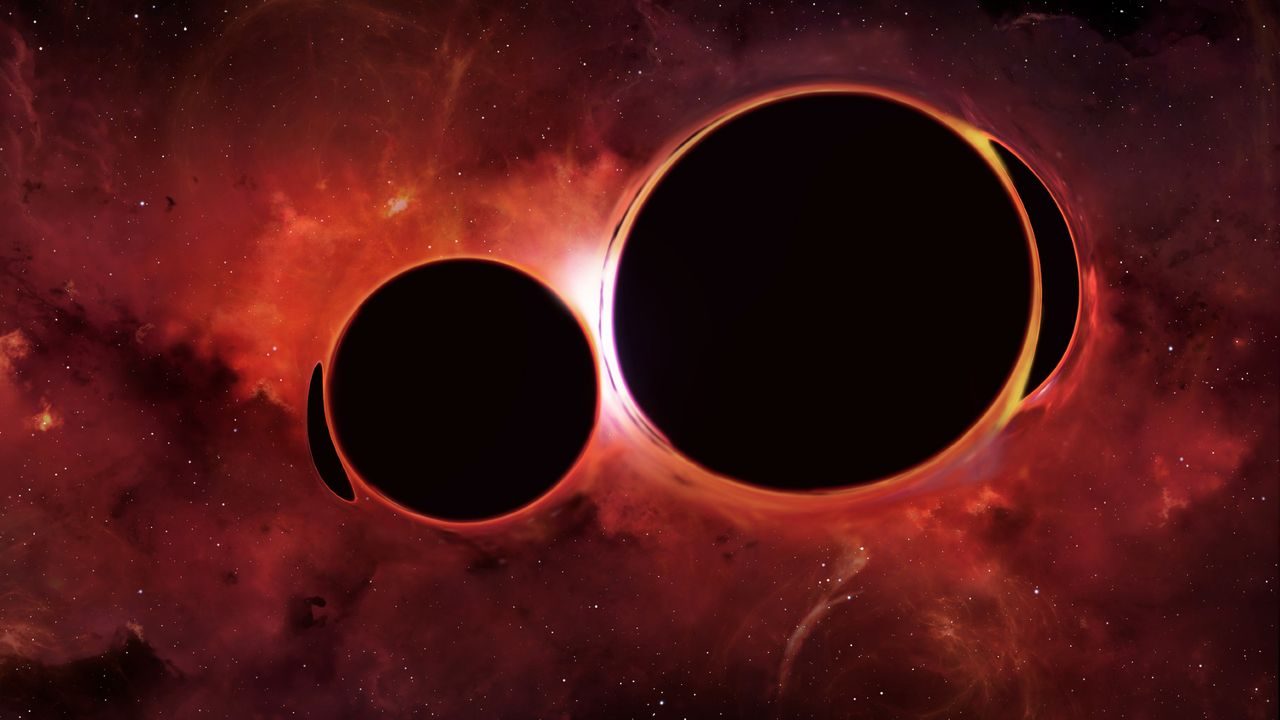
Some 500 million light-years away, two supermassive black holes are locked in a slow, spiraling dance — and astronomers now believe they could collide within the next 100 years. If that timeline holds, the effects of that cosmic crash would ripple across the universe and, remarkably, reach Earth.
This isn’t a distant hypothetical buried in theoretical physics. Researchers studying decades of radio telescope data have identified what they believe is a pair of black holes on a collision course, hidden inside an object once thought to be something far more ordinary. The discovery is already reshaping how scientists think about some of the universe’s most energetic phenomena.
For context: a century sounds like a long time, but on the scale of cosmic events, it’s essentially tomorrow. A supermassive black hole merger of this magnitude would be one of the most violent events in the observable universe — and the gravitational waves it sends out would wash over Earth like a tide.
What Astronomers Actually Found
The object at the center of this discovery was previously classified as a blazar — a brilliantly glowing core of a galaxy, typically powered by a single supermassive black hole. Blazars are already among the brightest, most energetic objects in the known universe, shooting jets of radiation directly toward Earth at nearly the speed of light.
But something about this particular object didn’t quite fit the blazar profile. Using decades of radio telescope observations, astronomers began piecing together a different picture. What they found suggests this isn’t a single black hole powering that luminous core — it may be two supermassive black holes orbiting each other, gradually spiraling inward as they bleed off energy and edge closer to a merger.
The object sits approximately 500 million light-years from our solar system. That’s close enough, in astronomical terms, that the gravitational wave signal from a merger could be detectable from Earth — and strong enough that scientists are paying very close attention.
Why a Supermassive Black Hole Collision Is Such a Big Deal
Black hole mergers aren’t new to science. Since 2015, gravitational wave detectors like LIGO have been picking up signals from colliding stellar-mass black holes — the kind that form when massive stars die. Those events are dramatic, but the black holes involved are relatively small, typically ranging from a few to a few dozen times the mass of our sun.
Supermassive black holes are in an entirely different category. These are the giants that sit at the centers of galaxies, sometimes containing millions or even billions of times the mass of the sun. A merger between two objects of that scale would produce gravitational waves of a frequency and intensity far beyond anything LIGO was designed to detect.
That’s where a different class of observatories comes in — pulsar timing arrays, which use networks of ultra-precise pulsars scattered across the galaxy as a kind of cosmic gravitational wave antenna. These instruments operate on timescales and wavelengths suited exactly to detecting the low-frequency rumble that a supermassive black hole merger would generate.
If this collision happens within the next century, as the new research suggests it might, it would represent a landmark moment — the first supermassive black hole merger close enough and soon enough for modern science to potentially observe in real time.
Key Facts About This Discovery at a Glance
| Detail | What We Know |
|---|---|
| Object type (original classification) | Blazar — glowing galactic core powered by a black hole |
| New interpretation | Possible binary supermassive black hole system |
| Distance from Earth | Approximately 500 million light-years |
| Estimated time to collision | Potentially within the next 100 years |
| Method of study | Decades of radio telescope observations |
| Expected Earth impact | Detectable gravitational waves reaching our planet |
- The object was originally catalogued as a blazar before new analysis raised questions about its true nature
- Radio telescope data spanning multiple decades was used to build the case for a binary black hole interpretation
- A merger would release gravitational waves — ripples in spacetime — that would travel outward in all directions, including toward Earth
- Current gravitational wave detectors like LIGO are not designed to capture signals from supermassive black hole mergers at this frequency range
What “Earth Would Feel It” Actually Means
When scientists say Earth would “feel” this collision, they don’t mean anything catastrophic. No one needs to worry about the planet being disrupted or life being threatened. At 500 million light-years away, this event poses zero danger to us.
What it means, practically speaking, is that the gravitational waves produced by the merger would pass through Earth — through everything, in fact, including you — as they radiate outward from the collision site. Gravitational waves don’t interact with matter the way light or radiation does. They stretch and compress spacetime itself, but at the amplitudes expected from this distance, the effect would be immeasurably small to any human being.
What it would be measurable to is our instruments. A confirmed detection of gravitational waves from a supermassive black hole merger would be a historic scientific achievement, opening an entirely new observational window on some of the most extreme physics in the universe.
What Happens Between Now and the Collision
If the 100-year estimate holds, astronomers alive today — and certainly those working in the coming decades — will have the opportunity to watch this system evolve in real time. As the two black holes spiral closer, the energy they radiate should increase, and the signals detectable from Earth should grow stronger and more distinctive.
The broader scientific community will likely focus significant resources on continued monitoring of this object. Pulsar timing array projects, already operational in multiple countries, are steadily improving in sensitivity and are considered the most promising tools for catching the eventual merger signal when it arrives.
Whether the 100-year timeline proves accurate remains to be seen — these estimates carry real uncertainty, and the actual merger could happen sooner or later than projected. But the fact that astronomers are now discussing a supermassive black hole collision as a near-term observable event, rather than a purely theoretical one, marks a genuine shift in what modern astronomy considers possible to witness.
Frequently Asked Questions
What is a blazar, and why does it matter here?
A blazar is an extremely bright galactic core typically powered by a single supermassive black hole shooting jets of energy toward Earth. This object was classified as a blazar before new research suggested it may actually contain two black holes, not one.
How far away is this black hole system from Earth?
The object is approximately 500 million light-years from our solar system, according to the astronomers studying it.
Would the collision be dangerous to Earth?
No. At 500 million light-years away, the event poses no physical threat to Earth or life on our planet. The gravitational waves produced would pass through Earth without causing any harm.
How did astronomers determine a collision could happen within 100 years?
Researchers used decades of radio telescope observations to study the object’s behavior and model the likely trajectory of the two black holes as they spiral toward each other.
Could we actually detect the gravitational waves from this merger?
Potentially yes, using pulsar timing arrays — networks of precisely timed pulsars that function as large-scale gravitational wave detectors suited to the low frequencies produced by supermassive black hole mergers.
Is the 100-year timeline definite?
No. The estimate carries scientific uncertainty, and the actual merger could occur on a different timeline. Continued observation of the system will help refine those projections over time.




Leave a Reply