
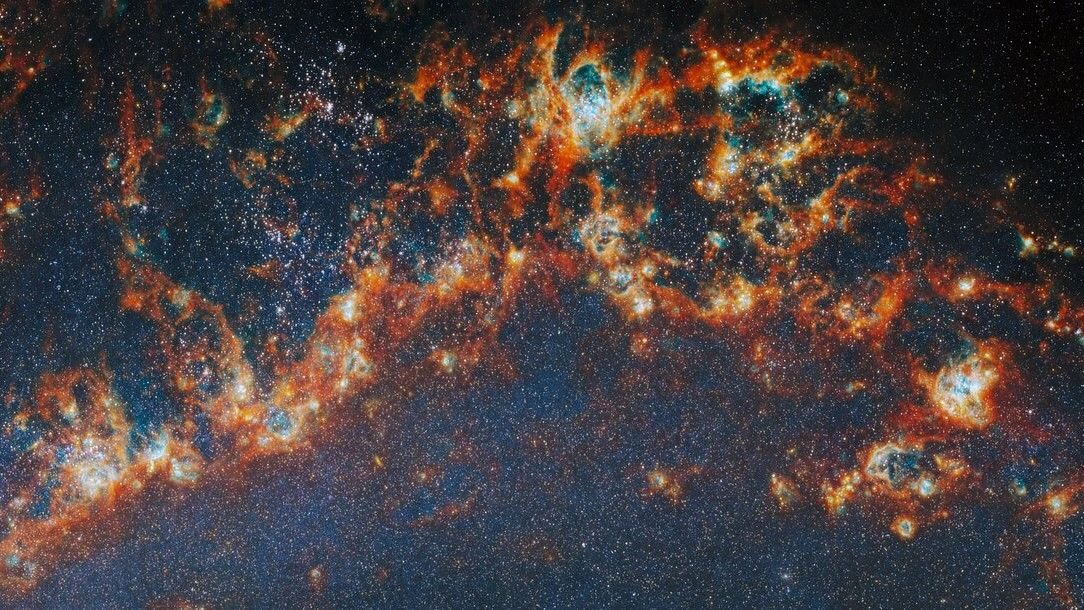
What happens the moment a newborn star breaks free from the cosmic cloud that created it? That question has puzzled astronomers for decades — and a stunning new image combining the power of two of humanity’s greatest telescopes is finally starting to provide some answers.
Released on May 6, 2026, the image focuses on one of the spiral arms of the Whirlpool Galaxy, known formally as Messier 51, located 31 million light-years away in the constellation Canes Venatici. It was created by merging data from both the James Webb Space Telescope (JWST) and the Hubble Space Telescope — a rare and powerful collaboration between NASA’s two flagship observatories.
The result is more than just a breathtaking picture. It is a scientific breakthrough that could reshape our understanding of how stars are born, how galaxies evolve, and what the early universe may have looked like.
Why the Whirlpool Galaxy Holds a Key to the Early Universe
Stars don’t simply flicker into existence. They form when enormous clouds of dust and hydrogen gas collapse under gravity, building a dense, superheated core that eventually ignites nuclear fusion. That process, at least in its broad strokes, is reasonably well understood.
What happens immediately after a star emerges from that birth cloud, however, has remained one of astronomy’s more stubborn mysteries — until now.
The new research, published May 6 in the journal Nature Astronomy, reveals a striking pattern: larger groups of stars escape their birth clouds far more quickly than smaller ones. The mechanism driving this appears to be the sheer force that bigger stellar populations generate. As more stars are born within a collapsing cloud, they collectively produce powerful stellar winds, intense ultraviolet radiation, and explosive supernovas that together blast the surrounding gas and dust away faster.
Understanding this process matters well beyond the Whirlpool Galaxy. The findings shed light on the forces that shape galaxies across cosmic time — including the kinds of young, star-forming galaxies that dominated the early universe and that JWST has been observing in unprecedented detail.
What Webb and Hubble Each Brought to the Image
This wasn’t a simple photograph. Combining data from two space telescopes operating in different wavelengths of light allowed scientists to see the Whirlpool’s spiral arm in ways that neither instrument could achieve alone.
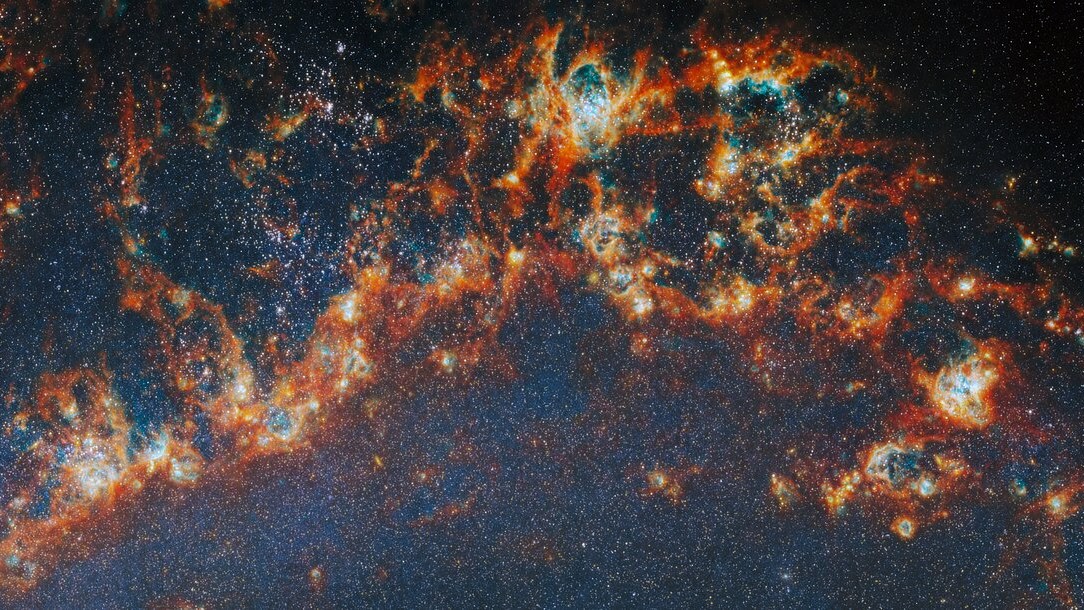
Hubble, which primarily observes in visible and ultraviolet light, is exceptionally good at detecting hot young stars and the energetic environments they create. Webb, operating in infrared, can peer through dust clouds that would otherwise block the view entirely — revealing structures hidden from optical telescopes.
Together, they give astronomers a layered, multi-wavelength portrait of the same region, allowing them to trace how stars at different stages of development relate to the gas and dust clouds around them.
The image is part of a broader series produced under the FEAST JWST program, credited to A. Pedrini, A. Adamo of Stockholm University, and the wider FEAST JWST team, in collaboration with ESA/Webb, NASA, and CSA. The program is specifically designed to study star formation across different types of galaxies.
Key Facts About This Image and Discovery
| Detail | Information |
|---|---|
| Subject | A spiral arm of the Whirlpool Galaxy (Messier 51) |
| Distance from Earth | 31 million light-years |
| Location in sky | Constellation Canes Venatici |
| Telescopes used | James Webb Space Telescope (JWST) and Hubble Space Telescope |
| Image shared | May 6, 2026 |
| Research published | Nature Astronomy, May 6, 2026 |
| Lead institution | Stockholm University (A. Adamo) |
| Key finding | Larger star groups escape birth clouds faster than smaller ones |
- The image is one of a series from the same Nature Astronomy paper
- The research examines processes that shape different types of galaxies
- Forces involved include stellar winds, ultraviolet radiation, and supernovas
- The FEAST JWST team led the observational program behind the findings
Why This Finding Matters Beyond One Galaxy
The implications here stretch far beyond the Whirlpool. One of the biggest open questions in modern astrophysics is how the very first galaxies in the universe assembled themselves — and why some grew quickly while others stalled.
Star formation is the engine of galaxy growth. If larger clusters of stars clear their birth clouds faster, that changes how quickly a galaxy can recycle its gas, trigger new rounds of star formation, or even shut the process down entirely. Understanding that feedback loop is essential to building accurate models of galactic evolution.
Researchers note that findings like these — grounded in detailed observations of a nearby, well-studied galaxy like M51 — can be applied as a framework for interpreting what JWST is seeing in the much more distant, and therefore much older, galaxies near the edge of the observable universe.
In other words, a single spiral arm of a galaxy 31 million light-years away is serving as a kind of Rosetta Stone for the cosmos.
What Comes Next for the FEAST Program
The Whirlpool Galaxy image is not a standalone result. It is part of a broader series of images and findings from the FEAST JWST program, all published together in the May 6 Nature Astronomy paper. The program is designed to study star formation across a range of galaxy types — meaning more images and more findings are likely to follow as the team continues its analysis.
JWST, still relatively early in its operational life, continues to push the boundaries of what is observable. Its ability to detect infrared light with extraordinary sensitivity makes it uniquely suited to studying the dust-enshrouded environments where stars are born — the very environments that optical telescopes like Hubble have historically struggled to see through.
The combination of both telescopes, as demonstrated by this image, suggests the most powerful astronomy of the coming years may come not from any single instrument, but from these kinds of carefully designed collaborations between them.
Frequently Asked Questions
What is the Whirlpool Galaxy?
The Whirlpool Galaxy, formally known as Messier 51 (M51), is a spiral galaxy located 31 million light-years from Earth in the constellation Canes Venatici.
What did Webb and Hubble discover together?
By combining their data, the telescopes helped reveal that larger groups of stars escape their birth clouds much faster than smaller groups, driven by stellar winds, ultraviolet light, and supernovas.
Where was this research published?
The findings were published on May 6, 2026, in the journal Nature Astronomy, as part of a broader paper from the FEAST JWST program.
Why does it matter how fast stars leave their birth clouds?
The speed at which stars escape their birth clouds affects how galaxies evolve over time, influencing when and where new generations of stars can form — with implications for understanding the early universe.
Who led the research behind this image?
The image and research are credited to A. Pedrini, A. Adamo of Stockholm University, and the FEAST JWST team, in collaboration with ESA/Webb, NASA, and CSA.
Is this the only image from this research?
No — the Whirlpool Galaxy image is one of a series published in the same Nature Astronomy paper, which examines star formation processes across different types of galaxies.



Leave a Reply