
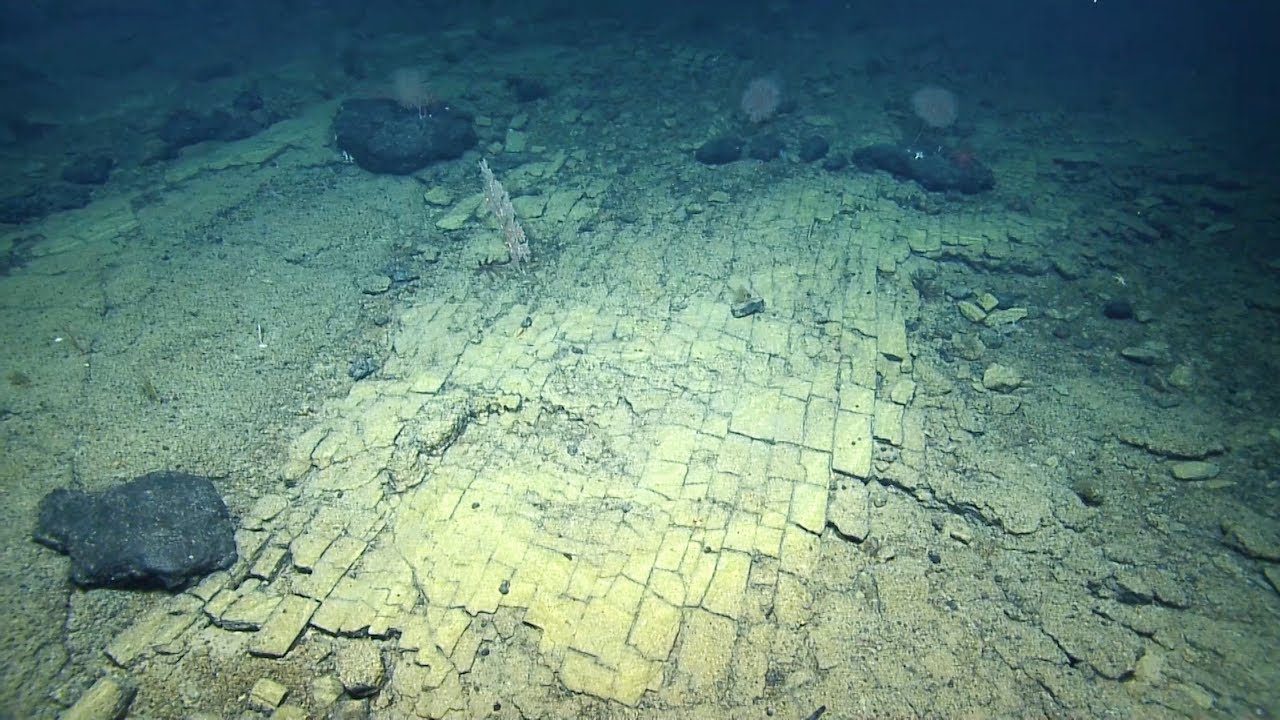
More than a kilometer beneath the surface of the Pacific Ocean, a remotely operated vehicle captured something that stopped scientists mid-sentence and sent viewers around the world into a frenzy. What appeared on the seafloor looked less like a geological formation and more like a road — a neatly paved, yellowish-toned path stretching across the ocean bottom, so regular in its pattern that it seemed impossible to explain without invoking either ancient civilizations or Hollywood fantasy.
The discovery, made in 2022 during an expedition north of Hawaiʻi, quickly went viral. And while the explanation turned out to be entirely natural, it left behind a question that is harder to dismiss: how much of our ocean floor remains completely unknown to us, and what else might be waiting down there?
What the Camera Actually Found on the Pacific Seafloor
The scene unfolded at Nootka Seamount, an underwater mountain located within the Papahānaumokuākea Marine National Monument — one of the largest marine protected areas on Earth. Scientists aboard the exploration vessel Nautilus were guiding a remotely operated vehicle across the seamount’s summit when the cameras picked up something extraordinary.
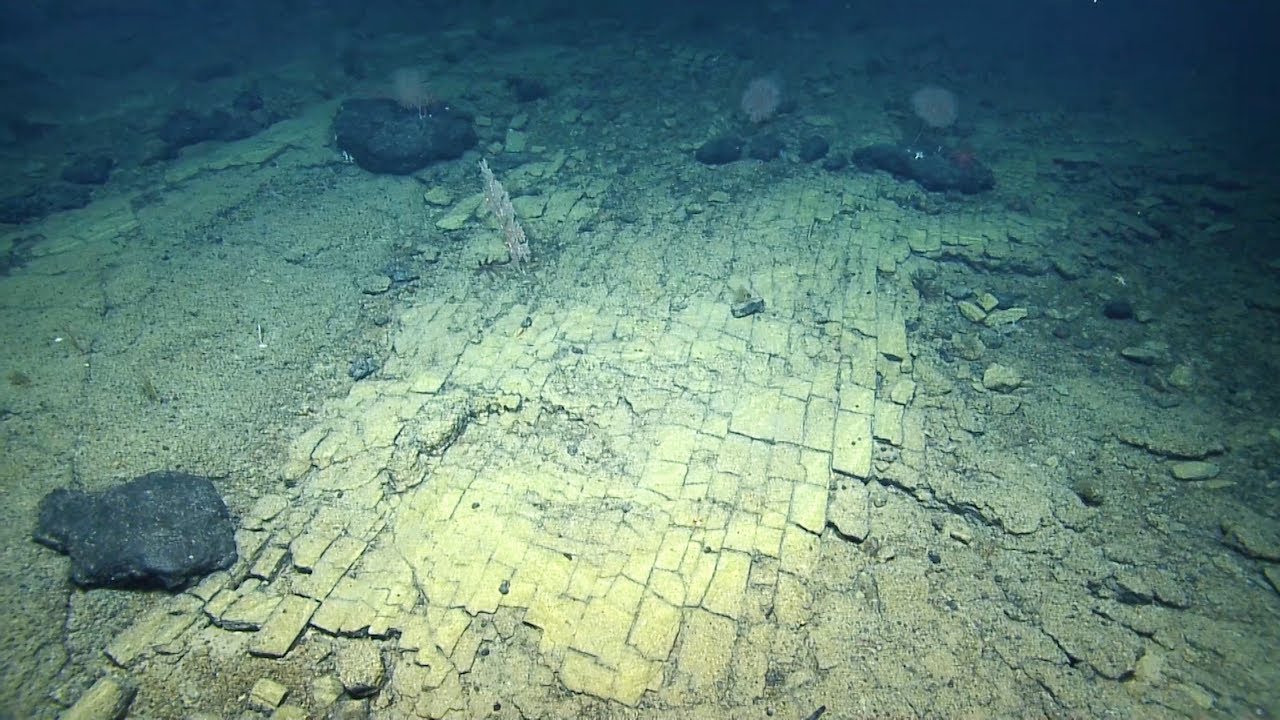
The seafloor appeared to be covered in what looked like carefully laid stone tiles, cracked at near-perfect right angles, forming a mosaic that stretched across the area like a dried lakebed — or, as the scientists themselves noted, like the yellow brick road from The Wizard of Oz.
The video was streaming live online at the time. Viewers from around the world watched in real time as the vehicle moved slowly across the pattern, more than a kilometer below the ocean surface. Comments referencing Atlantis and fictional fantasy worlds flooded in. Even the scientists aboard Nautilus were not immune — they joked about the same references as the footage played out.
But the explanation, once it came, was geology at its most theatrical.
The Science Behind the “Yellow Brick Road” Pattern
According to the Ocean Exploration Trust team responsible for the expedition, the tiles are not the remnants of any human structure. They are a fractured volcanic rock formation known as hyaloclastite — a type of rock that forms when superheated lava meets the freezing cold of deep seawater during energetic underwater eruptions.
When lava erupts on the ocean floor, the violent collision between extreme heat and extreme cold causes the molten rock to shatter and settle rapidly. Over time, repeated cycles of heating and cooling stress the hardened rock further, eventually fracturing it along sharp, near-perfect ninety-degree angles. The result is a natural mosaic of blocky shapes that can look, to the untrained eye, almost architectural.
The yellowish coloring — the detail that made the “brick road” comparison so striking — comes from the mineral composition of the hyaloclastite and the way it weathers over geological time in the deep ocean environment.
| Detail | Confirmed Information |
|---|---|
| Discovery year | 2022 |
| Location | Nootka Seamount, north of Hawaiʻi |
| Protected area | Papahānaumokuākea Marine National Monument |
| Depth | More than one kilometer below the ocean surface |
| Expedition vessel | Nautilus (Ocean Exploration Trust) |
| Rock type | Hyaloclastite (fractured volcanic rock) |
| Cause of pattern | Repeated heating and cooling stress creating 90-degree fractures |
Why This Discovery Matters Beyond the Spectacle
It would be easy to file this story under “weird things the ocean does” and move on. But the discovery at Nootka Seamount points to something genuinely unsettling about humanity’s relationship with the sea.
The Papahānaumokuākea Marine National Monument is one of the most protected marine environments on the planet. It covers a vast stretch of the Pacific and was established specifically to preserve ecosystems that remain largely unstudied. And yet, even within this protected zone, scientists are still encountering formations and geological features they have never seen before — in real time, on live video, to the visible surprise of trained researchers.
Seamounts like Nootka are known to be biodiversity hotspots. Their elevated summits create upwelling currents that concentrate nutrients, attracting fish, corals, and other marine life in densities rarely found on the flat ocean floor. Many seamounts around the world have never been surveyed at all. The ones that have been explored often yield surprises — new species, unusual geology, and formations that challenge existing models of how the deep ocean works.
The “yellow brick road” moment was striking precisely because it looked so familiar in a place that is, in reality, profoundly alien to us. It served as an accidental reminder that the deep ocean floor — covering the majority of our planet’s surface — remains one of the least understood environments anywhere on Earth.
The Uncomfortable Question the Video Left Behind
The scientists on board Nautilus laughed about Atlantis. The internet made memes. And then, for most people, the story moved on.
But the footage raises a question worth sitting with: if a formation this visually dramatic — sitting on the summit of an underwater mountain inside a major protected marine area — was only discovered in 2022, what does that say about everything we have not yet seen?
Estimates suggest that only a small fraction of the global ocean floor has been mapped in meaningful detail. Thousands of seamounts are believed to exist that have never been directly observed. Deep-sea ecosystems that could hold scientific, ecological, or even medical significance are being altered — by climate change, deep-sea mining proposals, and shifting ocean chemistry — before they are ever properly documented.
The yellow brick road at Nootka Seamount was not Atlantis. It was not magic. It was volcanic rock doing what volcanic rock does over millions of years. But the fact that it surprised everyone who saw it — including the scientists watching it live — is itself a kind of answer to the question of how well we actually know our own planet.
Frequently Asked Questions
Where exactly was the “yellow brick road” discovered?
It was found at Nootka Seamount, an underwater mountain located north of Hawaiʻi within the Papahānaumokuākea Marine National Monument.
What is the “yellow brick road” actually made of?
It is a natural formation of hyaloclastite, a volcanic rock that forms when hot lava meets cold seawater and then fractures into near-perfect right angles through repeated heating and cooling cycles.
How deep below the ocean surface was it found?
The formation was discovered more than one kilometer beneath the ocean surface.
Who made the discovery?
The discovery was made by the Ocean Exploration Trust team aboard the exploration vessel Nautilus during a 2022 expedition.
Was the footage available to the public?
Yes — the remotely operated vehicle’s camera was streaming live online at the time, allowing viewers around the world to watch the discovery in real time.
Is there any chance the formation is man-made?
No. Scientists confirmed it is entirely geological in origin, formed through natural volcanic and thermal processes on the seafloor over a very long period of time.



Leave a Reply