
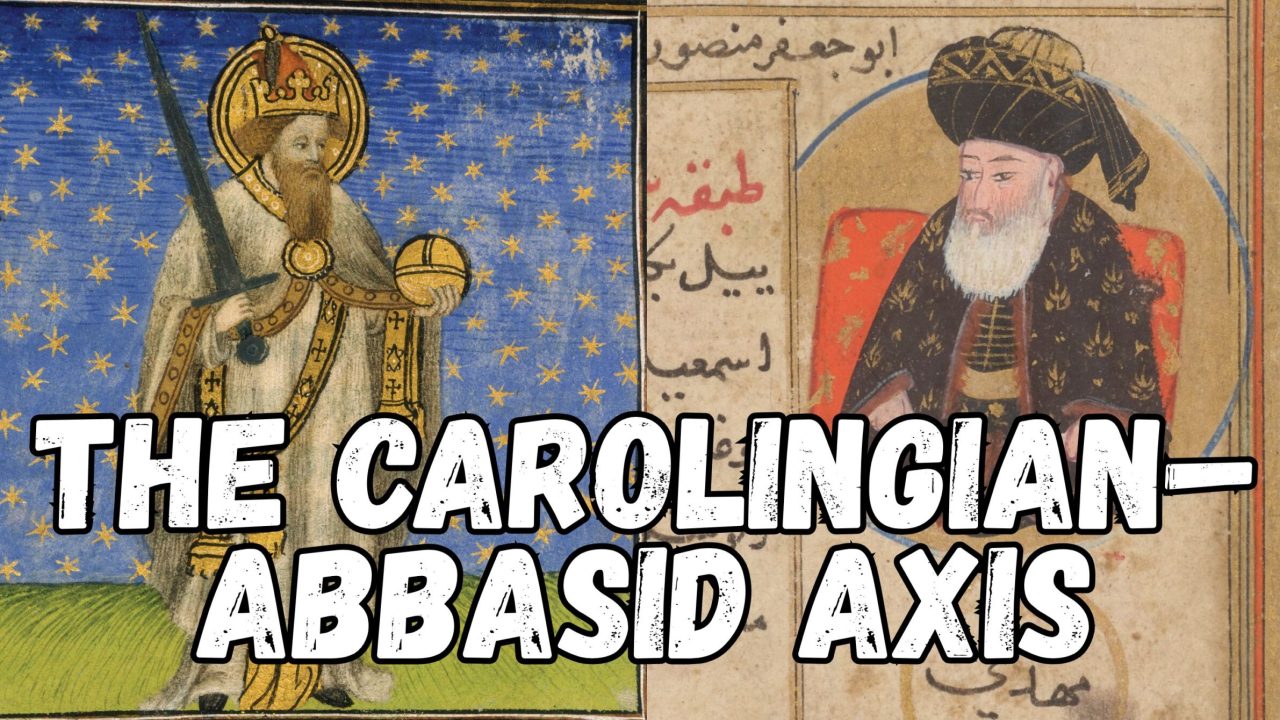
An elephant arrived at the court of Charlemagne in 802 — a gift from Harun al-Rashid, the Abbasid Caliph who ruled one of the most powerful empires on earth. It is one of the most striking images from the Early Middle Ages, and for generations it was read as a symbol of the vast cultural gap between a sophisticated Islamic East and a comparatively primitive Christian West.
That interpretation, scholars now largely agree, was wrong. And the story of how historians came to reconsider it reveals something far more interesting than a simple tale of medieval gift-giving: a strategic alliance between two empires that reshaped the political world of the eighth and ninth centuries.
The relationship between the Carolingian Empire under Charlemagne and the Abbasid Caliphate under Harun al-Rashid is the subject of renewed scholarly attention — and what researchers are finding challenges long-held assumptions about early medieval Europe and the nature of cross-cultural diplomacy in the ancient world.
The Alliance That Textbooks Mostly Ignored
For much of modern historiography, the exchange of diplomatic gifts between Charlemagne and Harun al-Rashid was treated as a curiosity — colorful but not especially significant. The elephant, named Abul-Abbas, became a kind of shorthand for the supposed contrast between the two rulers: the caliph as a cosmopolitan sovereign of vast refinement, Charlemagne as a northern European warlord with imperial pretensions he could barely justify.
That framing has steadily collapsed under the weight of new research. As historian David Bachrach notes in a recent analysis published by Medievalists.net, earlier generations of scholars saw in Harun al-Rashid’s gift “a metaphor for the sophistication of the Muslim East and the barbarism of the contemporary West.” But that dichotomy, he argues, has largely disappeared from specialist studies.
Since the 1960s, our understanding of the Carolingian Empire has been transformed. Researchers have documented the sophistication of Charlemagne’s government, the material wealth of his territories, and the genuine scope of his imperial ambitions — ambitions that extended well beyond northern Europe, reaching into southern France, Italy, and down to Rome itself.
What the Carolingian–Abbasid Axis Actually Looked Like
The relationship between these two empires was not simply ceremonial. It was strategic, shaped by shared rivals and mutual interest. Both the Carolingians and the Abbasids had reasons to build ties with one another — and those reasons were rooted in the hard realities of early medieval geopolitics.
The ties between the two courts extended from western Europe to the eastern Mediterranean, and the diplomatic record that survives from this period is more substantial than many general histories acknowledge. According to Bachrach, scholar Michael McCormick has published an edition and commentary of three texts produced in the early ninth century by Charlemagne’s own officials — men who had physically traveled to the region, producing firsthand documentary evidence of the relationship.
That kind of primary source material matters. It moves the story out of the realm of legend and into the domain of documented history.
Key Facts About the Carolingian–Abbasid Relationship
- Harun al-Rashid served as Abbasid Caliph from 786 to 809
- The famous elephant gift arrived at Charlemagne’s court in 802
- The relationship between the two empires was shaped by strategy, diplomacy, and shared rivals
- Carolingian officials physically traveled to the eastern Mediterranean, producing written records of the exchanges
- Charlemagne’s imperial ambitions extended to southern France, Italy, and Rome — not merely northern Europe
- Scholarly reassessment of the Carolingian Empire accelerated significantly after the 1960s
| Empire | Ruler | Period of Rule | Geographic Reach |
|---|---|---|---|
| Carolingian Empire | Charlemagne | 768–814 | Western Europe, extending to Rome |
| Abbasid Caliphate | Harun al-Rashid | 786–809 | Eastern Mediterranean and beyond |
Why the Old Story Was So Persistent — and Why It Mattered
The image of a barbaric Charlemagne receiving an exotic elephant from a civilized caliph was never just a historical footnote. It carried ideological weight, reinforcing a particular narrative about the superiority of Islamic civilization during the medieval period and the relative backwardness of early Christian Europe.
There is genuine scholarly value in that broader argument — the Abbasid Caliphate was indeed a remarkable civilization. But the framing required flattening Charlemagne’s empire into something simpler and cruder than the evidence actually supports. When historians began examining Carolingian governance, economics, and diplomacy more rigorously, the contrast became far less stark.
What emerged instead was a picture of two sophisticated empires engaging with each other as near-equals — each with something to gain, each capable of projecting power across enormous distances, and each aware of the other’s strategic value.
What This Means for How We Understand the Early Middle Ages
The Carolingian–Abbasid relationship is a window into something larger: the degree to which the early medieval world was interconnected in ways that popular history has consistently underestimated. Trade routes, diplomatic missions, and the movement of people and goods linked western Europe to the Islamic world far more directly than the standard narrative of isolated, insular medieval kingdoms would suggest.
Charlemagne’s court was not a provincial backwater receiving wonders from afar. It was a node in a network — one capable of sending its own officials thousands of miles east and receiving their written reports back home.
The ongoing scholarly work in this area, including McCormick’s documentary research and Bachrach’s analysis, is helping to reconstruct that network in detail. The elephant is still a remarkable image. But it is no longer a symbol of cultural distance — it is evidence of contact, calculation, and a relationship built on something more durable than spectacle.
Frequently Asked Questions
When did the elephant arrive at Charlemagne’s court?
The elephant, a gift from Abbasid Caliph Harun al-Rashid, arrived at Charlemagne’s court in 802.
Who was Harun al-Rashid?
Harun al-Rashid was the Abbasid Caliph who ruled from 786 to 809, leading one of the most powerful empires of the early medieval world.
Why did earlier historians misread the Carolingian–Abbasid relationship?
Earlier scholars interpreted the gift-giving as evidence of a cultural gap between a sophisticated Islamic East and a comparatively primitive Christian West — a view that specialist research has largely overturned since the 1960s.
What documentary evidence exists for the Carolingian–Abbasid relationship?
Scholar Michael McCormick has published an edition and commentary of three texts produced in the early ninth century by Charlemagne’s own officials who had traveled to the eastern Mediterranean.
What drove the alliance between the Carolingians and the Abbasids?
According to
Has the historical view of Charlemagne’s empire changed significantly?
Yes. Since the 1960s, research has dramatically expanded our understanding of the sophistication of Carolingian government, the material wealth of the empire, and the genuine scope of Charlemagne’s imperial ambitions.


Leave a Reply