
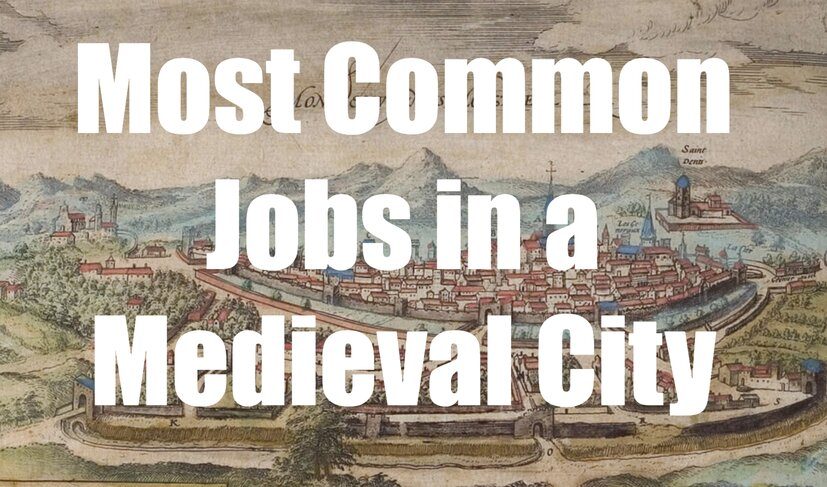
One in four workers in a thriving medieval city was a farmer. That single fact — drawn from detailed tax records spanning 15th-century Montpellier, France — tells you almost everything about how different daily working life looked six centuries ago.
Historian Lucie Laumonier examined tax records from 1435 to 1446 covering just under 2,200 households in Montpellier, a major urban centre in southern France. The profession of the head of household was recorded in roughly two-thirds of those cases, giving researchers a rare, data-rich window into what medieval city workers actually did for a living. The five most common jobs were farming, carpentry, butchery, shoemaking, and Church-related work.
What emerges is a portrait of a city that looks almost nothing like our modern idea of urban life — and yet follows its own clear economic logic.
Why Montpellier Is Such a Valuable Case Study for Medieval Jobs
Montpellier was no backwater. Founded in the late tenth century, it had grown into one of the most important cities in southern France by the thirteenth century. Before the Black Death devastated Europe’s population, more than 30,000 people called it home.
The city was known across the region for two things: its university, which was particularly renowned for teaching medicine, and its access to Mediterranean trade routes — the sea was only about a dozen kilometres away. Goods moved through Montpellier constantly, and so did people.
What makes Montpellier especially useful for historians is the quality of its surviving records. A series of tax documents spanning roughly 1380 to 1480 lists nearly 10,000 householders by name, with occupations recorded for approximately 6,500 of them. That is an extraordinary level of detail for the medieval period, and it allows for real analysis rather than guesswork. Notably, a handful of women who headed their own households also declared professions to city authorities — a small but meaningful detail about women’s economic presence in medieval urban life.
The 5 Most Common Jobs in a Medieval City
The occupational data from Laumonier’s analysis of the 1435–1446 tax records reveals a working population spread across dozens of trades — a reflection of how fragmented production chains were in the Middle Ages. But five professions stood clearly above the rest.
| Rank | Occupation | Notes |
|---|---|---|
| 1 | Farming | Made up approximately 25% of workers with recorded occupations |
| 2 | Carpentry | One of the most in-demand skilled trades in urban construction |
| 3 | Butchery | Essential food supply trade in any functioning city |
| 4 | Shoemaking | High-demand craft given the wear and repair needs of the era |
| 5 | Church-related work | Reflected the deep institutional presence of the Church in medieval urban life |
Farming sitting at the top of that list is the detail most likely to surprise modern readers. We tend to think of farming as rural work — something that happens outside city walls. But in 15th-century Montpellier, peasants made up around 25% of the workers whose occupations were recorded. Cities in this period were not yet fully separated from agricultural life the way modern cities are.
- Farming — The single largest occupational group, showing that the boundary between urban and rural labour was far more porous than we might assume.
- Carpentry — Skilled woodworkers were essential to construction, furniture-making, and the maintenance of buildings in a growing city.
- Butchery — Feeding a city of thousands required a steady, organised supply of meat. Butchers were among the most economically significant tradespeople in any medieval urban centre.
- Shoemaking — Footwear wore out quickly in an era of unpaved streets and long daily walks. Cobblers and shoemakers served a constant, reliable demand.
- Church-related work — The institutional Church was one of the largest employers in medieval Europe. Clergy, administrators, and workers tied to religious institutions formed a visible and significant share of the urban workforce.
What This Tells Us About Life in a Medieval City
The sheer variety of occupations recorded in Montpellier’s tax rolls — dozens and dozens of distinct trades listed simultaneously — reflects something important about how medieval economies worked. Production was highly fragmented. There was no single factory turning out finished goods. Instead, each stage of making something might involve a different specialist, a different workshop, a different street.
That fragmentation created a dense, interdependent urban economy. A carpenter needed suppliers for wood. A butcher needed farmers raising livestock. A shoemaker needed tanners processing leather. Everyone’s livelihood was connected to everyone else’s in ways that are easy to underestimate when looking at a simple occupational list.
The presence of Church-related workers in the top five also speaks to something modern readers might overlook: the medieval Church was not just a spiritual institution. It was a major landowner, employer, and economic actor. Its presence in the daily working lives of city residents was practical as much as religious.
What the Records Don’t Fully Capture
Tax records, however detailed, have their limits. Laumonier’s analysis covers the head of household — which in the vast majority of cases means a male householder. The economic contributions of wives, children, and domestic workers are largely invisible in these documents, even though they were almost certainly substantial.
The handful of women who did declare professions to city authorities offers a glimpse of female economic activity, but it almost certainly underrepresents the real picture. Women worked in medieval cities — in markets, in textile production, in household industries — but the formal record-keeping of the era was not designed to capture it systematically.
Still, what the Montpellier records do offer is rare and genuinely valuable: a statistically meaningful snapshot of who was doing what in a real medieval city, grounded in primary sources rather than assumption.
Frequently Asked Questions
What were the five most common jobs in a medieval city?
Based on tax records from 15th-century Montpellier, the five most common occupations were farming, carpentry, butchery, shoemaking, and Church-related work.
Why was farming so common in a medieval city?
Peasants made up approximately 25% of recorded workers in Montpellier, reflecting the fact that the boundary between urban and rural labour was far less defined in the medieval period than it is today.
What city and time period does this data come from?
The data comes from tax records dated 1435 to 1446 in Montpellier, a major city in southern France, covering just under 2,200 households.
How large was Montpellier in the medieval period?
Before the Black Death, Montpellier had a population of more than 30,000 people and was one of the most important urban centres in southern France.
Did women work in medieval cities?
A handful of women who headed their own households declared professions in Montpellier’s tax records, though historians note that women’s economic contributions were broadly undercounted in formal medieval documentation.
How many occupations existed at once in a medieval city like Montpellier?
Dozens and dozens of distinct occupations were recorded simultaneously, reflecting the highly fragmented nature of production chains in the medieval economy.

Leave a Reply