
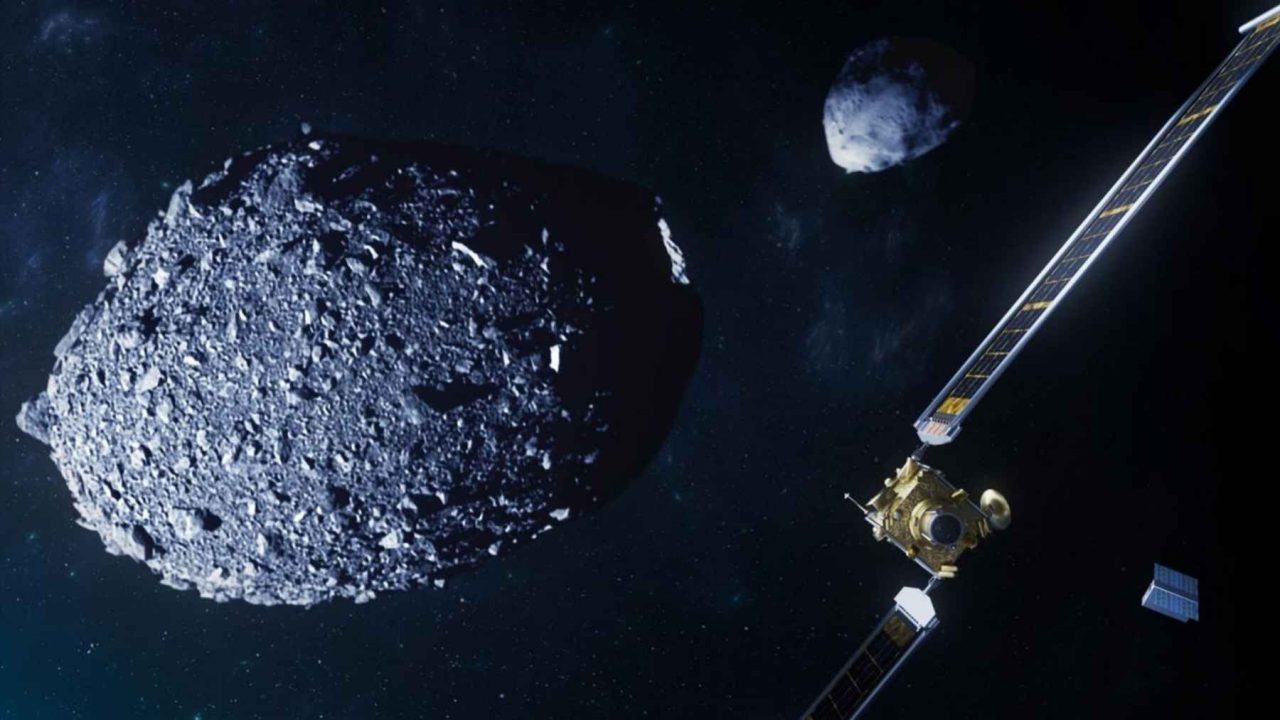
A fraction of a second doesn’t sound like much. But when that fraction of a second represents the first time in human history that we have measurably changed the orbit of a natural celestial body around the Sun, it becomes one of the most significant moments in the story of our species.
That is exactly what scientists are now reporting following NASA’s DART mission — and the implications stretch far beyond the numbers themselves.
In September 2022, NASA deliberately crashed a spacecraft into a small asteroid called Dimorphos. The mission was always described as a planetary defense test. What researchers have now confirmed goes further: that single impact didn’t just nudge Dimorphos. It measurably altered how the entire Didymos and Dimorphos binary asteroid system travels around the Sun — a first for humanity.
What the DART Mission Actually Did
The Double Asteroid Redirection Test — DART — was designed around a straightforward but ambitious question: can we hit a space rock hard enough to change where it’s going? The target was Dimorphos, a small moonlet orbiting the larger asteroid Didymos. Together, they form what’s called a binary asteroid system.
The spacecraft hit Dimorphos at high speed in late September 2022. Scientists already knew the impact changed Dimorphos’s orbit around Didymos — that was confirmed relatively quickly after the collision. But the new findings go one step further.
Researchers have now determined that the impact also shifted the solar orbit of the entire Didymos-Dimorphos system — the path both bodies travel together around the Sun. That has never been done before. Not by accident. Not by design. Never.
It is a milestone that reframes what human beings are capable of when it comes to interacting with the solar system.
The Numbers Behind the Historic Shift
The measured changes are small. Strikingly small. But that is also the point.
According to the research team’s analysis, the DART impact shortened the binary system’s roughly 770-day trip around the Sun by approximately 0.15 seconds. The estimated change in the system’s orbital speed came in at around 1.7 inches per hour — slower than the minute hand on a kitchen clock.
Those numbers might seem almost too small to matter. NASA scientist Thomas Statler addressed that directly, stating that “even a tiny change can grow to a significant deflection” given enough time. That logic is the entire foundation of planetary defense strategy. You don’t need to stop an asteroid in its tracks. You just need to nudge it — early enough, and precisely enough — so that years or decades later, it misses Earth entirely.
| Measurement | Value | Context |
|---|---|---|
| Change in solar orbital period | ~0.15 seconds shorter | Out of a ~770-day orbit around the Sun |
| Change in orbital speed | ~1.7 inches per hour | Slower than a clock’s minute hand |
| DART impact date | September 2022 | First deliberate spacecraft-asteroid collision |
| Target asteroid | Dimorphos | Moonlet of larger asteroid Didymos |
Why a Fraction of a Second Is Actually a Big Deal
The temptation is to read “0.15 seconds” and shrug. Resist that temptation.
Planetary defense doesn’t work the way action movies suggest. There’s no last-minute nuclear detonation. The real strategy depends on identifying a threat years — ideally decades — in advance, and then applying a small, precise force that compounds over time. Physics does the rest.
Think of it like steering a ship. A one-degree course correction barely registers at the helm. But over hundreds of miles of open ocean, that same correction means the difference between arriving at port and running aground. Space works the same way, just on vastly longer timescales.
The fact that DART produced a measurable change in the system’s solar orbit — even a tiny one — confirms that the physics works as intended. A spacecraft built and launched by humans can interact with a natural body in space and produce a real, detectable, lasting change in its trajectory. That has never been demonstrated before at this scale.
What This Means for Planetary Defense Going Forward
The DART mission was always framed as a test. A proof of concept. Scientists wanted to know if kinetic impactor technology — essentially, ramming a spacecraft into an asteroid — could actually work as a deflection method.
These new findings suggest the answer is yes, and more clearly than some had hoped. The impact not only changed Dimorphos’s local orbit around Didymos, it shifted the entire system’s path around the Sun. That is a more complete and more significant result than the mission’s baseline goals required.
For planetary defense planners, this matters enormously. Knowing that a single spacecraft impact can produce a measurable solar orbital shift — even a small one — helps scientists model future deflection missions with greater confidence. It also reinforces the critical importance of early detection. The earlier a threat is identified, the smaller the nudge needed to prevent a collision.
The DART mission has handed researchers something invaluable: real-world data from an actual asteroid impact, at scale, with measurable outcomes. That data will inform planetary defense planning for years to come.
A Moment Worth Recognizing
It is easy to let milestones like this slip past without fully absorbing what they mean. Humans have explored space, landed on the Moon, sent probes beyond the edge of the solar system. But changing the orbit of a natural celestial body? That is something different.
For all of recorded history, the movements of asteroids, planets, and moons have been governed entirely by gravity and the physics of the early solar system. They moved the way they moved, and we watched. September 2022 changed that. A spacecraft built on Earth, launched by human hands, struck a rock in space — and that rock now moves differently around the Sun than it did before.
The shift is 0.15 seconds. The significance is considerably larger.
Frequently Asked Questions
What was the DART mission?
NASA’s Double Asteroid Redirection Test was a planetary defense mission designed to test whether a spacecraft could deliberately alter the trajectory of an asteroid by crashing into it.
Which asteroid did DART hit?
DART struck Dimorphos, a small moonlet that orbits the larger asteroid Didymos. Together they form a binary asteroid system.
How much did the impact change the asteroid system’s orbit around the Sun?
According to researchers, the impact shortened the system’s approximately 770-day solar orbit by about 0.15 seconds and changed its orbital speed by roughly 1.7 inches per hour.
Why does such a small change matter?
NASA scientist Thomas Statler noted that even a tiny change can grow into a significant deflection over time — which is the core principle behind planetary defense strategies that rely on acting early.
Has humanity ever changed the orbit of a celestial body before?
No. Scientists say this is the first time a human-made object has measurably altered the solar orbit of a natural body, making it a historic first.
Does this mean we can protect Earth from asteroid impacts?
The DART results are a proof of concept that kinetic impactor technology can work, but full planetary defense capability would also require early detection systems and sufficient lead time before any potential impact.



Leave a Reply