
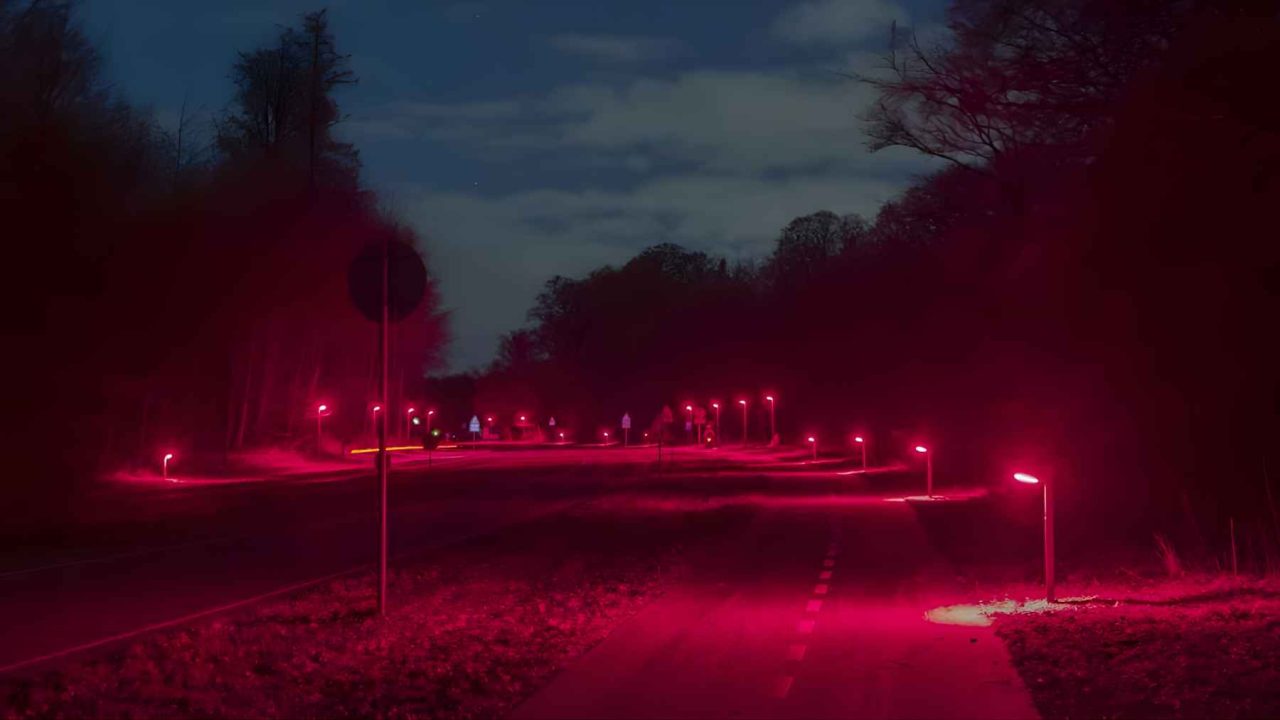
On February 8, 2026, drivers rolling into Gladsaxe — a suburb just outside Copenhagen — were met with something they almost certainly had never seen before: a busy road bathed entirely in deep red light. No emergency. No festival. Just a quiet Danish municipality doing something genuinely unusual to fix a problem most people have never thought about.
The road is called Frederiksborgvej, and the red glow stretching across its surface is not a temporary art installation. It is a deliberate, targeted response to a nighttime crisis that has been building for years in cities across the world — one that harms wildlife in ways that are almost entirely invisible to the people walking and driving past.
The problem, in short, is this: the white LED streetlights that now illuminate most modern cities are disrupting the natural movement of bats. And Denmark has decided to do something about it.
Why a Danish Town Turned Its Streetlights Red
The red LEDs installed along Frederiksborgvej were placed specifically near a known bat corridor — a route that a local bat colony uses to navigate through the night. That is not a coincidence. The targeted placement tells you everything about what this project is actually trying to solve.
Bats are nocturnal animals that evolved over millions of years in genuine darkness. They rely on echolocation and environmental cues to move through the landscape, find food, and return to their roosts. When bright white artificial light floods a corridor they depend on, it effectively acts as a barrier. Many bat species avoid brightly lit areas entirely, which can cut them off from feeding grounds or fragment their habitat in ways that quietly damage local populations.
White LED streetlights — the kind that replaced older sodium lamps in cities across Europe and North America over the past decade or so — are particularly problematic. They emit light across a broad spectrum, including wavelengths that are highly disruptive to nocturnal insects and the animals that feed on them.
Red light, by contrast, sits at a wavelength that is far less disruptive to most bat species. By switching from white LEDs to red LEDs in the specific stretch of road that crosses the bat corridor, Gladsaxe is attempting to keep the road functional for human drivers while dramatically reducing the light’s impact on the wildlife using the same space.
What Light Pollution Actually Does to the Night
Light pollution is one of those environmental problems that is easy to overlook because it does not leave visible damage behind. There is no oil slick, no deforested hillside, no pile of plastic. The harm is subtler — it is the slow erosion of the natural darkness that vast numbers of species depend on.
Artificial light spilling into the night brightens the sky, creates glare, and makes genuinely dark conditions increasingly rare even in areas that are technically outside city centers. Suburban zones like Gladsaxe, where built-up areas meet patches of thick greenery, are especially sensitive. They sit at the exact boundary where wildlife habitat and human infrastructure overlap.
Bats are far from the only animals affected. Moths, beetles, and other nocturnal insects are drawn to artificial light in ways that are often fatal. Birds that migrate at night can become disoriented. Even plants and trees can be affected when artificial light interrupts seasonal cycles tied to changing day length. The consequences ripple through ecosystems in ways that researchers are still working to fully document.
The Key Facts About the Gladsaxe Project
| Detail | Information |
|---|---|
| Location | Frederiksborgvej, Gladsaxe, near Copenhagen, Denmark |
| Launch date | February 8, 2026 |
| Change made | White LED streetlights replaced with red LED streetlights |
| Reason for placement | Located near a known bat corridor and local bat colony |
| Primary goal | Reduce light pollution impact on bats while keeping road usable for drivers |
| Broader context | Part of efforts to address urban light pollution affecting wildlife |
- The red lighting targets a specific stretch of road where suburbia meets thick greenery
- The project is described as a wildlife and safety measure, not a decorative one
- The bat colony in the area is a known, documented presence that informed the decision
- The change is permanent, not a short-term experiment or seasonal installation
Why This Matters Beyond One Road in Denmark
It would be easy to read this story as a charming local curiosity — a small Scandinavian town doing something quirky for the sake of some bats. But the underlying issue is genuinely significant, and what Gladsaxe is doing represents a way of thinking about urban infrastructure that most cities have not yet adopted.
The standard approach to streetlighting has always prioritized human visibility above everything else. Brighter has generally been considered better. The shift to white LEDs over the past decade was driven by energy efficiency and cost savings — valid goals — but the ecological consequences were largely an afterthought.
Advocates for wildlife-sensitive lighting argue that cities can meet human needs and ecological ones at the same time, if they are willing to think carefully about where lights go, what spectrum they emit, and how bright they actually need to be. The red LEDs on Frederiksborgvej are a working example of that idea applied to a real road with real traffic.
The fact that drivers can still use the road safely under red light — that the change does not require anyone to sit in darkness — is part of what makes this approach worth watching. It suggests that the trade-off between human convenience and wildlife protection may be smaller than it first appears.
What Comes Next for Bat-Friendly Lighting
Whether Gladsaxe’s red-light experiment will be evaluated formally, expanded to other roads, or adopted by other municipalities is not confirmed in available reporting. What is clear is that the project launched in early 2026 and represents one of the more concrete and visible attempts by a local government to directly address the impact of streetlight design on nocturnal wildlife.
Other European cities have experimented with dimming streetlights at certain hours, switching off lights in low-traffic areas overnight, or using motion-sensitive systems that reduce light output when no one is present. Each approach tries to chip away at the same basic problem from a different angle.
The Gladsaxe project goes a step further by changing the spectrum of the light itself — not just when it is on or how bright it is, but what kind of light it produces. That distinction matters, and it may be the detail that other urban planners pay closest attention to as interest in light pollution grows.
Frequently Asked Questions
Why did Gladsaxe specifically choose red light?
Red light sits at a wavelength that is significantly less disruptive to bat species than white or blue-spectrum light, making it a practical choice for roads near bat corridors.
When did the red streetlights go live on Frederiksborgvej?
The red LED streetlights were switched on February 8, 2026, in Gladsaxe, a suburb just outside Copenhagen, Denmark.
Is the road still safe for drivers under red light?
Based on reporting, the road remains in use by regular traffic, and the change is described as keeping the road usable for people while reducing its impact on local bats.
What is a bat corridor and why does it matter?
A bat corridor is a route that bats regularly use to travel between roosting and feeding areas. Disrupting it with bright artificial light can effectively cut bats off from food sources or fragment their habitat.
Is this the only place in Europe experimenting with bat-friendly lighting?
Other European cities have explored related approaches such as dimming or switching off lights overnight, but this has not been confirmed in the source as a direct comparison.
Will other roads in Gladsaxe or Denmark follow with similar changes?
This has not yet been confirmed in available reporting. The Frederiksborgvej project appears to be targeted at a specific bat corridor rather than announced as a citywide rollout.




Leave a Reply