
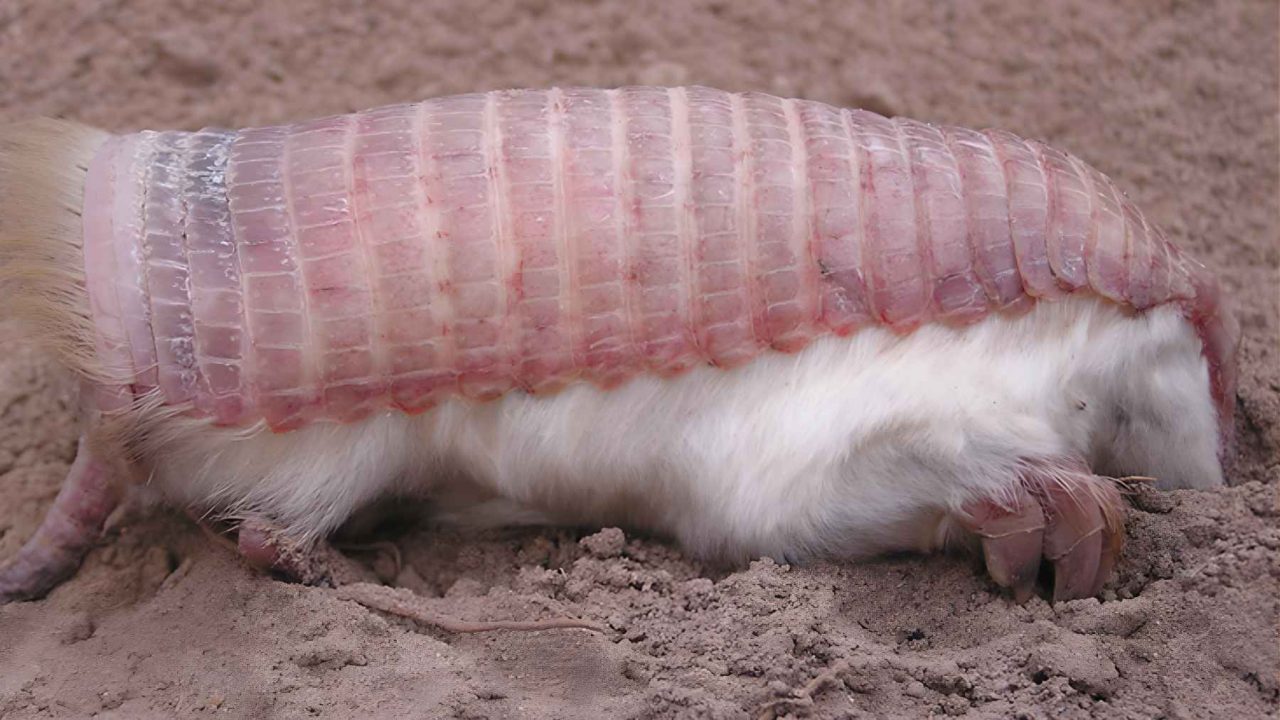
One of the rarest and most elusive mammals on Earth has just been spotted again — and the location says everything about why some wild places deserve to stay protected.
The pink fairy armadillo, a tiny burrowing creature that spends most of its life hidden underground, has been confirmed inside the Ñacuñán Biosphere Reserve in Argentina’s Mendoza province. Park rangers and local residents both reported the sighting, marking a rare documented appearance for a species that is notoriously difficult to find, let alone photograph or study.
For conservationists, this kind of record is not just a feel-good moment. It is a signal. When a species this sensitive to environmental disturbance turns up alive and present, it tells you something important about the ground beneath your feet, the plants around you, and the health of an entire ecosystem you might never have thought to question.
Why the Pink Fairy Armadillo Is So Hard to Find
The pink fairy armadillo — known scientifically as Chlamyphorus truncatus — is the world’s smallest armadillo species. It is found only in Argentina, primarily in the dry grasslands and sandy plains of the central and western regions. Its entire body is adapted for a subterranean life. It burrows fast, surfaces rarely, and vanishes at the slightest disturbance.
That behavior makes it extraordinarily difficult to survey or monitor. Researchers cannot simply set camera traps and wait. Even when the animal is present in an area, confirmed sightings are uncommon. The species is listed as data-deficient in some assessments precisely because so little is known about its actual population size or range.
What is well understood is that the pink fairy armadillo depends on a very specific set of conditions to survive. It needs stable, loose soil for burrowing. It needs native plant cover that supports the insects and plant matter it feeds on. It needs an environment that has not been torn apart by agriculture, overgrazing, or development. Disruption to any one of those elements can make an area uninhabitable for the species.
That is exactly why a confirmed sighting inside a protected reserve carries so much weight.
What the Ñacuñán Reserve Actually Protects
The Ñacuñán Biosphere Reserve is located in eastern Mendoza province and is one of Argentina’s designated UNESCO biosphere reserves. It protects a stretch of the Monte desert ecosystem, a dry scrubland environment dominated by native shrubs and grasses that is home to a wide range of endemic and regionally significant wildlife.
According to officials connected to the reserve, Ñacuñán does not simply conserve landscapes. It conserves what one protected areas director described as “complete ecological dynamics” — meaning the full web of relationships between soil, plants, insects, and animals that allows rare species to survive over time.
That distinction matters. Many protected areas focus on preserving what looks impressive: dramatic scenery, large animals, photogenic habitats. Ñacuñán’s approach, as described by officials, is to protect the underlying processes that make life possible in the first place. Quiet, invisible processes. The kind you only notice when they break down.
What Officials Said About the Sighting
The confirmed reappearance drew formal responses from provincial biodiversity and conservation officials, both of whom framed the sighting as evidence of ecosystem integrity rather than a lucky coincidence.
| Official | Role | Key Statement |
|---|---|---|
| Ignacio Haudet | Biodiversity Director | Described each confirmed record as “a concrete sign that the ecosystem works” |
| Iván Funes Pinter | Protected Areas Director | Said Ñacuñán conserves “complete ecological dynamics” that allow unique species to survive |
Haudet’s framing is worth sitting with. The pink fairy armadillo does not survive in degraded environments. Its presence requires a functioning chain of ecological conditions — soil stability, native vegetation, low human disturbance — that can unravel quietly over years before anyone notices. A confirmed sighting, then, is not just about one small animal. It is a data point about the whole system.
Funes Pinter’s comments pointed toward a broader lesson about conservation strategy. Many of the threats facing ecosystems like the Monte are not dramatic or sudden. They are slow and cumulative — a patch of land cleared here, a fence line pushed further there, grazing pressure that builds year after year until the soil compacts and the native plants give way. Protected areas that focus on preserving ecological processes, not just scenery, are the ones best positioned to absorb those pressures.
The Bigger Picture for Argentine Conservation
Argentina’s network of protected areas covers a significant portion of the country’s diverse ecosystems, from Patagonian steppe to Andean cloud forest to the Monte desert. But protection on paper does not always translate to protection in practice. Reserves that are underfunded, understaffed, or poorly managed can lose species silently, without anyone recording the absence until it is too late to reverse.
The Ñacuñán sighting is a reminder that the opposite can also be true. An ecosystem that appears quiet — that does not make headlines, that does not host the most charismatic megafauna — can still be doing its job. It can still be holding together the conditions that allow something as fragile and secretive as a pink fairy armadillo to live out its life underground, unseen, until one day a park ranger or local resident catches a glimpse and reports it.
That kind of confirmation is rare. It should be treated accordingly.
What Comes Next for the Species and the Reserve
The sighting has renewed attention on Ñacuñán as a functioning habitat for one of Argentina’s most elusive native species. Officials have indicated that each confirmed record contributes to a broader understanding of where the pink fairy armadillo still survives and what conditions support it.
There is no suggestion in the available reporting that a formal new survey or monitoring program has been announced in response to this specific sighting. But the confirmation itself adds to the scientific record and strengthens the case for continued protection of the reserve and its surrounding landscape.
For a species this difficult to find, every sighting counts. And for a reserve this easy to overlook, every rare species that surfaces is an argument for keeping it intact.
Frequently Asked Questions
Where exactly was the pink fairy armadillo spotted?
The animal was confirmed inside the Ñacuñán Biosphere Reserve in Mendoza province, Argentina, by park rangers and local residents.
Why is the pink fairy armadillo so rarely seen?
The species is a fast-burrowing, subterranean mammal that surfaces infrequently and disappears underground at the slightest disturbance, making confirmed sightings uncommon even in areas where it is present.
What did officials say the sighting means for the ecosystem?
Biodiversity director Ignacio Haudet called it “a concrete sign that the ecosystem works,” noting that the species depends on a chain of ecological conditions that can break down easily.
What kind of habitat does the pink fairy armadillo need?
It requires stable, loose soil for burrowing, native plant cover, and minimal human disturbance — conditions that are preserved within the Ñacuñán reserve.
Is the pink fairy armadillo endangered?
The species is considered data-deficient in some assessments due to the difficulty of studying it, but it is recognized as sensitive to habitat disturbance and is found only in Argentina.
Will there be new surveys or monitoring programs following this sighting?
This has not yet been confirmed in the available reporting, though officials noted that each confirmed record contributes to the broader scientific understanding of the species’ range and habitat needs.


Leave a Reply