
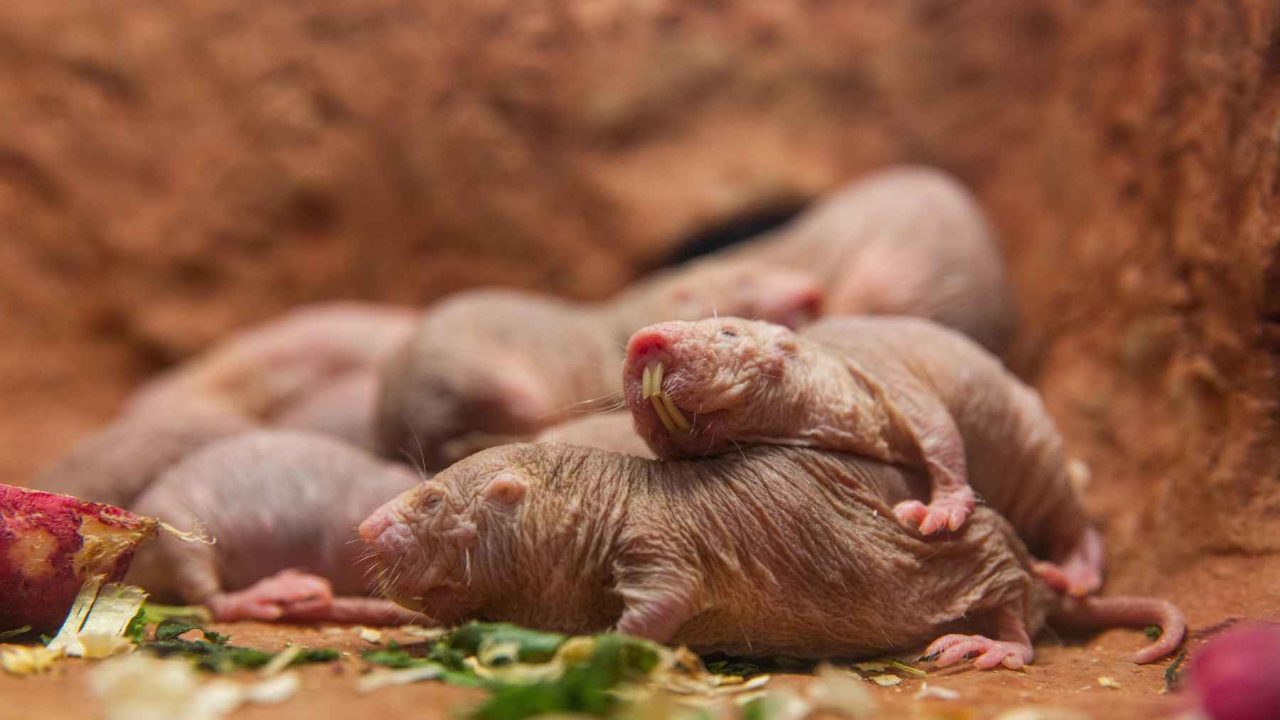
What if the most ruthless power struggle in the animal kingdom doesn’t always have to end in blood? That’s the surprising question raised by a new six-year study of naked mole-rats — creatures long known for violent, often fatal queen successions. Researchers have now documented something that, until recently, scientists didn’t believe was possible: a peaceful handover of power in one of nature’s most brutal social hierarchies.
The findings come from a Salk Institute colony observed over six years, and they challenge a core assumption about how these underground mammals operate. The old story was simple — when a queen loses her grip, chaos and fighting follow. The new story is considerably more complicated, and more interesting.
For anyone who finds human politics exhausting, the naked mole-rat’s world offers a strange kind of perspective. These animals have built one of the most rigid social systems in all of mammal biology. And yet, it turns out, even they have a gentler option available when circumstances allow.
Why Naked Mole-Rat Queens Are Such a Big Deal in Science
Naked mole-rats are genuinely unusual mammals. They live in large underground colonies — sometimes numbering in the hundreds — organized around a single breeding female: the queen. Every other female in the colony is reproductively suppressed, meaning they don’t breed. Instead, they dig tunnels, forage for food, and care for the queen’s offspring.
This system is called eusociality, and it’s far more commonly associated with insects like ants and bees than with mammals. The fact that naked mole-rats evolved it independently makes them one of the most studied creatures in behavioral biology.
The queen doesn’t just hold a symbolic title. She is the sole reproductive engine of the entire colony. When she dies or loses fertility, everything is at stake — the colony’s survival, its genetic future, its social order. That’s why succession matters so much, and why it has historically been violent.
Researchers had long assumed that when a queen’s reign ended, subordinate females would fight — sometimes to the death — to claim her role. That assumption shaped how scientists understood the entire species. The new research suggests it was only part of the picture.
What the Six-Year Salk Study Actually Found
Researchers at the Salk Institute monitored one captive colony continuously for six years. During that time, the reigning queen experienced a major disruption that caused her to pause reproduction. What happened next defied expectations.
Rather than triggering an explosion of aggression among the subordinate females, the colony remained relatively stable. Subordinate females began breeding — but the process was gradual, not violent. The result was a slow handoff of reproductive power that kept the colony functioning during a period of stress.
According to the research, this peaceful succession became possible because two specific conditions were met at the same time: the queen’s fertility declined, and the broader social structure of the colony held together. When both of those things happened simultaneously, the usual trigger for violent competition appeared to be removed.
That combination — a weakening queen plus a stable colony — seems to create a window where power can transfer without a fight. It’s a narrow window, but it’s real.
The Key Conditions That Made Peaceful Succession Possible
The study points to a clear set of factors that distinguished this peaceful transition from the violent ones previously documented. Understanding those factors helps explain why this outcome is rare, not routine.
- The queen’s fertility declined gradually, rather than ending abruptly through death or sudden incapacitation.
- The colony’s social structure remained intact during the transition period, meaning the usual hierarchy of workers and subordinates stayed in place.
- Subordinate females began breeding incrementally, rather than one dominant female seizing reproductive control all at once.
- The transition occurred during a period of stress for the colony — which is precisely when stability is most critical for survival.
| Succession Type | Trigger | Colony Stability | Outcome |
|---|---|---|---|
| Violent succession | Queen dies or is suddenly removed | Disrupted | Females fight, sometimes fatally |
| Peaceful succession | Queen’s fertility declines gradually | Intact | Gradual handoff, colony remains functional |
The contrast is striking. The difference between a bloody power struggle and a calm transition appears to hinge less on personality or individual dominance, and more on the structural conditions present when the change begins.
Why This Discovery Matters Beyond the Underground
At first glance, this might seem like an interesting footnote in animal behavior research. But the implications reach further than a single mole-rat colony in a Salk Institute lab.
Eusocial mammals are extraordinarily rare. Naked mole-rats are one of only a handful of mammal species known to organize their societies this way. Every new piece of data about how their social systems work — and how they can flex under pressure — adds to a broader understanding of how complex cooperative societies evolve and sustain themselves.
The finding also raises questions about what researchers may have missed in previous studies. If peaceful succession is possible but requires a specific and relatively uncommon set of conditions, it could easily have been overlooked in shorter observation windows. Six years of continuous monitoring was what it took to catch this one.
There’s also a deeper biological question here. The fact that the colony remained stable during stress — not despite it, but through a transition triggered by it — suggests that eusocial systems may have more built-in resilience than previously understood. When the external pressure is high enough, and the internal structure holds, these colonies may default to cooperation rather than conflict.
What Researchers Will Be Watching For Next
The Salk Institute study documents one confirmed case of peaceful succession in one captive colony over six years. That’s a significant finding, but it’s also a single data point. The next step for researchers will likely involve determining how often these conditions arise in wild colonies, where environmental pressures are far less controlled.
Scientists will also want to know whether the subordinate females who began breeding during the transition eventually established a new dominant queen, or whether the colony shifted to a more distributed reproductive structure.
What is confirmed is that the binary assumption — violent takeover or colony collapse — is no longer the complete picture. Naked mole-rat societies, it turns out, have more options than anyone realized.
Frequently Asked Questions
What is a naked mole-rat queen?
She is the single breeding female in a naked mole-rat colony. All other females are reproductively suppressed and instead perform tasks like digging, foraging, and caring for pups.
Why are naked mole-rat queen successions usually violent?
When a queen dies or loses power, subordinate females compete — sometimes fatally — to take over the sole reproductive role in the colony.
What made the peaceful succession in this study possible?
According to the research, it required two conditions occurring together: the queen’s fertility declining gradually, and the colony’s social structure remaining intact during the transition.
Where did this research take place?
The six-year study was conducted at the Salk Institute, where researchers monitored one captive naked mole-rat colony continuously.
Are naked mole-rats really eusocial like ants and bees?
Yes. They are one of the very few mammal species known to practice eusociality, where one female monopolizes reproduction while the rest of the group performs colony tasks.
Does this mean peaceful successions are common in naked mole-rats?
Not necessarily. This study documents one confirmed case, and the conditions required appear to be specific and relatively uncommon. Further research is needed to determine how frequently this occurs.



Leave a Reply