
Why does anything have mass? It sounds like a philosophical question, but it sits at the very heart of modern physics — and a new experiment may have just nudged scientists closer to an answer.
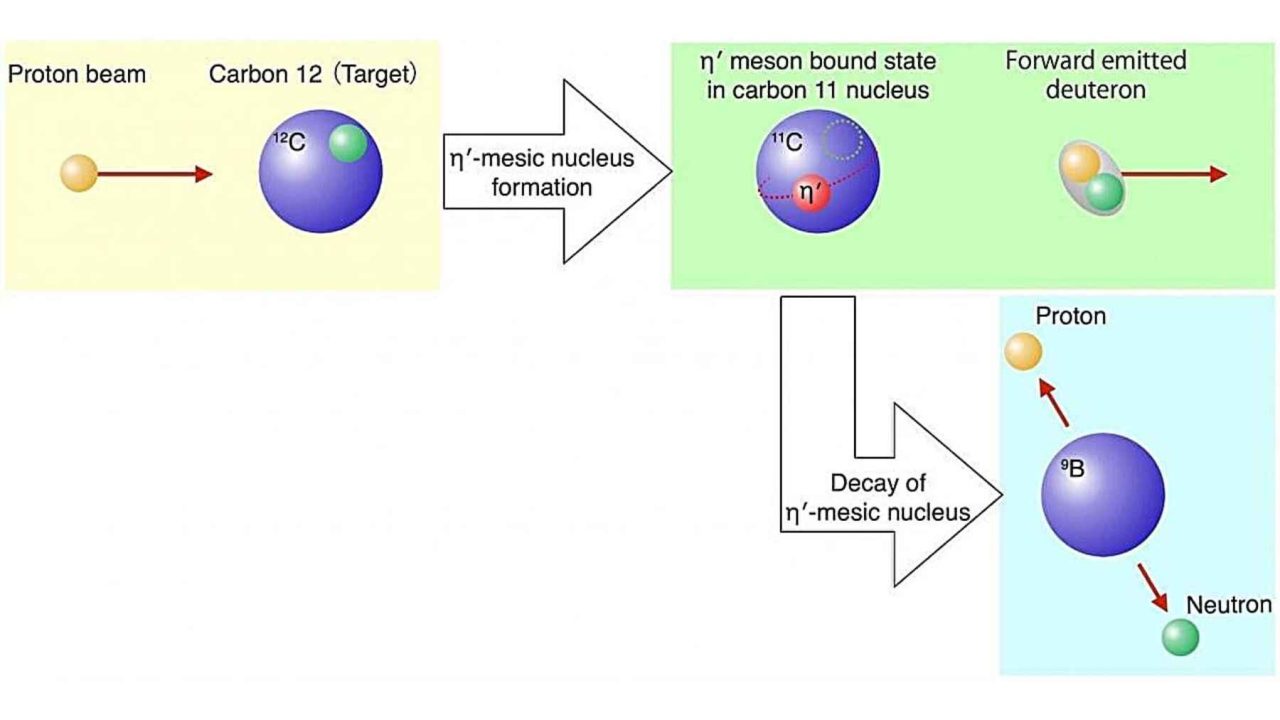
Researchers have found what they describe as the first signs of an η′-mesic nucleus, an exotic and extremely short-lived state of matter in which a particle called the eta prime meson briefly becomes trapped inside an atomic nucleus. The finding had been theoretically predicted for years, but clear experimental evidence had remained out of reach — until now.
The result is being described as early evidence rather than a definitive discovery. Even so, physicists say it opens a rare window into one of the most fundamental and least understood forces in nature: the strong nuclear force that holds atomic nuclei together.
What Is an η′-Mesic Nucleus, and Why Does It Matter?
To understand what makes this finding significant, it helps to start with what a meson actually is. A meson is a subatomic particle built from two ingredients: a quark and an antiquark. These particles are extraordinarily unstable — they appear and vanish in fractions of a second, making them some of the most fleeting objects in the known universe.
A mesic nucleus is what forms when one of these mesons, rather than instantly decaying or flying away, briefly becomes a kind of temporary resident inside an atomic nucleus. The strong force — the same force that binds protons and neutrons together — acts as a kind of cage, holding the meson in place for a short time before it disappears.
The eta prime meson, specifically, is of enormous interest to physicists because of its connection to a concept called chiral symmetry. In normal empty space, the eta prime has a relatively large mass compared to other mesons. But theory suggests that inside dense nuclear matter — the crowded interior of a nucleus — its effective mass may change. Observing that change would give researchers direct evidence of how the strong force behaves under extreme conditions, and it could shed light on the deeper question of where mass itself originates.
Why This Has Been So Difficult to Detect
The challenge of finding a mesic nucleus is not just technical — it is almost a problem of timing. Mesons decay or escape so quickly that detectors often cannot distinguish whether a meson was ever genuinely bound inside a nucleus or simply passed through it on its way out.
The eta prime meson makes this problem especially acute. It is heavier and more unstable than many other mesons, and the signal that would indicate it was truly trapped is subtle and easy to confuse with background noise. Experiments have been searching for this state for years without producing results clear enough to publish with confidence.
The new experiment appears to have cleared that bar — at least partially. Researchers are presenting the data as the first signs of the state, a cautious framing that reflects both the excitement of the result and the rigorous standards the physics community applies before declaring a discovery confirmed.
Key Facts About the η′-Mesic Nucleus Finding
| Aspect | What the Research Indicates |
|---|---|
| Particle involved | Eta prime meson (η′), made of a quark and an antiquark |
| What was found | First signs of the η′ meson becoming temporarily bound inside an atomic nucleus |
| Status of the finding | Early evidence — not yet presented as a confirmed discovery |
| Key physical implication | The eta prime may have a different effective mass inside nuclear matter than in empty space |
| Force being studied | The strong nuclear force, which binds atomic nuclei together |
| Broader significance | Could help explain the origins of mass in the universe |
- A meson is a particle composed of one quark and one antiquark — inherently unstable and extremely short-lived.
- A mesic nucleus forms when a meson is temporarily held inside an atomic nucleus by the strong force.
- The eta prime meson is thought to be sensitive to chiral symmetry conditions inside dense nuclear matter.
- The effective mass of the eta prime may shift when it enters a nucleus — a change that could reveal fundamental information about mass itself.
- Detecting this state requires distinguishing a genuine bound state from a meson that simply passed through the nucleus without being trapped.
What This Could Tell Us About the Origin of Mass
The question of where mass comes from is more complicated than most people realize. The Higgs boson — famously detected in 2012 — explains how certain fundamental particles acquire mass. But the Higgs mechanism accounts for only a small fraction of the mass we observe in everyday matter.
Most of the mass in a proton or neutron, and therefore most of the mass in everything around us, comes from the energy of the strong force itself — from the frantic motion and interactions of quarks and gluons confined inside those particles. Understanding exactly how that works requires probing the strong force in conditions as extreme as those found inside a dense atomic nucleus.
That is precisely what a confirmed η′-mesic nucleus would allow. If the eta prime’s effective mass genuinely changes inside nuclear matter, it would provide a measurable signal of how the strong force reshapes the properties of particles in high-density environments. It would be a direct experimental test of theoretical predictions that have existed for decades but never had solid data to confirm or challenge them.
What Happens Next in This Research
Because the current findings are described as early signs rather than a confirmed observation, the immediate next step is independent verification. Other experimental groups will need to reproduce the result, and the original team will likely seek to strengthen their own signal with additional data.
The physics community applies a high standard — typically a statistical confidence level known as “five sigma” — before formally declaring a new particle state discovered. The current result has not been described as meeting that threshold yet, which means the work ahead involves refining detectors, improving analysis techniques, and running more experimental trials.
If the evidence holds up, the η′-mesic nucleus would join a short list of exotic nuclear states that exist at the boundary between nuclear physics and particle physics — objects that challenge tidy categories and force theorists to sharpen their models of how matter behaves at its most fundamental level.
Frequently Asked Questions
What is an η′-mesic nucleus?
It is an exotic state of matter in which an eta prime meson becomes temporarily trapped inside an atomic nucleus, held in place by the strong nuclear force.
Has this state been officially confirmed as a discovery?
No. Researchers are presenting the results as early evidence or first signs, not as a confirmed discovery — the physics community requires a higher standard of statistical certainty before that designation applies.
Why is the eta prime meson important to understanding mass?
The eta prime is thought to be sensitive to conditions inside dense nuclear matter, and its effective mass may change when it enters a nucleus — a measurement that could shed light on how the strong force generates most of the mass in ordinary matter.
How is this different from the Higgs boson explaining mass?
The Higgs mechanism explains how certain fundamental particles acquire mass, but most of the mass in everyday matter comes from the energy of the strong force inside protons and neutrons — which is what this research is probing.
Why is it so hard to detect a mesic nucleus?
Mesons decay or escape almost instantly, making it extremely difficult to determine whether a meson was genuinely bound inside a nucleus or simply passed through it without being trapped.
What would a confirmed η′-mesic nucleus mean for physics?
It would provide a direct experimental test of long-standing theoretical predictions about how the strong force behaves in high-density environments, offering new insight into the origins of mass in the universe.




Leave a Reply