
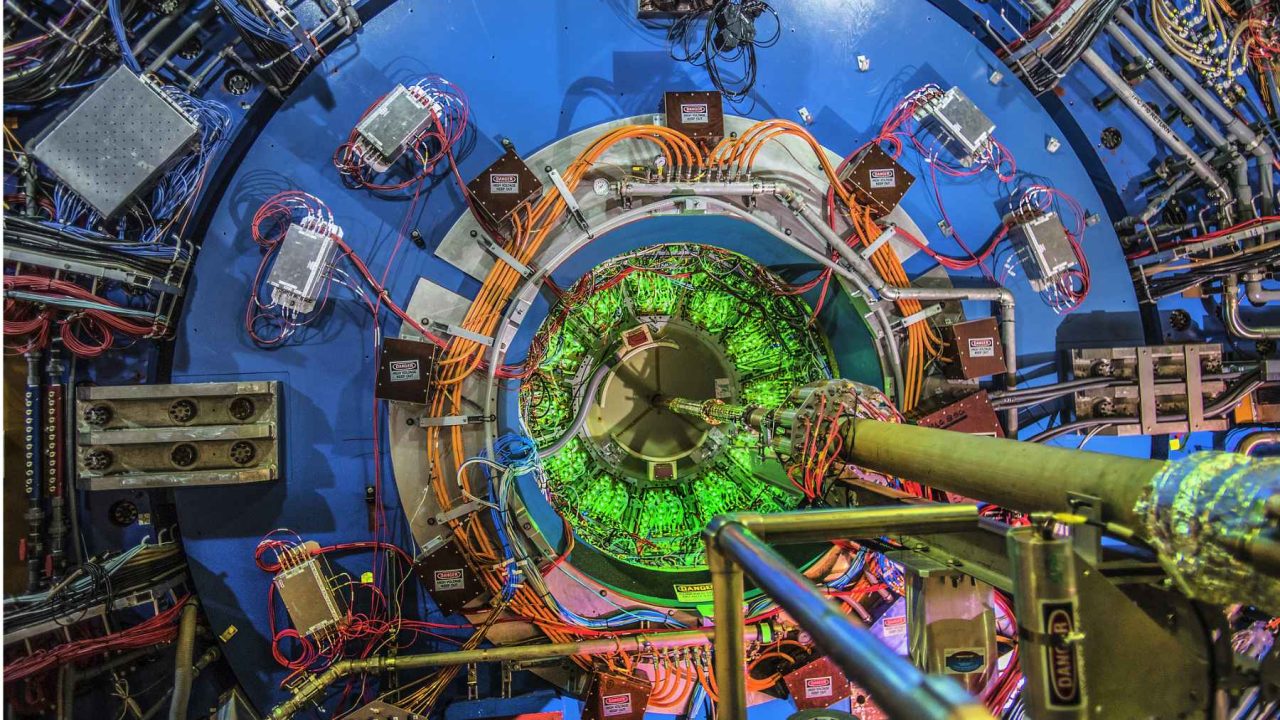
Empty space has always seemed like the simplest thing in the universe — nothing there, nothing happening, nothing to measure. Quantum physics has challenged that idea for decades. Now, for what researchers are calling the first time, an experiment has produced direct experimental evidence that the quantum vacuum — the so-called emptiness of space — can leave a measurable imprint on real, detectable particles.
The finding comes from the STAR Collaboration at the U.S. Department of Energy’s Brookhaven National Laboratory in New York, working with data from high-energy proton collisions at the Relativistic Heavy Ion Collider (RHIC). What they observed in those collisions may fundamentally change how physicists think about empty space, visible matter, and the invisible forces that shape everything we can see.
It sounds abstract. The implications are anything but.
What the Quantum Vacuum Actually Is
When most people hear the word “vacuum,” they picture the void between planets — a place where nothing exists and nothing happens. In quantum physics, that picture has always been incomplete.
Even in “empty” space, energy fields are constantly jittering. Those jitters are not random noise to be ignored. According to quantum theory, they can briefly behave like pairs of particles — flickering in and out of existence so fast that, under normal circumstances, no instrument can catch them in the act.
This has been a cornerstone of quantum field theory for a long time. The problem is that while the math has always predicted these fluctuations exist, finding hard experimental proof that they interact with real, stable matter has been extraordinarily difficult. The STAR Collaboration’s work at RHIC is now being described as a breakthrough on exactly that front.
What the RHIC Experiment Actually Found
The STAR team tracked paired particles produced during high-energy proton collisions inside the Relativistic Heavy Ion Collider. What made those pairs significant was not just their existence — it was the way their spins lined up.
Spin is a quantum property, a kind of intrinsic angular momentum that particles carry. When the researchers analyzed how the spins of these paired particles were oriented relative to each other, they found a pattern they directly connect to the quantum vacuum itself.
That spin alignment, the team argues, is a measurable mark left by vacuum fluctuations on real particles — something that had never been experimentally demonstrated before. The researchers describe it as the first direct experimental evidence of its kind.
“This work gives us a unique window into the quantum vacuum that may open a new era in our understanding of how visible matter forms and how its fundamental properties emerge.” — Zhoudunming (Kong) Tu, co-leader of the analysis
Tu’s framing is careful but significant. The word “era” is not used lightly in physics. It signals that researchers believe this result could open an entirely new line of inquiry, not just answer one narrow question.
Why This Finding Matters Beyond the Laboratory
The quantum vacuum is not just a theoretical curiosity. It sits at the heart of some of the biggest unsolved questions in physics — including why visible matter exists at all, and how the fundamental properties of particles like mass and spin actually arise.
If vacuum fluctuations can leave detectable signatures on particles, that means the vacuum is not a passive backdrop to the universe. It is an active participant. That shift in understanding could eventually reshape models of how matter formed in the early universe, and why the physical constants that govern everything — from atomic structure to the speed of light — have the values they do.
For most readers, the direct day-to-day impact of this discovery is not immediate. But findings like this tend to precede technological leaps that are impossible to predict in advance. Quantum mechanics itself once seemed purely theoretical. It now underlies semiconductors, MRI machines, lasers, and the processor running whatever device you are reading this on.
Key Facts About the Discovery at a Glance
| Detail | What the Source Confirms |
|---|---|
| Research institution | Brookhaven National Laboratory, New York |
| Collaboration name | STAR Collaboration |
| Facility used | Relativistic Heavy Ion Collider (RHIC) |
| Funding body | U.S. Department of Energy |
| Key researcher named | Zhoudunming (Kong) Tu, co-leader of the analysis |
| What was measured | Spin alignment of paired particles in proton collisions |
| Claimed significance | First direct experimental evidence linking vacuum fluctuations to real particles |
- The vacuum fluctuations being studied appear and vanish faster than conventional instruments can normally detect
- The experiment used high-energy proton-proton collisions to produce the paired particles
- The spin alignment pattern observed is what the team links specifically to the quantum vacuum
- Researchers describe this as potentially opening a “new era” in understanding how visible matter forms
What Comes Next for This Research
What the researchers have signaled is that this result represents a new window — meaning the expectation is that further work will follow to probe exactly what the vacuum’s influence on matter looks like under different conditions.
The Relativistic Heavy Ion Collider has been a central tool for probing the fundamental structure of matter for years, and findings like this typically generate significant follow-on research both at the same facility and at comparable colliders around the world.
Whether this particular result holds up under further scrutiny — and whether the spin alignment pattern can be reproduced and refined — will determine how far-reaching the implications ultimately prove to be. For now, what the STAR Collaboration has put on the table is a measurable signal where physics once said there should be nothing at all.
That alone is worth paying attention to.
Frequently Asked Questions
What is the quantum vacuum?
In quantum physics, the vacuum is not truly empty — it contains energy fields that constantly fluctuate, briefly behaving like pairs of particles that appear and vanish almost instantly.
What did the STAR Collaboration actually detect?
The team tracked paired particles produced in high-energy proton collisions at RHIC and observed a spin alignment pattern they link directly to quantum vacuum fluctuations — described as the first direct experimental evidence of this kind.
Where did this experiment take place?
The research was conducted at the Relativistic Heavy Ion Collider (RHIC) at Brookhaven National Laboratory in New York, a facility operated under the U.S. Department of Energy.
Who led this research?
Zhoudunming (Kong) Tu is named in the source as a co-leader of the analysis for the STAR Collaboration.
Why does this matter if it is just a physics experiment?
The quantum vacuum is connected to fundamental questions about why matter exists and how particles acquire their properties — answers that could eventually influence future technologies, much as earlier quantum discoveries did.
Has this been confirmed by other institutions or peer review?


Leave a Reply