
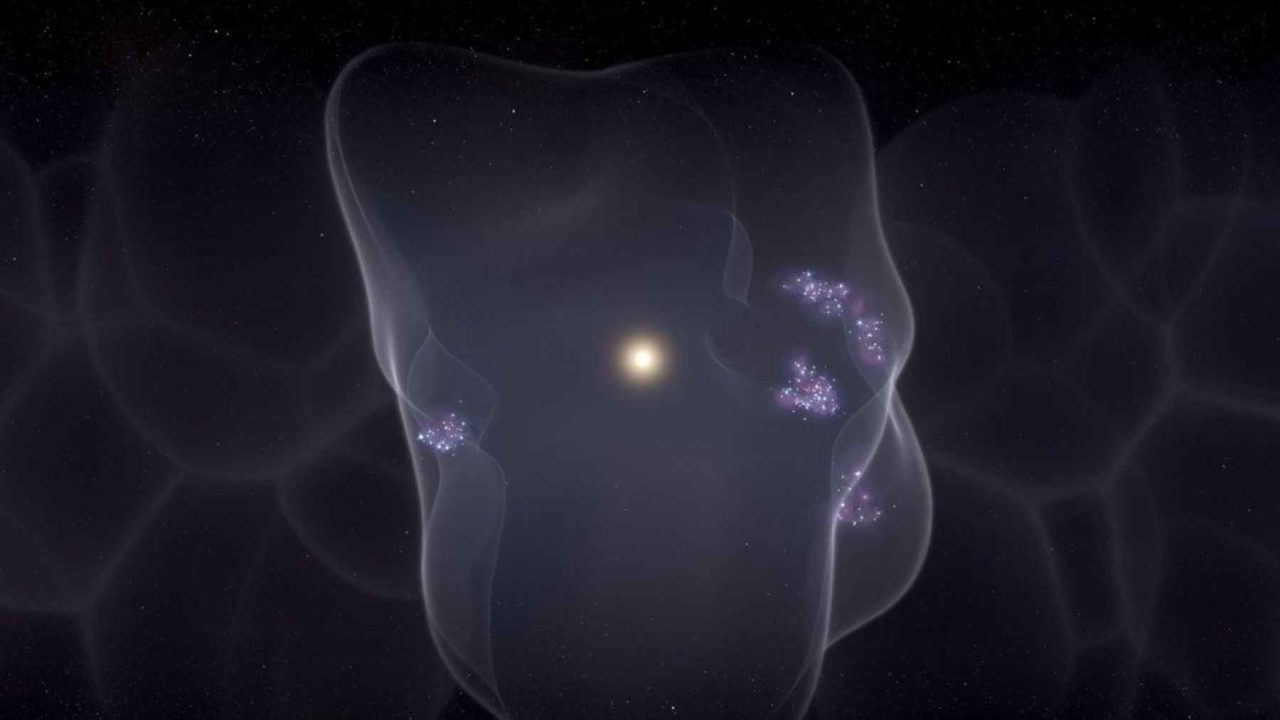
A massive cloud of molecular hydrogen has been hiding just 300 light-years from Earth — practically next door in cosmic terms — and astronomers only just found it. The structure, now nicknamed Eos, is so enormous that it would span roughly 40 full moons across the night sky if human eyes could detect the wavelengths of light it emits.
The fact that no one had spotted it before isn’t a failure of effort. It’s a failure of method. And that distinction matters enormously for everything scientists think they know about where stars are born.
This discovery doesn’t just add one cloud to a catalog. It raises a much bigger question: if something this large was hiding this close, how many others are out there that our maps have missed entirely?
What Eos Actually Is — and Why It Stayed Hidden So Long
Eos is a molecular hydrogen cloud — a vast region of cold gas that serves as raw material for star formation. It sits approximately 300 light-years from Earth, or about 1.8 quadrillion miles away. Astronomers place it near the surface of the Local Bubble, a large cavity in the interstellar medium that our entire solar system currently moves through.
To be clear: Eos poses no threat to Earth. It is simply part of the diffuse material that drifts between star systems, the kind of cosmic ingredient that eventually collapses under gravity and ignites into new suns.
So why did it take this long to find? The answer comes down to chemistry. Traditional surveys of molecular clouds rely heavily on detecting carbon monoxide, or CO, as a stand-in signal for hydrogen. Hydrogen is the most abundant element in the universe, but molecular hydrogen in cold clouds doesn’t emit light at wavelengths that are easy to detect from Earth’s surface.
Carbon monoxide does. So astronomers have long used CO as a tracer — where you find CO, you assume hydrogen is also present. The problem is that not all hydrogen clouds contain enough CO to show up in those surveys. Clouds like Eos, which are described as “CO-dark,” can be loaded with molecular hydrogen while remaining essentially invisible to the standard detection toolkit.
The team behind the Eos discovery used a different approach entirely: they tracked a faint far-ultraviolet glow emitted directly by molecular hydrogen itself. That signal had been sitting in the data, waiting for someone to look for it in the right way.
The Numbers Behind the Discovery
The sheer scale of Eos is what makes this finding so striking. Here’s a quick breakdown of what 8 quadrillion miles)
To put the apparent size in perspective: the full moon as seen from Earth takes up roughly half a degree of sky. A structure spanning 40 full moons would be a spectacular feature of the night — if only we could see it.
Why This Changes How We Map Star-Forming Gas
The deeper implication of Eos isn’t about this one cloud. It’s about the reliability of every molecular cloud survey ever conducted using CO as a proxy.
If a structure this large — sitting this close to our own solar system — managed to slip through the cracks of traditional detection methods, then scientists have good reason to wonder how complete their current maps of the Milky Way’s star-forming fuel actually are.
Molecular clouds are where stars come from. They are the reservoirs of gas that collapse, fragment, and eventually ignite into nuclear fusion. Understanding how much of this raw material exists, where it is concentrated, and how it behaves is fundamental to understanding how galaxies like ours build and sustain themselves over billions of years.
CO-dark clouds like Eos represent a potential blind spot in that understanding. The far-ultraviolet detection method used to find Eos offers a way to look past that blind spot — and the implication is that applying this method more broadly could reveal other hidden structures scattered across the sky.
What the Local Bubble Has to Do With It
The Local Bubble is the region of relatively low-density interstellar space that our solar system currently travels through. It was likely carved out by ancient supernova explosions that blasted away much of the surrounding gas and dust millions of years ago.
Eos sits near the surface of this bubble — essentially at the edge of the relatively empty space we call home. That position makes it a particularly interesting object for researchers studying how the boundary regions of such bubbles behave, and whether they play a role in triggering new rounds of star formation.
The fact that such a prominent structure exists at this boundary, and remained undetected until now, adds another layer of complexity to models of how the Local Bubble and similar structures evolve over time.
What Comes Next for Eos Research
The discovery of Eos opens several lines of inquiry that researchers are likely to pursue. The most immediate is simply characterizing the cloud more fully — its total mass, its internal structure, and whether any parts of it show signs of beginning to collapse toward star formation.
Beyond Eos itself, the detection method that revealed it is likely to be applied to broader sky surveys. If CO-dark clouds have been systematically undercounted, then recalibrating our understanding of the Milky Way’s total molecular gas content becomes a meaningful scientific priority.
Frequently Asked Questions
What is Eos?
Eos is a large molecular hydrogen cloud located approximately 300 light-years from Earth, recently discovered near the surface of the Local Bubble in the interstellar medium.
Is Eos dangerous to Earth?
No. Researchers have confirmed that Eos poses no risk to Earth and is simply part of the thin material that exists between star systems.
Why hadn’t astronomers found Eos before?
Traditional surveys use carbon monoxide as a tracer for molecular hydrogen, but Eos is a “CO-dark” cloud, meaning it lacks enough CO to show up in those methods. Researchers found it by detecting a faint far-ultraviolet glow emitted directly by molecular hydrogen.
How big is Eos?
Eos spans approximately 40 full moons across the sky, making it an enormous structure that would be visually dominant if human eyes could detect the wavelengths it emits.
What does this discovery mean for our maps of the Milky Way?
It raises serious questions about how complete existing maps of star-forming gas are, since CO-dark clouds like Eos could exist elsewhere and have been missed by conventional detection methods.
Will Eos eventually form stars?
This has not yet been confirmed in the available source material. Whether any portion of Eos is beginning to collapse toward star formation remains an open question for further research.




Leave a Reply