
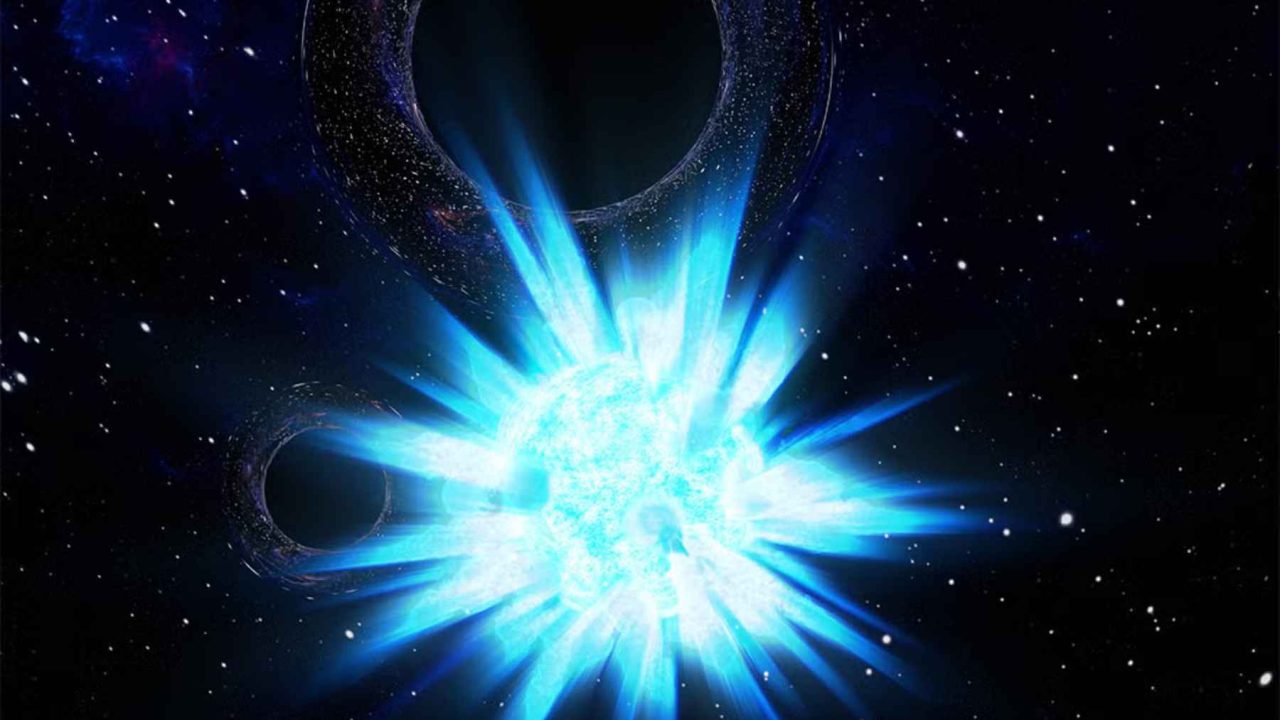
What if a star could explode so completely that it leaves absolutely nothing behind — not even a black hole? That idea, once theoretical, now has growing observational support, and it’s forcing astronomers to rethink the basic rules of how massive objects form and die.
A study published on April 1, 2026, reveals a striking gap in the distribution of black hole masses detected through gravitational-wave observations. The data points to a range of masses that are essentially missing from the universe’s black hole population — a zone where black holes, according to the new findings, are far rarer than anyone expected.
The implications stretch well beyond a curiosity in the data. If confirmed, this “forbidden zone” rewrites part of the story of how stars live, collapse, and end — and it raises a question that’s harder to answer than it sounds: how do you find evidence of something that doesn’t exist?
The Forbidden Zone in Black Hole Masses
To understand what’s missing, you first need to know how astronomers measure black holes. Because the actual numbers involved are enormous, scientists compare black hole masses to the mass of our own sun. A black hole described as “45 solar masses” is 45 times heavier than the sun.
What researchers have found, using gravitational-wave data, is a notable drop-off in detected black holes starting around 45 times the mass of our sun. More specifically, the analysis supports the existence of a “pair instability gap” — a missing band of smaller, secondary black holes falling between approximately 44 and 116 solar masses.
In plain terms, that range is a no-show zone. Black holes in that mass window are conspicuously absent from what gravitational-wave detectors are picking up, and that absence is itself the discovery.
The phenomenon behind this gap is called pair instability. The theory holds that certain very massive stars, rather than collapsing into a black hole at the end of their lives, instead blow themselves apart in a catastrophic explosion so complete that nothing is left behind — no remnant, no black hole, no neutron star. The star essentially erases itself.
Why This Gap Is So Hard to Explain Away
Gaps in data are common in science and often turn out to be observational artifacts — quirks of how instruments work, not real features of the universe. But researchers argue this gap is different, because it shows up in a specific and theoretically predicted place.
The pair instability mechanism has been discussed in astrophysics for decades. The new gravitational-wave evidence now aligns with where that theory predicted the gap should appear, which makes it significantly harder to dismiss as noise or instrument bias.
What makes the gap especially striking is the mismatch it creates in observed black hole mergers. When two black holes spiral together and collide — the events gravitational-wave detectors like LIGO and Virgo are built to catch — the larger black hole in a merger can sometimes fall into the same mass range where secondary black holes are supposed to be absent. That asymmetry in the data adds another layer of evidence that something real is happening in that mass window.
Key Numbers Behind the Discovery
| Feature | Detail |
|---|---|
| Study publication date | April 1, 2026 |
| Mass drop-off begins around | ~45 solar masses |
| Pair instability gap range (secondary black holes) | ~44 to 116 solar masses |
| Data source | Gravitational-wave observations |
| Proposed cause | Pair instability supernova — stars that destroy themselves completely |
The mass range of 44 to 116 solar masses represents the core of what researchers are calling the forbidden zone — a stretch of the black hole mass spectrum where the laws of stellar physics, if this theory holds, simply prevent black holes from forming through normal stellar collapse.
What This Means for How We Think About Stars and Black Holes
For most of modern astrophysics, the end-of-life story for a massive star went something like this: the star burns through its fuel, its core collapses under gravity, and depending on how massive it was, it leaves behind either a neutron star or a black hole. The pair instability finding complicates that narrative.
It means there is a mass range where stars are too massive to simply collapse — but instead of making a bigger black hole, they detonate so violently that the explosion consumes the entire star. No remnant forms. The star is gone.
This has real consequences for understanding the universe’s black hole population. If a whole category of stellar deaths produces no black holes at all, then the census of black holes astronomers have been building is missing an important chapter. It also raises questions about what happens to the heavy elements those stars would have forged and scattered — elements that seed future generations of stars and, eventually, planets.
Researchers note that the mismatch between merger partners in gravitational-wave events — where one black hole is in a mass range where its counterpart shouldn’t exist — adds pressure to existing models and may require significant revisions to how stellar evolution is simulated.
What Researchers Are Looking at Next
The gravitational-wave detector network continues to collect data from black hole and neutron star mergers across the observable universe. Each new detection adds to the statistical picture, and with more events catalogued, the shape of the mass gap should become either sharper or blurrier — both of which tell scientists something important.
The pair instability gap is not the only open question. Researchers are also working to understand what happens to stars that fall just at the edge of the forbidden zone — whether they collapse partially, explode partially, or follow some more complicated path that current models don’t fully capture.
What’s clear is that the missing black holes are not just an absence. They are a signal — one that points directly at some of the most violent and least understood events in the universe.
Frequently Asked Questions
What is the “forbidden zone” in black hole masses?
It refers to a gap in the observed distribution of black hole masses, roughly between 44 and 116 solar masses, where black holes appear to be far rarer than expected based on current models.
Why are black holes missing from this mass range?
Researchers believe the gap is caused by pair instability supernovae — a process where certain massive stars explode so completely that they leave no remnant behind, preventing black holes from forming in that mass window.
How was this gap detected?
The gap was identified through analysis of gravitational-wave data, which captures signals from black hole and neutron star mergers across the universe.
When was this study published?
The study was published on April 1, 2026.
Does this change what we know about how stars die?
Yes — it suggests that some of the most massive stars do not leave black holes behind at all, which challenges the standard picture of stellar collapse and requires updates to models of stellar evolution.
Will more data confirm or challenge this finding?
Ongoing gravitational-wave observations are expected to add more merger events to the dataset, which should either strengthen or complicate the case for the pair instability gap over time.




Leave a Reply