
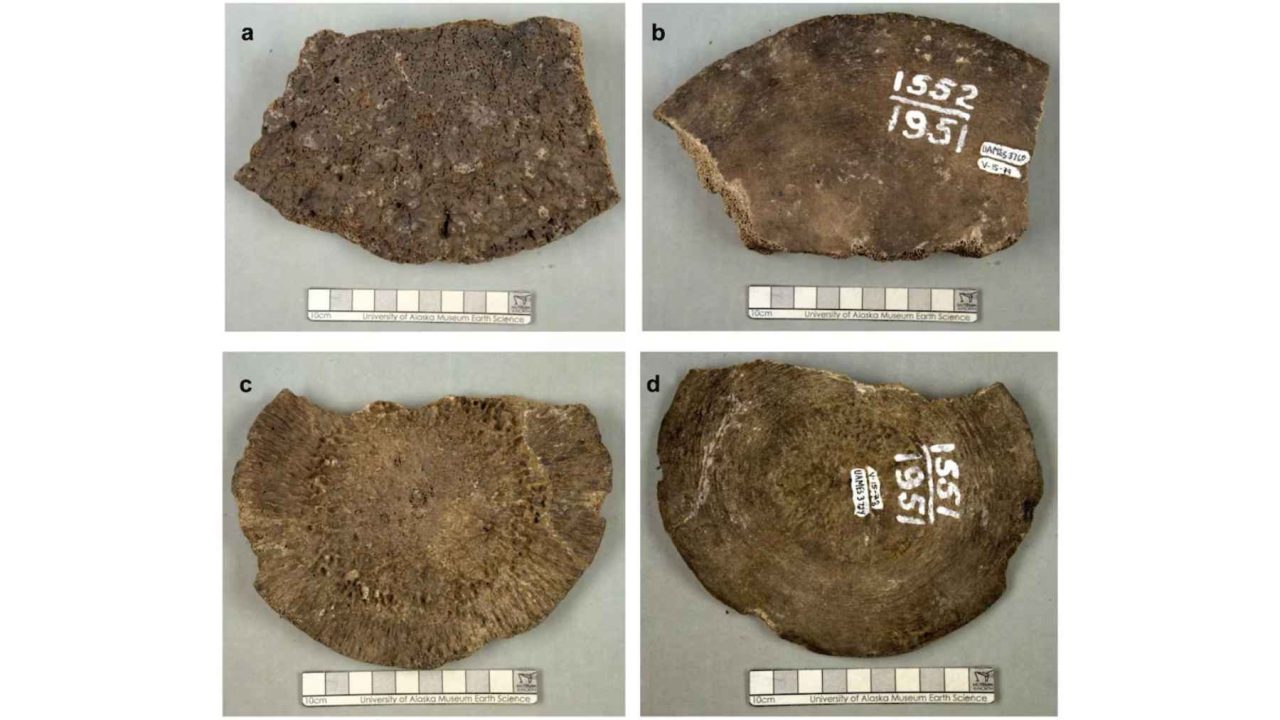
For more than 70 years, two large fossil bones sat inside the University of Alaska Museum of the North, quietly labeled as woolly mammoth remains. Nobody questioned them. Then scientists took a closer look — and everything changed.
What researchers eventually confirmed was one of the more surprising paleontological mix-ups in recent memory. The bones didn’t belong to mammoths at all. They belonged to two whales, found roughly 250 miles from the nearest coastline, reportedly collected near Fairbanks, Alaska, in the early 1950s. Marine animals, deep in the interior of the continent, misidentified for decades.
It’s the kind of discovery that answers one question while immediately raising another, far stranger one.
How a Mammoth Record Turned Into a Whale Mystery
The story starts with a program called Adopt a Mammoth, launched in 2022 with a straightforward scientific goal: systematically radiocarbon date woolly mammoth fossils held in Alaskan museum collections. Researchers wanted to build a clearer picture of when mammoths actually went extinct on the mainland — and whether any populations might have survived longer than current evidence suggests.
That last part matters more than it might seem. Environmental DNA recovered from permafrost has hinted at the possibility that small, isolated “cryptic” mammoth populations may have persisted into the Holocene — the warm geological period that followed the last Ice Age. To test that idea properly, scientists need physical fossil evidence to match against those genetic signals. So they started going through museum collections, one specimen at a time.
When the two bones from the University of Alaska Museum of the North were radiocarbon dated, the results were striking. The ages came back so young that the specimens briefly appeared to be record-breaking late-surviving mammoths — exactly the kind of find the project was designed to uncover.
But follow-up testing told a completely different story.
What the Science Actually Revealed
Stable isotope analysis and ancient DNA testing were the tools that cracked the case. Together, they showed that neither bone came from a mammoth. One belonged to a common minke whale. The other came from a North Pacific right whale. Both are marine species — animals that have no business being found hundreds of miles from any ocean.
The bones had been catalogued as mammoth remains reportedly collected near Fairbanks, Alaska, in the early 1950s. How they ended up labeled as mammoth fossils, and why no one caught the error for over seven decades, remains unclear. Museum collections from that era weren’t always documented with the rigor applied today, and large bones from unfamiliar species could plausibly be misidentified without genetic tools.
What’s harder to explain is how whale remains ended up near Fairbanks in the first place.
| Detail | Confirmed Information |
|---|---|
| Museum holding the bones | University of Alaska Museum of the North |
| Original classification | Woolly mammoth |
| Years misidentified | More than 70 years |
| Actual species (bone 1) | Common minke whale |
| Actual species (bone 2) | North Pacific right whale |
| Reported collection location | Near Fairbanks, Alaska (early 1950s) |
| Distance from nearest coastline | Approximately 250 miles (400 kilometers) |
| Discovery program | Adopt a Mammoth (launched 2022) |
| Key testing methods | Radiocarbon dating, stable isotope analysis, ancient DNA |
The Question Nobody Can Answer Yet
Solving the mammoth misidentification is the easy part. The genuinely puzzling question now is how whale bones ended up so far from the ocean.
Alaska’s interior is landlocked terrain. Fairbanks sits deep within the state, far removed from the Pacific coast, the Bering Sea, or any marine environment. Whale bones don’t drift inland on their own. Someone, at some point, brought them there — or they arrived through a chain of events that hasn’t been reconstructed yet.
Possible explanations exist, even if none have been confirmed. Whale bones and other marine materials were sometimes traded or transported by Indigenous communities across Alaska for tools, trade goods, or ceremonial purposes. Commercial and scientific collectors in the early twentieth century also moved specimens across long distances. It’s possible the bones passed through multiple hands before ending up near Fairbanks and eventually reaching the museum — misidentified somewhere along the way.
But that’s speculation. The source of the bones, and the full story of how they traveled so far inland, has not yet been established.
Why the Adopt a Mammoth Project Still Matters
Despite the unexpected result, the broader scientific mission behind Adopt a Mammoth hasn’t been derailed. If anything, this case demonstrates exactly why systematic verification of museum collections is worth doing.
Woolly mammoths are one of the most studied extinct megafauna on Earth, yet fundamental questions about their extinction remain open. The leading hypothesis holds that a combination of climate change at the end of the Ice Age and pressure from human hunters drove mainland populations to collapse. But environmental DNA from permafrost continues to produce signals that complicate that picture, suggesting genetic material from mammoth-like animals may have persisted in some regions into the Holocene.
Matching those genetic signals to verified physical fossils is the only way to test whether they represent genuine late-surviving mammoths or something else entirely. That requires going through collections carefully, dating specimens that have never been dated, and — as this case proves — being willing to accept surprising results when the evidence demands it.
The two whale bones have now been correctly identified and reclassified. The mammoth record they briefly seemed to threaten remains intact. And somewhere in a museum drawer, the next specimen is waiting to be dated.
Frequently Asked Questions
What were the bones originally believed to be?
The two fossil bones were catalogued as woolly mammoth remains and had been held at the University of Alaska Museum of the North for more than 70 years under that classification.
What did testing reveal the bones actually were?
Stable isotope analysis and ancient DNA testing confirmed that one bone belonged to a common minke whale and the other to a North Pacific right whale.
How far from the ocean were the bones found?
The bones were reportedly collected near Fairbanks, Alaska, in the early 1950s — approximately 250 miles, or about 400 kilometers, from the nearest coastline.
What is the Adopt a Mammoth program?
Adopt a Mammoth is a project launched in 2022 to systematically radiocarbon date woolly mammoth fossils from mainland Alaska, helping researchers investigate whether mammoth populations survived later than currently believed.
How did whale bones end up so far inland?
This has not yet been confirmed. Researchers have identified the species and corrected the classification, but the reason the marine bones were found hundreds of miles from any coastline remains an open question.
Does this discovery affect what scientists know about mammoth extinction?
The mammoth record these bones briefly appeared to challenge remains intact. The find does, however, highlight why systematic verification of museum fossil collections is scientifically valuable.


Leave a Reply