
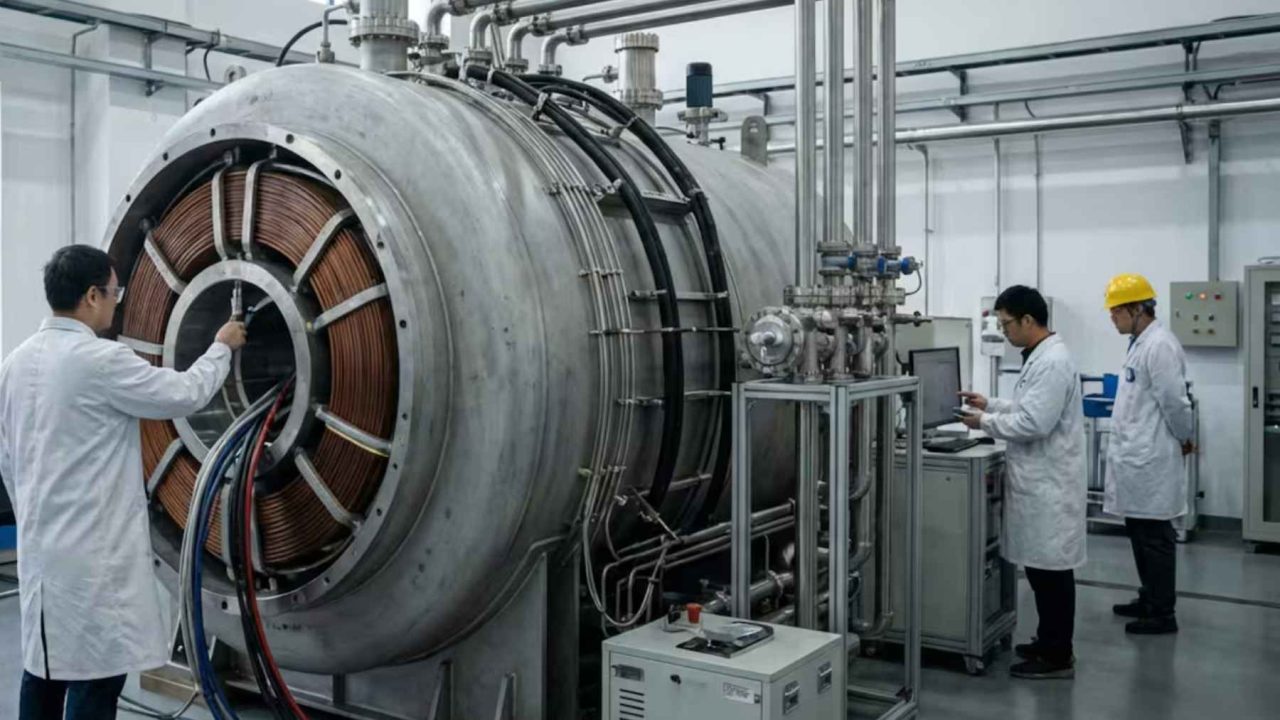
A magnet 700,000 times stronger than Earth’s own magnetic field is now operating inside a research facility in Beijing — and it just set a world record that the scientific community has been chasing for years.
On January 28, 2026, scientists in Beijing announced they had achieved 35.6 tesla at the center of a fully superconducting research magnet built for shared scientific use. To put that in perspective, Earth’s magnetic field near the surface measures roughly half a gauss. This machine produces 356,000 gauss. That is not a small step forward — it is a different category of instrument entirely.
The announcement immediately raised a question worth sitting with: what kind of research actually requires a magnetic field that extreme? The answer touches on materials science, medical technology, quantum physics, and the basic structure of matter itself.
What Makes 35.6 Tesla So Significant
Most people have encountered magnetic fields in two familiar forms: the fridge magnet and the hospital MRI scanner. A fridge magnet produces around 100 gauss. A typical MRI machine operates somewhere between 1.5 and 3 tesla — powerful enough to image soft tissue inside the human body with remarkable clarity.
The Beijing magnet operates at 35.6 tesla. That is roughly 12 to 24 times stronger than a standard hospital MRI scanner, depending on which model you compare it against. It also has a usable opening of 35 millimeters — about 1.4 inches wide — which is the space where research samples are placed and studied.
That opening size matters. A wider bore allows more experimental setups to fit inside, making the instrument more versatile for the research community. At 35 millimeters, this magnet is designed to be genuinely useful, not just a record-setting demonstration piece.
The other critical detail is what “fully superconducting” means in practice. Superconductivity is the property of certain materials to carry electrical current with zero energy loss, but only after they are cooled below a specific critical temperature. In a conventional high-powered magnet, enormous amounts of electricity are constantly being converted into heat — a costly and logistically demanding problem during long experiments. A superconducting magnet sidesteps much of that waste, making extended research sessions far more practical and affordable.
How This Magnet Compares to Everything Else
| Magnetic Source | Approximate Field Strength |
|---|---|
| Earth’s surface magnetic field | ~0.5 gauss (0.00005 tesla) |
| Refrigerator magnet | ~100 gauss (0.01 tesla) |
| Hospital MRI scanner (standard) | 1.5–3 tesla |
| Beijing superconducting research magnet | 35.6 tesla (356,000 gauss) |
One tesla equals 10,000 gauss — a conversion worth keeping in mind when these numbers start to feel abstract. The Beijing instrument sits in a range that simply does not exist outside the most specialized laboratory environments on the planet.
Why Researchers Need Fields This Powerful
The honest answer is that extreme magnetic fields reveal things about matter that weaker fields cannot. At very high field strengths, the electronic and quantum properties of materials behave in ways that are otherwise impossible to observe or measure. Physicists studying new superconductors, for instance, need powerful external fields to probe how those materials respond at their limits.
The same logic applies to research in condensed matter physics, where scientists are trying to understand how electrons organize themselves inside exotic materials. The stronger the magnetic field available, the more clearly those behaviors can be separated, measured, and understood.
There are also implications for future medical technology. MRI machines work because hydrogen atoms in the body respond to magnetic fields in predictable ways. Higher-field research instruments help scientists understand those responses at a deeper level — work that has historically fed back into improvements in clinical imaging over time.
The fact that this magnet was built for shared use is also worth noting. Rather than serving a single research group, it is designed as a shared facility, meaning multiple teams across different disciplines can apply to use it. That model tends to accelerate discovery, because the same instrument can address questions in chemistry, physics, biology, and materials science without each field needing to build its own machine.
What Superconductivity Changes About the Equation
Building a 35.6-tesla magnet is one thing. Building one that is fully superconducting is a meaningfully harder engineering problem — and it is why the Beijing team’s record is specifically notable within the superconducting category.
Resistive magnets — the kind that are not superconducting — can reach very high fields, but they consume enormous amounts of electricity and generate tremendous heat in the process. Running one for hours or days is expensive and operationally demanding. A superconducting system, once cooled to its operating temperature, loses far less energy to heat, which means researchers can run longer experiments without the same overhead costs.
For research that requires sustained high-field environments — studying how a material behaves over time, for example, or conducting experiments that require slow, careful measurement — that difference is not just convenient. It is what makes the experiment possible at all.
What Comes Next for High-Field Magnet Research
Records in scientific instrumentation tend to fall in clusters. Once a new benchmark is established and the engineering techniques behind it are understood and published, other teams around the world typically build on that knowledge. The 35.6-tesla announcement from Beijing will almost certainly prompt responses from research programs in the United States, Europe, and elsewhere.
The broader trajectory of high-field magnet research has consistently pointed toward stronger fields, more efficient operation, and wider accessibility through shared facilities. Whether this particular record holds for months or years, the underlying science it enables — in quantum materials, condensed matter physics, and advanced imaging — will continue regardless.
For now, Beijing holds the benchmark for a fully superconducting research magnet designed for shared scientific use, and the experiments made possible by that instrument are only beginning.
Frequently Asked Questions
How strong is the new Beijing magnet compared to Earth’s magnetic field?
The magnet reached 35.6 tesla, which researchers say is more than 700,000 times stronger than Earth’s magnetic field near the surface.
How does it compare to a hospital MRI scanner?
The Beijing magnet is approximately 12 to 24 times stronger than a standard hospital MRI scanner, depending on the MRI model used for comparison.
What does “fully superconducting” mean?
It means the magnet uses materials that carry electrical current with no energy loss after being cooled below a critical temperature, making long experiments more practical by reducing the energy wasted as heat.
What is the usable opening size of the magnet?
The magnet has a usable bore — the space where research samples are placed — of 35 millimeters wide, or about 1.4 inches.
When was the record announced?
Scientists in Beijing announced the record on January 28, 2026.
Who can use this magnet?
The magnet was built as a shared-use research instrument, meaning multiple scientific teams across different disciplines can apply to conduct experiments with it, rather than it serving a single research group.



Leave a Reply