
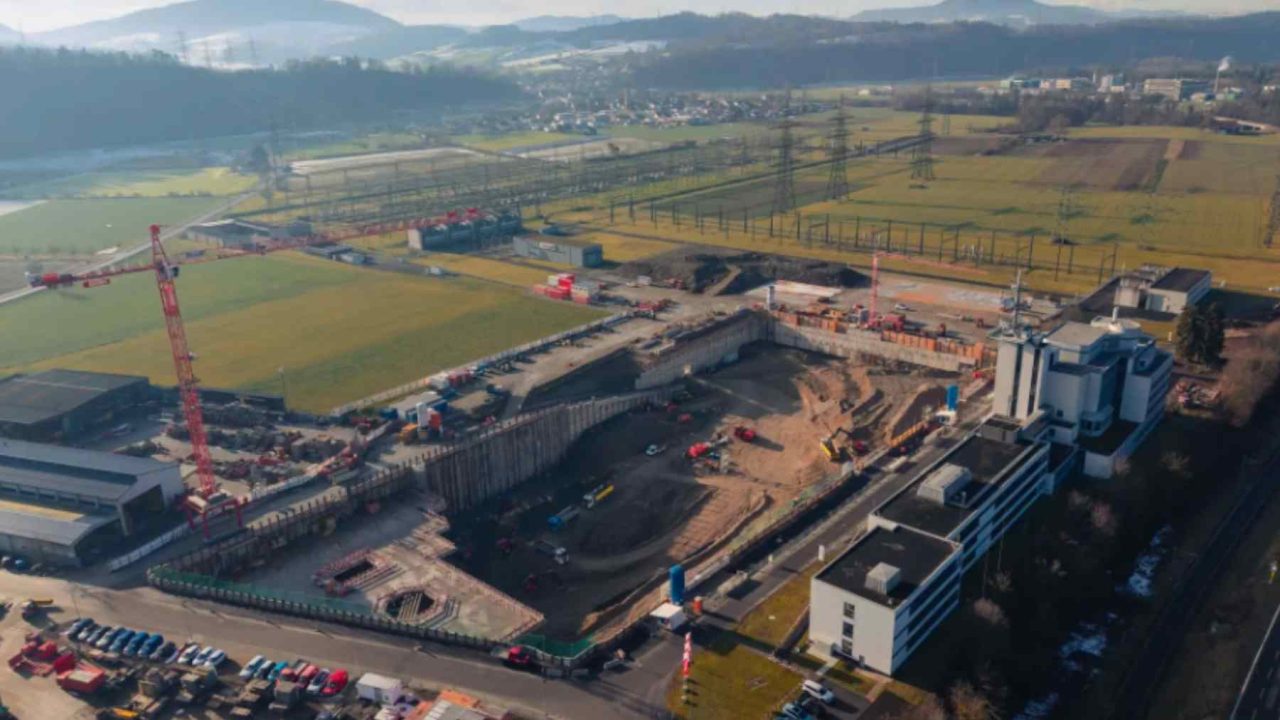
Beneath a quiet Swiss town on the Rhine, workers are digging a hole nearly 90 feet deep — and what goes inside it could reshape how electricity flows across an entire continent.
FlexBase Group is building what it describes as the world’s largest and most advanced redox-flow battery storage system in Laufenburg, Switzerland. The planned capacity sits at more than 2.1 gigawatt-hours, with output exceeding 1.2 gigawatts. Those numbers are large enough that energy observers are already asking whether this small border town is about to become one of the most strategically important energy sites in Europe.
The project is still very much in its early stages — the ground is being broken, not the ribbon — but the ambitions behind it are hard to overstate.
What Is Actually Being Built in Laufenburg
The construction site itself gives a sense of the scale involved. According to reporting from Swissinfo, FlexBase is excavating a pit roughly 89 feet deep and longer than two soccer fields to house the underground battery installation.
This isn’t just a battery in a warehouse. The future technology center is planned to cover more than 215,000 square feet and will include the battery system itself alongside an AI data center, offices, and laboratories. It’s designed as a full energy and technology campus, built underground to take advantage of the stable conditions and available space along the Rhine.
The battery technology at the center of the project is a redox-flow system — a type of large-scale energy storage that works by pumping liquid electrolytes through electrochemical cells to store and release electricity. Unlike lithium-ion batteries, redox-flow systems are generally considered better suited for long-duration storage at grid scale, which is exactly what Europe’s energy transition increasingly demands.
Why the Timing and Location Matter
Laufenburg sits on the Swiss-German border, and that geography is not incidental. The town already has deep roots in European energy infrastructure, and adding a 2.1-GWh battery to that location places it at a natural intersection point for electricity flows between countries.
The core problem the project is trying to solve is one that every electricity user in Europe quietly lives with. Renewable energy — solar panels, wind turbines — generates power based on weather, not demand. When the sun is blazing and the wind is strong, grids can be overwhelmed. When clouds roll in or the air goes still, supply drops fast. The result is price volatility, strain on infrastructure, and in the worst cases, blackouts.
A battery capable of storing more than 2 gigawatt-hours and releasing more than 1.2 gigawatts of power acts as a massive buffer. It absorbs surplus electricity when the grid doesn’t need it and pushes it back out when demand spikes. Advocates argue that facilities like this are not a luxury for the clean energy transition — they’re a prerequisite for it.
The Numbers Behind the Project
| Feature | Specification |
|---|---|
| Planned storage capacity | More than 2.1 gigawatt-hours (GWh) |
| Planned output | More than 1.2 gigawatts (GW) |
| Excavation depth | Approximately 89 feet (27 meters) |
| Excavation footprint | Longer than two soccer fields |
| Total facility size | More than 215,000 square feet |
| Additional features | AI data center, offices, laboratories |
| Battery technology | Redox-flow system |
| Developer | FlexBase Group |
What This Could Mean for Europe’s Power Grid
The phrase “secret heart of Europe’s power grid” may sound dramatic, but the underlying logic is straightforward. Europe’s electricity network is deeply interconnected, and Switzerland sits at its geographic center. A facility in Laufenburg that can absorb and release gigawatt-scale power has the potential to act as a stabilizing force for grids well beyond Switzerland’s borders.
Grid operators across Europe have been under growing pressure to manage the variability that comes with expanding renewable capacity. Wind and solar now make up a significant and rising share of electricity generation in Germany, France, Italy, and across Scandinavia. But storage infrastructure has not kept pace. Large-scale projects like the one in Laufenburg represent exactly the kind of investment that grid planners say is needed to make the system work reliably as fossil fuels are phased out.
The AI data center component is also notable. Pairing large-scale energy storage with computing infrastructure suggests FlexBase is building something more integrated than a simple battery farm — a facility that can actively manage and optimize how energy flows in real time.
What Happens Before Any of This Goes Live
There is still a significant distance between a deep excavation pit and a fully operational 2.1-GWh battery facility.
Projects of this scale and technical complexity typically take several years from groundbreaking to full operation. The underground construction alone — 89 feet down, across a footprint larger than two football pitches — represents a serious engineering challenge before a single battery cell is installed.
What is clear is that FlexBase Group has committed to the physical work. The excavation is happening. The hole is being dug. And in a European energy landscape that is increasingly desperate for large-scale storage solutions, that alone has drawn serious attention to a town most people outside Switzerland have never heard of.
Frequently Asked Questions
What kind of battery is being built in Laufenburg?
FlexBase Group is building a redox-flow battery system, a technology considered well-suited for large-scale, long-duration grid energy storage.
How large is the planned storage capacity?
The system is planned to store more than 2.1 gigawatt-hours of electricity and deliver output exceeding 1.2 gigawatts.
Why is the battery being built underground?
The facility is being housed in an excavated pit approximately 89 feet deep, though
Will the facility include anything beyond the battery itself?
Yes — the planned technology center will also include an AI data center, offices, and laboratories, covering more than 215,000 square feet in total.
When will the facility be operational?
A confirmed operational timeline has not been reported in the available source material.
Who is developing the project?
The project is being developed by FlexBase Group, which describes it as the world’s largest and most advanced redox-flow battery storage system.




Leave a Reply