
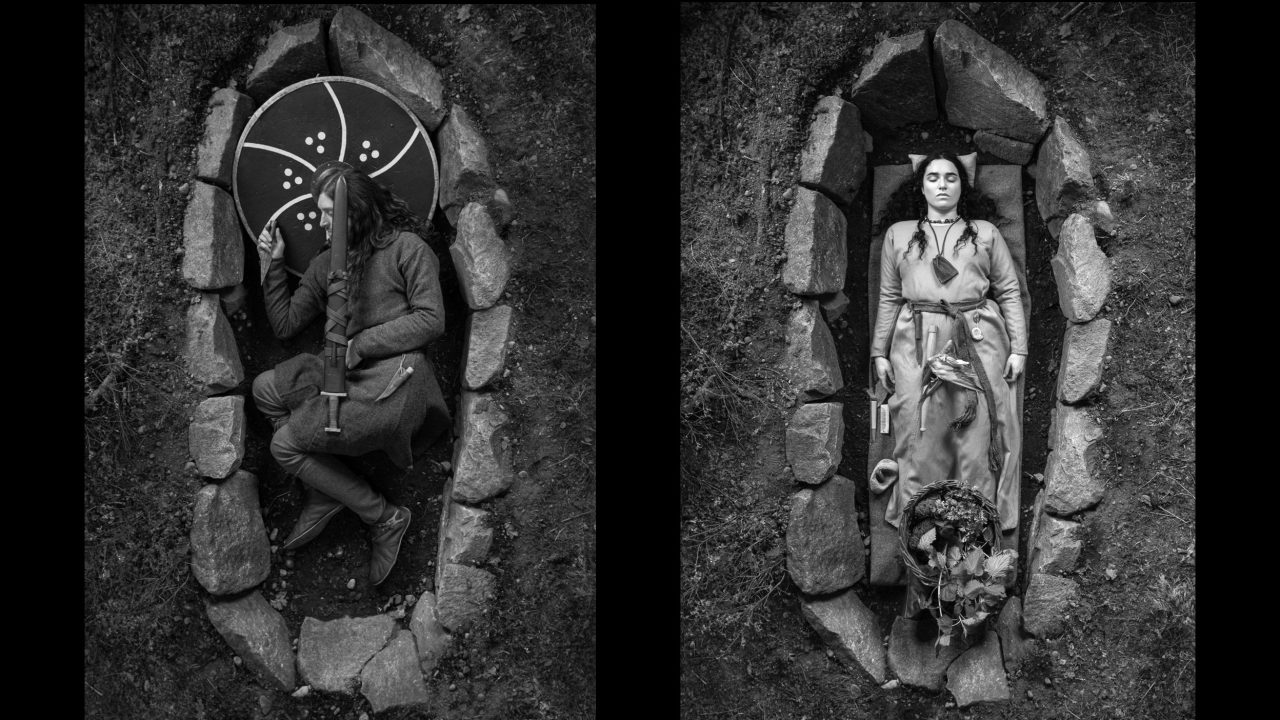
What does it mean to bury the dead — and what can a thousand-year-old grave tell us about the living? A new book is asking those questions in a way that is unlike almost anything else published on the Viking Age, blending experimental archaeology, fine art photography, and genuine scholarly grounding into something that feels both ancient and urgently present.
Earth Wounds: Creative Explorations of Viking Age Funerary Customs is a new publication by experimental archaeologists Kevin Alexandrowicz and Devon Rawlings, shot on both 35mm film and digital photography, and published by Hyldyr — a small, artisanal press based in Washington State with a focus on bringing medieval and ancient subjects to wider audiences.
https://www.instagram.com/p/DW5Ao5-FOaL/
Reviewer Terri Barnes, writing for Medievalists.net, describes it as a book that will make you “see the archaeology of death in the Viking Age like never before.” That is a significant claim. But given what the book actually does — staging carefully researched recreations of real Viking Age graves as visual art — it may well be true.
What Earth Wounds Actually Does
The concept behind the book is deceptively simple. Alexandrowicz and Rawlings took actual, documented Viking Age graves as their starting point and created staged, recreated burials based on those real archaeological records. Then they photographed them — carefully, thoughtfully, with an artist’s eye and a researcher’s discipline.
The result sits somewhere between documentary record and fine art. It is not a dry academic catalogue, but it is also not romanticized fantasy. The recreations are grounded in what archaeologists call material culture — the physical objects, arrangements, and evidence that survive in the ground — and every staging decision is tied to real scholarship.
What began as an art project with the goal of illuminating a frequently misunderstood subject gradually expanded into something larger: a meditation on memory, loss, and mortality that uses the Viking past as its lens.
The Scholars Behind the Book
Alexandrowicz and Rawlings are the creative core of the project, but they are joined by two archaeologists who contributed introductions and lend the work significant academic credibility.
| Contributor | Role | Field |
|---|---|---|
| Kevin Alexandrowicz | Co-author, photographer | Experimental archaeology |
| Devon Rawlings | Co-author, photographer | Experimental archaeology |
| Leszek Gardeła | Introduction contributor | Archaeology |
| Giorgia Sottotetti | Introduction contributor | Archaeology |
| Terri Barnes | Reviewer | History / medievalism |
The involvement of Gardeła and Sottotetti is worth noting. Both are working archaeologists, and their contributions signal that this is not simply a coffee-table art book dressed up in academic language. The scholarship is real, and it shows in the work.
Why Viking Age Funerary Customs Are So Widely Misunderstood
Popular culture has given most of us a very specific — and often very wrong — picture of how Vikings handled death. Longship burials set ablaze on open water. Horned helmets. Dramatic, fire-lit sendoffs for warrior kings.
The archaeological reality is considerably more varied, more nuanced, and in many ways more fascinating. Viking Age burial practices differed by region, time period, social status, and likely by individual belief. Some of the dead were cremated. Others were interred with elaborate grave goods. Some burials were modest. The material record tells a complicated story that popular imagination tends to flatten.
This is precisely the gap that Earth Wounds tries to close — not by lecturing, but by making the real evidence visually compelling and emotionally accessible to modern readers.
A Book You Can Hold in Your Hand
One of the more unexpected details about Earth Wounds is its physical form. Despite running to 200 pages, Barnes notes that the book is tiny — small enough to fit in your hand like a prayer book, as she describes it. That is a deliberate choice, and an interesting one.
There is something appropriate about a book on burial and mortality being intimate in scale. Death is, after all, a personal subject. The prayer book comparison is not just a size reference — it suggests a certain kind of relationship between reader and object, quiet and close rather than grand and distanced.
The dual use of 35mm film and digital photography throughout the book also reflects the project’s dual nature: one foot in the analog, tactile past and one in the contemporary present. Film photography, in particular, carries its own associations with memory and impermanence — a fitting choice for a subject rooted in how we remember the dead.
Art as a Way Into the Archaeological Record
Using art to document and interpret material culture is not a new idea — Barnes acknowledges this directly. Museums have long commissioned illustrations and reconstructions to help visitors visualize the past. But Earth Wounds takes a different approach.
Rather than producing neutral reconstructions designed to educate, Alexandrowicz and Rawlings have created images designed to provoke feeling. The staged burials are not just informational. They ask the viewer to sit with questions about mortality, about what we leave behind, about how the living make meaning from the bodies of the dead.
That emotional register is what separates this book from a standard archaeological publication — and what makes it potentially valuable to readers who would never pick up a journal article on Viking funerary rites.
The publisher, Hyldyr, has carved out a specific niche doing exactly this kind of work: taking medieval and ancient subjects and presenting them in ways that feel alive and relevant rather than dusty and remote. Earth Wounds appears to be a strong example of that mission in practice.
Frequently Asked Questions
Who wrote Earth Wounds: Creative Explorations of Viking Age Funerary Customs?
The book was written and photographed by experimental archaeologists Kevin Alexandrowicz and Devon Rawlings, with introductions contributed by archaeologists Leszek Gardeła and Giorgia Sottotetti.
Who published the book and where?
It was published by Hyldyr, a small artisanal press based in Washington State that focuses on popularizing medieval and ancient materials.
How long is the book and what does it look like?
The book is 200 pages but physically small — described by reviewer Terri Barnes as fitting in your hand like a prayer book. It uses both 35mm film and digital photography.
Is the book based on real archaeological evidence?
Yes. The staged burial recreations in the book are based on actual Viking Age graves, and the project is grounded in archaeological scholarship rather than popular myth.
What photography formats were used in the book?
Both 35mm film photography and digital photography were used throughout the book.
Is this book suitable for general readers or only specialists?
Based on the review, the book is aimed at general audiences — it began as an art project intended to make Viking Age funerary customs accessible and emotionally engaging to modern readers, not just academic specialists.

Leave a Reply