
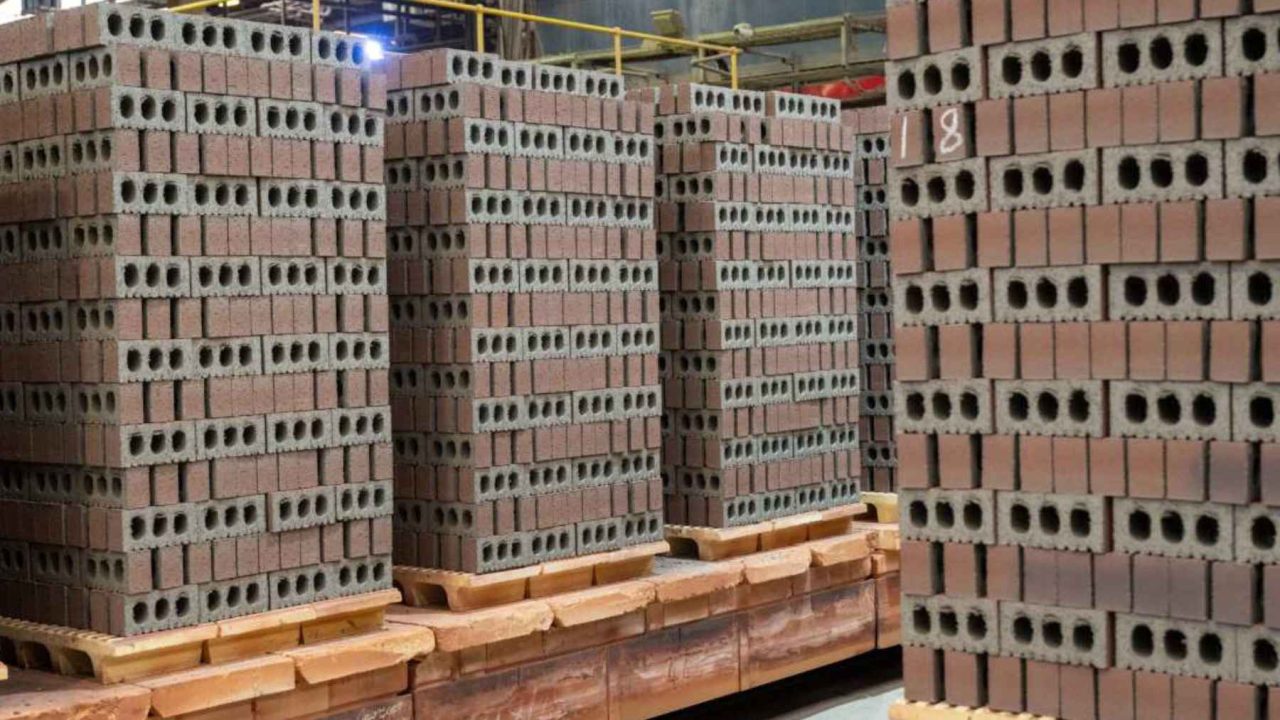
Two tunnel kilns. Two hundred and twenty-four natural-gas burners. One factory in Denton, Greater Manchester — and a plan to replace every single one of those burners with green hydrogen. What Wienerberger UK & Ireland is building in the north of England could become the world’s first commercial-scale hydrogen-fired brick plant, and the construction industry is watching closely.
Bricks are one of those materials most people never think about until they’re laying the foundations of something new. But making them is an energy-intensive process that has relied on fossil fuels for generations. Changing that, at commercial scale, without demolishing and rebuilding the factory from the ground up — that’s the part of this story that deserves attention.
The project has secured government-backed funding, and the company says the retrofit approach — not a new build — is a key part of what makes this viable. For an industry where shutting down production even briefly carries real financial costs, that distinction matters more than it might first appear.
Why Bricks Are One of the Hardest Industrial Problems to Solve
The construction materials sector sits in a corner of the climate challenge that doesn’t get enough airtime. Unlike electricity generation, where renewables can swap directly into the grid, industries that require intense, sustained heat — ceramics, steel, cement, glass, bricks — have very few clean alternatives to burning fossil fuels.
Bricks are fired at extremely high temperatures. That heat has traditionally come from natural gas, and there’s no simple way to electrify a kiln at the scale and temperature required without significant technical and financial barriers. Green hydrogen — produced using renewable electricity to split water — is one of the most promising routes forward for these so-called “hard-to-abate” sectors.
That’s what makes the Denton project significant. It’s not a pilot plant or a laboratory experiment. It’s a commercial facility, using existing industrial infrastructure, being converted to run entirely on hydrogen. Supporters of the project argue this is exactly the kind of real-world deployment the clean energy transition needs more of.
What the Denton Project Actually Involves
The scale of the conversion is worth spelling out clearly. This isn’t a token switch of one burner or a partial blend of hydrogen and gas. The plan involves a full transition across the facility’s two tunnel kilns.
| Component | Detail |
|---|---|
| Location | Denton, Greater Manchester, UK |
| Company | Wienerberger UK & Ireland |
| Kilns being converted | Two tunnel kilns |
| Burners being replaced | 224 natural-gas burners replaced with hydrogen systems |
| Fuel switch | Natural gas to 100% green hydrogen |
| Additional upgrades | New hydrogen supply equipment, electrical upgrades, control systems |
| Kiln structures | Existing structures retained — no demolition |
| Funding | Government-backed |
The key engineering decision here is the retrofit approach. Rather than tearing down the existing kilns and constructing new hydrogen-ready infrastructure from scratch, the project works around what’s already there. New hydrogen supply systems, updated electrical infrastructure, and modern control systems are being integrated into the existing kiln structures.
- All 224 natural-gas burners are being replaced with hydrogen-compatible systems
- The physical kiln structures themselves are being preserved
- New hydrogen supply equipment is being added to the site
- Electrical systems and process controls are being upgraded alongside the fuel switch
- The facility is intended to operate at commercial scale — not as a demonstration project
The Part of This Story Most Reports Are Missing
There’s a practical argument buried in the retrofit decision that goes beyond cost savings. Every time an industrial facility goes offline for a major rebuild, it creates disruption — lost production, supply chain gaps, and workforce uncertainty. The ability to convert an existing facility rather than replace it entirely changes the economics of decarbonisation for manufacturers who can’t afford extended shutdowns.
If the Denton approach works at commercial scale, it creates a potential template. There are brick factories, ceramic plants, and other high-heat industrial facilities across the UK and beyond that face the same decarbonisation challenge. A proven retrofit model could accelerate the transition in ways that new-build-only approaches simply can’t match on timeline or budget.
Advocates for industrial hydrogen argue that this is precisely why commercial-scale projects matter more than laboratory proofs of concept. The technology itself is understood. What the sector needs is evidence that it works in the real world, under real production pressures, at real commercial volumes.
What This Means for the UK’s Industrial Decarbonisation Push
The UK has set legally binding targets to reduce carbon emissions, and the industrial sector — manufacturing, construction materials, heavy industry — is one of the areas where progress has been slowest. Green hydrogen has been identified by policymakers as a critical tool for decarbonising industries that can’t easily electrify.
Government-backed funding for a project like Denton signals that this isn’t purely a private sector bet. Public investment in commercial-scale hydrogen infrastructure reflects a policy judgement that the technology needs real-world deployment to bring costs down and build supply chains — not just more research.
For workers and communities in industrial regions like Greater Manchester, that kind of investment carries weight beyond the environmental headlines. It points to a version of industrial transition where existing facilities are modernised rather than closed, and where the skills and supply chains built around traditional manufacturing have a place in a lower-carbon economy.
What Happens Next
The project is described as creating the world’s first commercial-scale hydrogen-fired brick plant.
A specific operational date has been referenced in connection with the project, though the precise timeline for full commercial hydrogen production has not been detailed in the available reporting. What is confirmed is that the scope of the conversion is set, the funding is in place, and the infrastructure upgrades — hydrogen supply equipment, electrical systems, and control systems — are part of the defined project plan.
Whether this becomes a model that other brick manufacturers or high-heat industrial operators follow will depend on how the Denton conversion performs once fully operational. The construction materials industry, and the broader industrial decarbonisation effort, will be paying close attention.
Frequently Asked Questions
Where is the hydrogen-powered brick factory being built?
The project is located in Denton, Greater Manchester, and is being developed by Wienerberger UK & Ireland.
What makes this factory different from other hydrogen projects?
It is described as the world’s first commercial-scale hydrogen-fired brick plant, and it involves retrofitting existing kilns rather than constructing a new facility from scratch.
How many burners are being converted to hydrogen?
The project will replace 224 natural-gas-powered burners with hydrogen systems across two tunnel kilns.
Is this fully funded?
Yes, the project has secured government-backed funding, according to the available reporting.
Will the existing kilns be demolished?
No — the existing kiln structures are being retained and retrofitted, which is a central part of the project’s approach.
When will the factory begin operating on hydrogen?
A date has been set in connection with the project, but the precise operational timeline has not been confirmed in the available source material.



Leave a Reply