
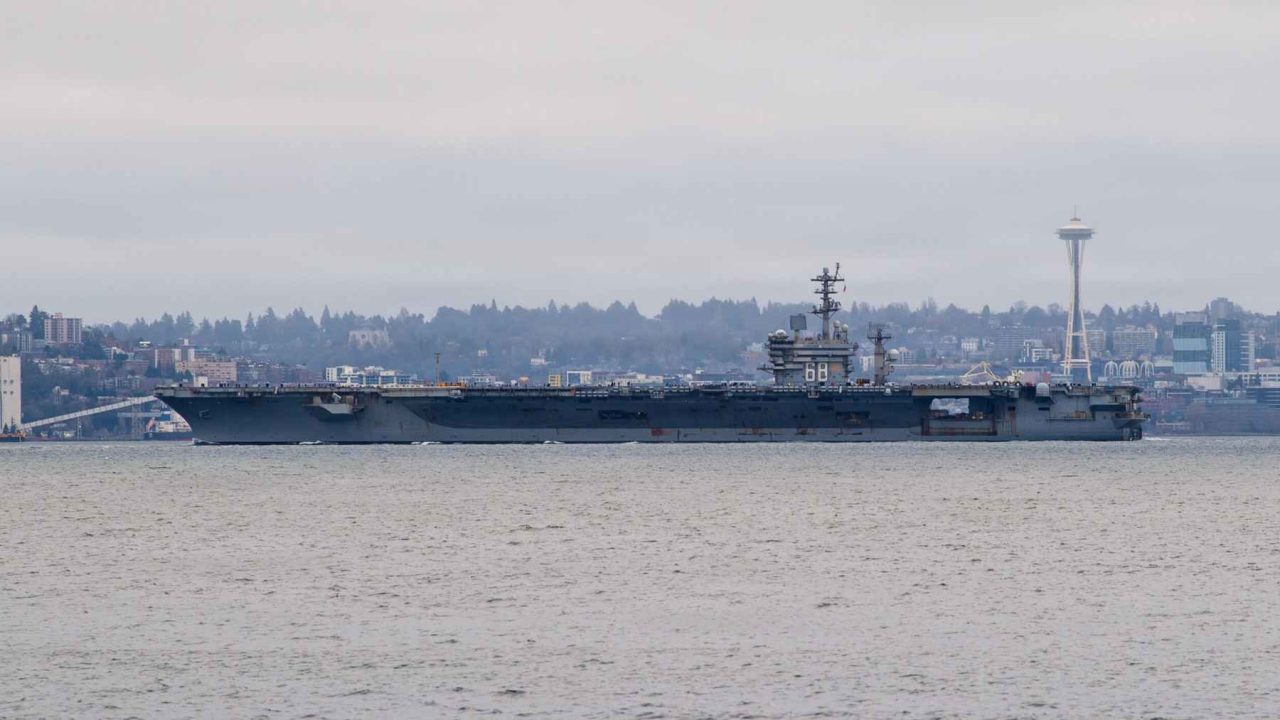
At 51 years old, the USS Nimitz should be winding down. Instead, the U.S. Navy has decided to keep one of its most storied nuclear-powered aircraft carriers in active service until March 2027 — a move that says as much about the state of American naval readiness as it does about the ship itself.
The decision is driven by a straightforward but consequential problem: federal law requires the Navy to maintain no fewer than 11 operational aircraft carriers at all times, and the next ship in line to replace Nimitz isn’t ready yet. So the old carrier stays at sea, buying the Navy the time it needs to keep that number intact.
But this isn’t just a story about military logistics. It touches on industrial planning, nuclear safety, and the long, expensive process of retiring one of the most complex vessels ever built by human hands.
Why the U.S. Navy Is Keeping the USS Nimitz Running
The USS Nimitz is the lead ship of its class — the first of the nuclear-powered Nimitz-class carriers that defined American naval dominance for generations. Commissioned in 1975, it has spent more than five decades as a symbol of U.S. sea power, projecting force across virtually every corner of the globe.
The reason it’s still active comes down to timing. The Navy’s legally mandated 11-carrier floor means there’s no room for gaps. If Nimitz retires before its replacement arrives, the fleet drops below that threshold — which isn’t just a technicality, it’s a statutory requirement written into federal law governing U.S. combat forces.
The ship stepping in to fill that slot is the future USS John F. Kennedy (CVN 79), the second carrier in the newer Gerald R. Ford class. According to the Navy, Kennedy completed its builder’s sea trials in February 2026. But reporting from USNI News indicates its delivery isn’t expected until March 2027 — the same month Nimitz is now slated to step down.
That overlap is intentional. The Navy is threading a needle: keeping Nimitz active just long enough to hand the baton to Kennedy without the fleet ever dipping below 11.
Key Facts About the USS Nimitz Decision
| Detail | Information |
|---|---|
| USS Nimitz age (as of 2026) | 51 years |
| USS Nimitz commissioned | 1975 |
| Planned inactivation date | March 2027 |
| Replacement carrier | USS John F. Kennedy (CVN 79) |
| Kennedy’s builder’s sea trials completed | February 2026 |
| Kennedy’s expected delivery | March 2027 |
| Legal minimum carrier fleet size | 11 operational aircraft carriers |
| Nimitz class type | Nuclear-powered aircraft carrier |
| Kennedy’s class | Gerald R. Ford class (second ship) |
| Planned nuclear defueling location | Newport News, Virginia |
- The USS Nimitz is the lead ship of the Nimitz class, meaning it was the first of its kind
- The Gerald R. Ford class represents the next generation of U.S. carrier design, with the USS Gerald R. Ford (CVN 78) being the first ship of that class
- Federal law explicitly mandates that U.S. combat forces include not less than 11 operational aircraft carriers
- The Kennedy’s delivery timeline has been a key factor in determining how long Nimitz must remain in service
This Is More Than a Military Decision — It’s an Environmental and Industrial One
Retiring a nuclear-powered aircraft carrier is nothing like decommissioning a conventional ship. You can’t simply dock it, strip it for parts, and send the steel to a recycler. The nuclear reactors that have powered Nimitz for half a century require careful, highly regulated defueling and disposal — a process that takes years and demands specialized infrastructure.
That work is planned to take place at Newport News, Virginia, home to the shipyards with the expertise and facilities to handle it. The same extended timeline that keeps Nimitz at sea is also giving planners time to prepare for that complex inactivation process.
Officials have noted that the environmental and safety protocols around nuclear defueling are rigorous by design. A carrier of this scale carries nuclear material that must be handled with precision — there’s no shortcut, and no rushing the process once it begins.
The industrial side matters too. Newport News is one of the few places in the country with the workforce and equipment capable of managing a nuclear carrier’s end-of-life. Coordinating that work alongside the ongoing construction and delivery of new Ford-class carriers is a significant logistical challenge for the shipbuilding industry.
What This Means for American Naval Power Right Now
For most Americans, the day-to-day operations of an aging aircraft carrier feel distant. But the 11-carrier mandate exists for a reason — it reflects a congressional judgment about the minimum level of naval force projection the United States needs to fulfill its global commitments.
Carriers don’t just fight wars. They serve as floating deterrents, disaster response platforms, and symbols of national reach. When one goes offline without a replacement ready, that capacity shrinks — even temporarily. The decision to keep Nimitz running is, at its core, a decision to maintain that presence without interruption.
The arrival of the USS John F. Kennedy also matters beyond just filling a number. The Ford class incorporates newer technology than the Nimitz class, and Kennedy’s entry into the fleet represents a generational upgrade in capability — not just a one-for-one swap of aging steel.
What Happens After March 2027
Once Kennedy is delivered and operational, Nimitz is expected to begin the inactivation process. That means the focus shifts to Newport News, where the nuclear defueling operation will be planned and executed.
This isn’t a quick process. Nuclear-powered warships require years of careful work to safely remove and dispose of their reactor fuel. The Navy and the shipbuilding industry will need to coordinate closely, particularly given that Newport News is simultaneously involved in building and supporting other carriers in the fleet.
The March 2027 handoff — Nimitz stepping down as Kennedy steps up — is designed to keep the carrier count at exactly 11, satisfying the legal requirement while beginning the long farewell to one of the most iconic warships in American history.
Frequently Asked Questions
Why is the USS Nimitz still in service at 51 years old?
Federal law requires the U.S. Navy to maintain at least 11 operational aircraft carriers, and the ship set to replace Nimitz — the USS John F. Kennedy — isn’t expected to be delivered until March 2027.
When is the USS Nimitz expected to be retired?
The USS Nimitz is planned to be inactivated in March 2027, timed to coincide with the delivery of the USS John F. Kennedy (CVN 79).
What ship is replacing the USS Nimitz?
The USS John F. Kennedy (CVN 79), the second carrier of the Gerald R. Ford class, is the ship that will replace Nimitz in the fleet.
Where will the USS Nimitz be decommissioned?
The nuclear defueling and inactivation process is planned to take place at Newport News, Virginia, which has the specialized facilities required for that work.
What is the Gerald R. Ford class?
It is the newest class of U.S. nuclear-powered aircraft carriers, representing a generational upgrade over the older Nimitz class in terms of design and technology.
Is retiring a nuclear aircraft carrier different from retiring a regular ship?
Yes, significantly. Nuclear-powered carriers require careful, heavily regulated defueling and disposal of their reactor material — a complex, multi-year process that cannot be rushed.



Leave a Reply