
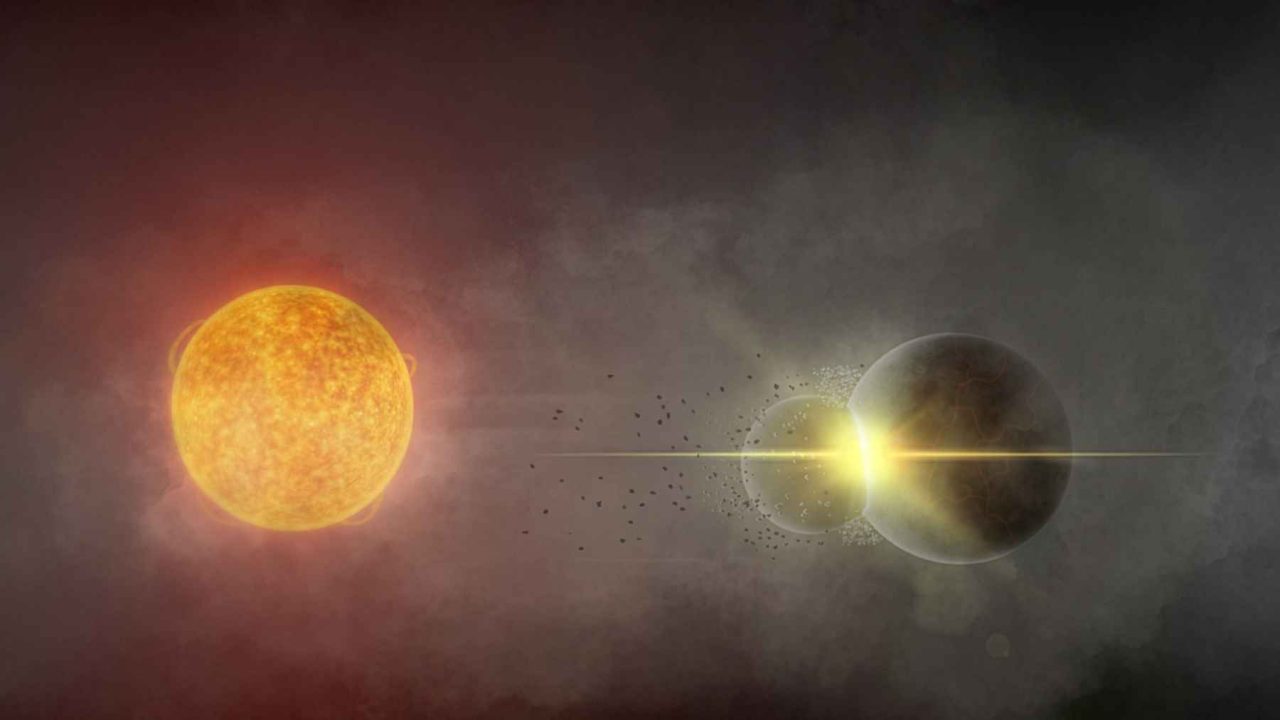
Eleven thousand light-years away, two young worlds slammed into each other — and for the first time in history, astronomers watched it happen in real time. That’s not a simulation, not a reconstruction from ancient rock samples, and not a theoretical model. It’s an observation, unfolding live, of the kind of catastrophic planetary collision that scientists believe gave Earth its Moon.
The discovery centers on a star called Gaia20ehk — also catalogued as Gaia-GIC-1 — a young, hot star classified as F-type, meaning it burns hotter than our own Sun. For years it sat quietly in sky survey data, unremarkable and dim on the charts. Then, in 2016, everything changed.
What followed has captivated the astronomy community and raised one of the most profound questions in the search for life beyond Earth: just how rare are the collisions that build planets like ours?
A Star That Started Blinking When It Shouldn’t Have
Gaia20ehk had a light curve — the graph astronomers use to track a star’s brightness over time — that was almost perfectly flat for years. Flat is normal. Flat means nothing unusual is happening. Then, starting in 2016, the star’s light began dropping in a pattern nobody expected.
Three distinct dips appeared in the data. Each one lasted roughly seven months. Each one cut the star’s visible light by approximately one-third. That’s not a minor flicker — that’s a dramatic, repeated dimming of a star that had shown no signs of anything unusual before.
Astronomers call stars that behave this way “dippers.” The name is straightforward: something passes in front of the star and blocks part of its light, creating a dip in the brightness graph. But what was doing the blocking here was far from ordinary.
The leading explanation, according to researchers, is that a massive cloud of dust — produced by a violent collision between two planetesimals, the rocky building blocks from which planets form — is drifting across the face of the star. Each time the dust cloud passes, the light dims. Each time it clears, the star brightens again.
Why This Planetary Collision Discovery Matters So Much
Planetesimal collisions aren’t just destructive events. They’re creative ones. The leading scientific theory for how Earth got its Moon involves exactly this kind of smashup: a Mars-sized body crashing into the early Earth, sending debris into orbit that eventually coalesced into the Moon. Without that collision, our world might look very different — and life as we know it might never have taken hold.
That connection is precisely why researchers find Gaia20ehk so compelling. As senior author James R. A. Davenport put it: “How rare is the event that created the Earth and moon? That question is fundamental to astrobiology.”
Lead researcher Anastasios (Andy) Tzanidakis, affiliated with the University of Washington, described the star’s behavior with striking candor, saying it “went completely bonkers.” That kind of language from a scientist signals just how unexpected and dramatic this signal was against the backdrop of routine sky survey data.
The study has been published as open-access research through IOPscience, meaning anyone can read the full findings without a subscription paywall.
Breaking Down What the Data Actually Shows
Here’s a clear look at the key observational facts confirmed by the research:
- The star Gaia20ehk is located approximately 11,000 light-years from Earth
- It is classified as an F-type star — hotter than the Sun
- The star is described as young, placing it in a stage of stellar development where planet formation is still actively occurring
- Unusual dimming began in 2016
- Three separate dipping events were recorded
- Each dip lasted roughly seven months
- Each dip reduced the star’s visible light by approximately one-third
- The suspected cause is dust from a collision between planetesimals — the rocky bodies that eventually become planets
| Feature | Detail |
|---|---|
| Star designation | Gaia20ehk / Gaia-GIC-1 |
| Star type | F-type (hotter than the Sun) |
| Distance from Earth | ~11,000 light-years |
| Dimming began | 2016 |
| Number of dipping events | 3 |
| Duration of each dip | ~7 months |
| Light reduction per dip | ~one-third of visible light |
| Suspected cause | Dust from planetesimal collision |
| Research published via | IOPscience (open access) |
What This Means for the Search for Other Earths
This detection matters beyond the immediate spectacle of two worlds colliding. It opens a window into a process that astronomers have long theorized about but never directly witnessed while it was happening.
Planet formation is messy, violent, and chaotic. The early solar system was a demolition derby — rocks smashing into rocks, some growing larger, some being destroyed entirely. The fact that we can now observe what appears to be that same process unfolding around another star, in another part of the galaxy, is scientifically extraordinary.
It also raises a pointed question for researchers studying where life might exist in the universe: if giant impacts are necessary to build rocky, Moon-bearing planets like Earth, how often do those impacts actually happen? Are they common features of solar system formation, or rare accidents that made our world uniquely suited for life?
Gaia20ehk may not answer that question alone. But it gives scientists a real, living case study — not a fossil record, not a model — to work with as they try to understand how planets like ours come to be.
What Researchers Are Watching For Next
Because the dimming events began in 2016 and three distinct dips have already been recorded, astronomers will continue monitoring Gaia20ehk to see whether the pattern continues, fades, or changes. The dust cloud produced by a planetesimal collision would not persist forever — it would gradually disperse, settle, or be absorbed — so the light curve of the star should evolve over time.
Continued observation could help researchers determine how large the colliding bodies were, how much material was ejected, and whether the dust is behaving consistently with collision models or pointing toward some other explanation. The open-access nature of the published study also means the broader scientific community can weigh in with independent analysis.
This is, by any measure, one of the more remarkable astronomical detections in recent memory — not because it involves a distant galaxy or a black hole, but because it may be showing us, in slow motion, the same kind of violent construction project that built the ground beneath our feet.
Frequently Asked Questions
What is Gaia20ehk?
Gaia20ehk, also known as Gaia-GIC-1, is a young F-type star located approximately 11,000 light-years from Earth that began showing unusual dimming behavior starting in 2016.
What caused the star’s light to dim?
Researchers believe the dimming was caused by a cloud of dust produced by a violent collision between planetesimals — the rocky building blocks of planets — passing in front of the star.
How significant was the dimming?
Each of the three recorded dipping events lasted roughly seven months and reduced the star’s visible light by approximately one-third.
Why do scientists connect this to Earth’s Moon?
The leading theory for the Moon’s formation involves a giant impact between Earth and another large body — the same type of planetesimal collision believed to be responsible for the dust around Gaia20ehk.
Who conducted this research?
The study was led by Anastasios (Andy) Tzanidakis, with James R. A. Davenport as senior author, and is affiliated with the University of Washington. It is published as open-access research through IOPscience.
Can the public read the full study?
Yes — the research has been published as open access through IOPscience, meaning it is freely available to anyone without a subscription.


Leave a Reply