
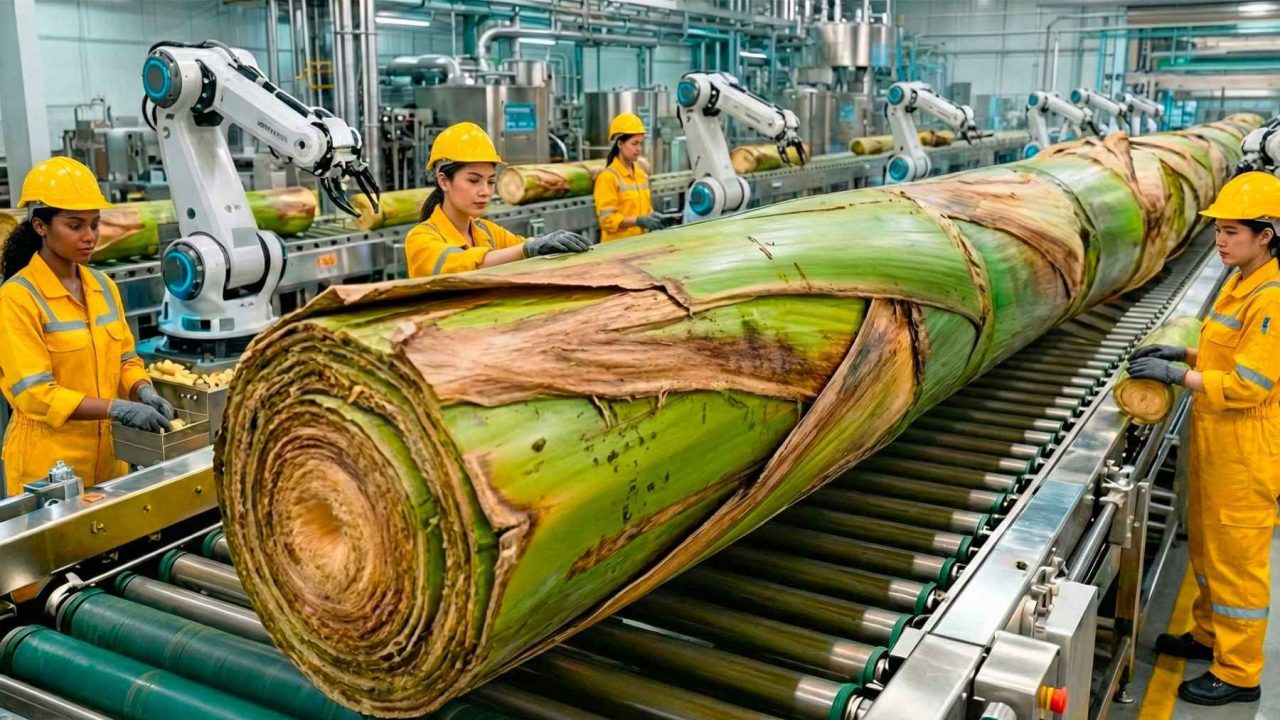
Every year, banana farms generate what could conservatively be described as a staggering mountain of waste — with residue in some production systems reaching around 220 tons per hectare after harvest. That leftover material, the thick fibrous trunk of the banana plant known as the pseudostem, has long been left to rot in fields or hauled away as agricultural refuse. Now, manufacturers and researchers are looking at that same “waste” and seeing something else entirely: the raw material for your next T-shirt, your notebook, or the tray holding fruit at your local supermarket.
The shift is happening faster than most people realize. What started as small-scale craft experimentation is moving toward genuine industrial-scale production, driven by mechanical extraction techniques and controlled drying processes that are helping standardize banana fiber as a usable commercial material.
Producer countries like Brazil are at the center of this transformation, where researchers estimate that banana pseudostems generate tens of millions of tons of waste every single year. The question is no longer whether that material has value — it clearly does. The question is how quickly industry can catch up to the science.
Why the Banana Trunk Is Suddenly Worth So Much
The banana plant is one of the most widely cultivated crops on Earth, but here is the part most people never think about: only a small fraction of the plant actually becomes food. The rest — the leaves, the roots, and especially the pseudostem — is biomass that typically stays in the field after harvest.
That pseudostem is not just bulk. It contains cellulosic fibers with tensile strengths that researchers say can surpass classic natural fibers like jute and sisal. Those are the same types of fibers that have been used in rope, burlap, and industrial reinforcement materials for generations. Banana fiber, it turns out, can hold its own — and in some properties, outperform them.
That makes the pseudostem attractive for a surprisingly wide range of applications: textile yarns, paper production, bio-based composite materials, and packaging. The agricultural byproduct that farms have been discarding for decades may be one of the more versatile natural raw materials available at scale.
What Banana Fiber Can Actually Become
The range of potential end products from banana pseudostem fiber is broader than most consumers would expect. Here is what researchers and manufacturers have identified as viable applications:
- Textiles and clothing: The cellulosic fibers can be processed into yarns suitable for fabric production, offering a plant-based alternative to synthetic materials.
- Paper and stationery: Banana fiber pulp can be used in paper manufacturing, including notebooks and specialty papers.
- Packaging materials: Bio-based composites derived from the pseudostem are being explored for fruit trays and other food packaging.
- Reinforcement composites: Given the fiber’s tensile strength relative to jute and sisal, it has applications in industrial and structural composite materials.
The common thread across all of these uses is that banana fiber is stepping into spaces currently occupied by either synthetic materials or other natural fibers — often with a smaller environmental footprint, since the raw material is already being generated as agricultural waste.
The Numbers Behind the Opportunity
| Factor | Detail |
|---|---|
| Residue per hectare (some systems) | Around 220 tons after harvest |
| Annual waste volume (producer countries) | Tens of millions of tons per year |
| Key producer country highlighted | Brazil |
| Fiber strength comparison | Can surpass jute and sisal in tensile strength |
| Share of plant that becomes food | Only a small fraction of the whole plant |
| Processing methods driving industrialization | Mechanical extraction and controlled drying |
The scale of available raw material is one reason industry interest has accelerated. Unlike crops grown specifically for fiber — which require dedicated land, water, and inputs — banana pseudostems are already being produced wherever bananas are grown. Using them requires no additional agricultural footprint.
How Mechanical Extraction Is Changing the Picture
One of the historical barriers to scaling banana fiber production was consistency. Hand-processed fiber varied too much in quality to meet the standardized requirements of large manufacturers. That is where mechanical extraction and controlled drying come in.
These industrial techniques are helping producers create a more uniform raw material — one that factories can rely on the same way they rely on cotton bales or wood pulp shipments. Controlled drying, in particular, addresses the moisture content challenges that have historically made banana fiber difficult to process at scale, since the pseudostem holds a great deal of water by nature.
Advocates of banana fiber industrialization argue that solving the consistency problem is the key that unlocks the rest of the supply chain. Once manufacturers can count on standardized inputs, the economics of producing banana-fiber textiles, paper, and composites become far more competitive.
What This Means for Farmers, Industry, and Consumers
For banana farmers, particularly in countries like Brazil where the waste volumes are enormous, this shift represents a potential new revenue stream from material they are currently paying to remove or simply leaving to decompose. Converting pseudostem waste into a sellable commodity changes the economics of the entire farming operation.
For manufacturers, it opens access to a natural fiber with strong performance characteristics that is available in massive quantities and does not require new land to produce. For consumers, it means the sustainable materials showing up in clothing, stationery, and packaging may increasingly carry a banana farm’s fingerprint — even if the label never mentions it.
The circularity argument is straightforward: a food system that currently discards the vast majority of what it grows is beginning to find uses for what it throws away. Banana fiber is one of the cleaner examples of that principle moving from concept to factory floor.
Frequently Asked Questions
What is a banana pseudostem?
The pseudostem is the thick trunk-like structure of the banana plant. It is not a true woody stem but is made up of tightly packed leaf bases, and it is left over after the fruit is harvested.
How much banana waste is produced each year?
Researchers estimate that banana pseudostems generate tens of millions of tons of waste annually in producer countries, with residue in some farming systems reaching around 220 tons per hectare.
Is banana fiber stronger than other natural fibers?
According to researchers, banana pseudostem fibers have tensile strengths that can surpass classic natural fibers like jute and sisal, making them attractive for textiles and industrial reinforcement materials.
What products can be made from banana trunk fiber?
Confirmed applications include clothing and textiles, paper and notebooks, packaging materials such as fruit trays, and bio-based composite materials.
Which countries are leading banana fiber production?
Brazil is specifically highlighted in current research as a major source of banana pseudostem waste and a focus of industrialization efforts, though the opportunity exists across all major banana-producing regions.
What is making industrial-scale banana fiber production possible now?
Mechanical extraction techniques and controlled drying processes are the key advances helping manufacturers produce standardized, consistent banana fiber at the scale commercial industries require.



Leave a Reply