
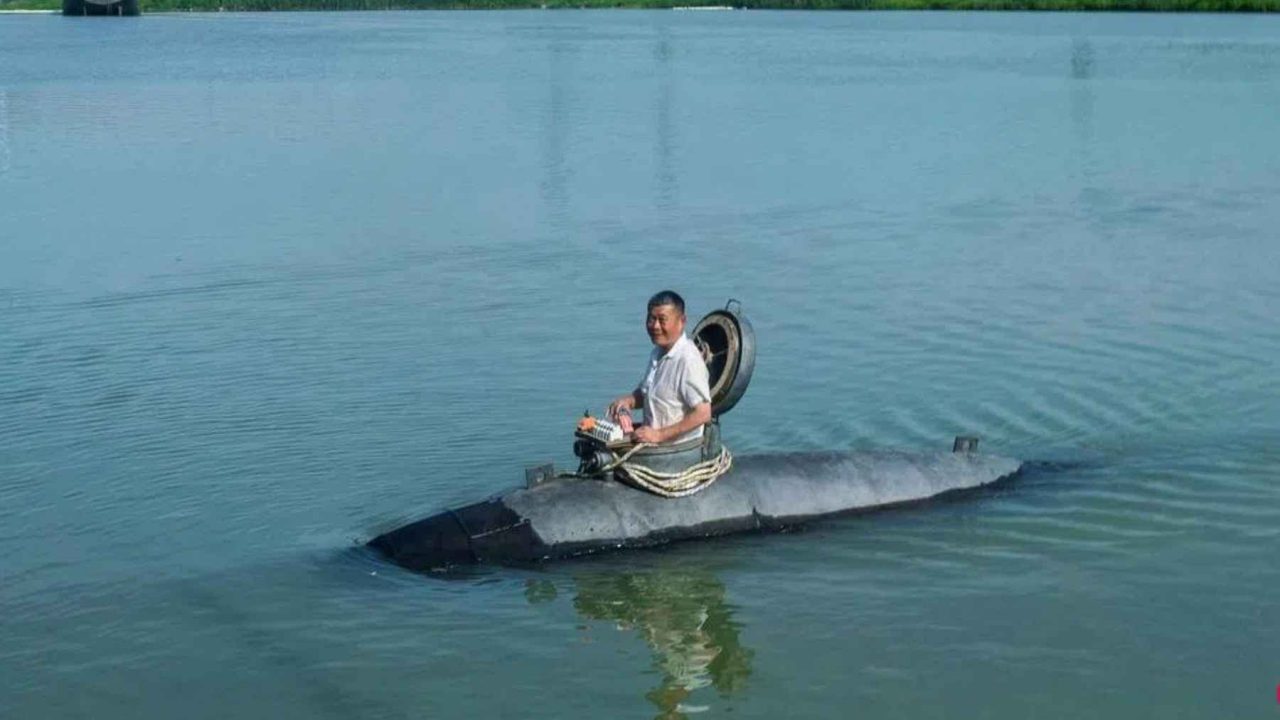
With roughly $700 in parts and no formal engineering training, a 60-year-old farmer from eastern China built a working submarine that can carry two people and descend 26 feet underwater. That alone is remarkable. But the story of Zhang Shengwu and his homemade vessel — nicknamed “Big Black Fish” — is less about a single lucky build and more about what happens when someone refuses to stop at the first version.
Zhang, who lives in Anhui Province, didn’t just build one submarine. He built two. The second cost more than eight times as much as the first, and the gap between them tells you everything about how seriously he took the project. This wasn’t a weekend stunt. It was a years-long experiment in welding, balance, risk, and stubborn curiosity.
And what he plans to do next? That’s where the story gets genuinely surprising.
How a TV Program Started All of This
Zhang had spent most of his working life around water. He had experience with carpentry and shipping, and had worked at a small riverside wharf where cargo boats were a daily reality. He understood structure. He understood how things moved through water — or at least on top of it.
Then, in 2014, a television program about homemade submarines changed the direction of his thinking entirely. He later recalled that he had seen metal boats and wooden boats throughout his entire life, but had never once seen a vessel that could go below the surface.
That observation — simple, almost childlike — turned into a years-long building project. Most people watch a program like that and move on. Zhang started sketching.
The Two Submarines: What Changed Between Version One and Version Two
The first submarine, built for around $700, was essentially a proof of concept. It worked — it went underwater, it carried people, it came back up — but Zhang wasn’t satisfied. He identified weaknesses in the design and set about correcting them in a second, far more ambitious build.
The second version was heavier, larger, and built with safety more explicitly in mind. By the time it was finished, the cost had climbed to more than $5,600 — a significant investment for a farmer, and a clear signal that this was never just about showing off.
| Version | Cost | Key Characteristics |
|---|---|---|
| Submarine 1 (“Big Black Fish” — original) | ~$700 | Two-person capacity, 26-foot dive depth, proof-of-concept build |
| Submarine 2 (revised version) | ~$5,600+ | Heavier, larger, improved safety features |
The jump from $700 to $5,600 is not just a number. It reflects a builder who took his own work seriously enough to tear it apart and do it better. That’s not the behavior of someone chasing attention — that’s the behavior of someone trying to actually solve a problem.
What Makes This More Than a Quirky Human Interest Story
Stories about self-taught inventors in rural areas often get covered as charming oddities — proof that human creativity survives outside of university labs and corporate R&D departments. And there’s truth in that framing. But Zhang’s project deserves a closer look than the “farmer builds wild thing” headline usually allows.
His background mattered. Years working around boats, cargo, and a riverside wharf gave him a practical understanding of buoyancy, weight distribution, and propulsion that no amount of casual tinkering would provide on its own. He didn’t stumble into submarine-building — he arrived at it through a lifetime of working with his hands near water.
The decision to build a second, improved version also matters. It shows a methodical mind, not just an impulsive one. He tested, identified failures, and rebuilt. That’s an engineering process, even without the formal title.
- Zhang drew on real experience in carpentry and shipping before starting the project
- The original build used approximately $700 in parts and successfully dove 26 feet
- A second, upgraded submarine followed — costing more than $5,600
- The second version was explicitly designed to be heavier, larger, and safer
- The project began after Zhang watched a 2014 television program about homemade submarines
The Part of the Story Most Headlines Skip Over
The craziest detail isn’t that the submarine worked. It’s what Zhang reportedly plans to do next.
What is clear is that Zhang didn’t build these vessels as a final destination. For him, the submarines appear to be a means to something else entirely.
That ambiguity is, in its own way, telling. Someone who spends years refining a homemade submarine — moving from a $700 prototype to a $5,600 improved model — doesn’t do that without a larger goal in mind. Whatever he’s planning, it’s safe to say it involves going further, deeper, or somewhere specific.
What This Tells Us About Backyard Innovation
Zhang Shengwu is not the first person to build something extraordinary without institutional support, and he won’t be the last. China, in particular, has produced a notable number of self-taught inventors who have built aircraft, robots, and other complex machines from salvaged parts and personal savings.
What separates the more serious efforts from pure novelty acts is usually the same thing that separates Zhang’s first submarine from his second: the willingness to go back, acknowledge what didn’t work, and spend more — in time, money, and effort — to get it right.
A $700 submarine that actually dives is impressive. A builder who then spends $5,600 to make a better one is something else entirely. That’s a person with a plan.
Frequently Asked Questions
Who built the homemade submarine?
Zhang Shengwu, a 60-year-old farmer from Anhui Province in eastern China, built the submarine known as “Big Black Fish.”
How much did the first submarine cost to build?
The first version cost approximately $700 in parts and was capable of carrying two people to a depth of about 26 feet.
Did he only build one submarine?
No. Zhang built a second, improved version that was heavier, larger, and designed with greater safety in mind — at a cost of more than $5,600.
What inspired him to build a submarine?
A 2014 television program about homemade submarines sparked the idea. Zhang later recalled that despite a lifetime around boats, he had never seen one that could go below the water’s surface.
What does Zhang plan to do next?
Did his background help him build the submarine?
Yes — Zhang had prior experience in carpentry and shipping, and had worked at a riverside wharf, giving him practical knowledge of structure and how vessels behave in water.



Leave a Reply