
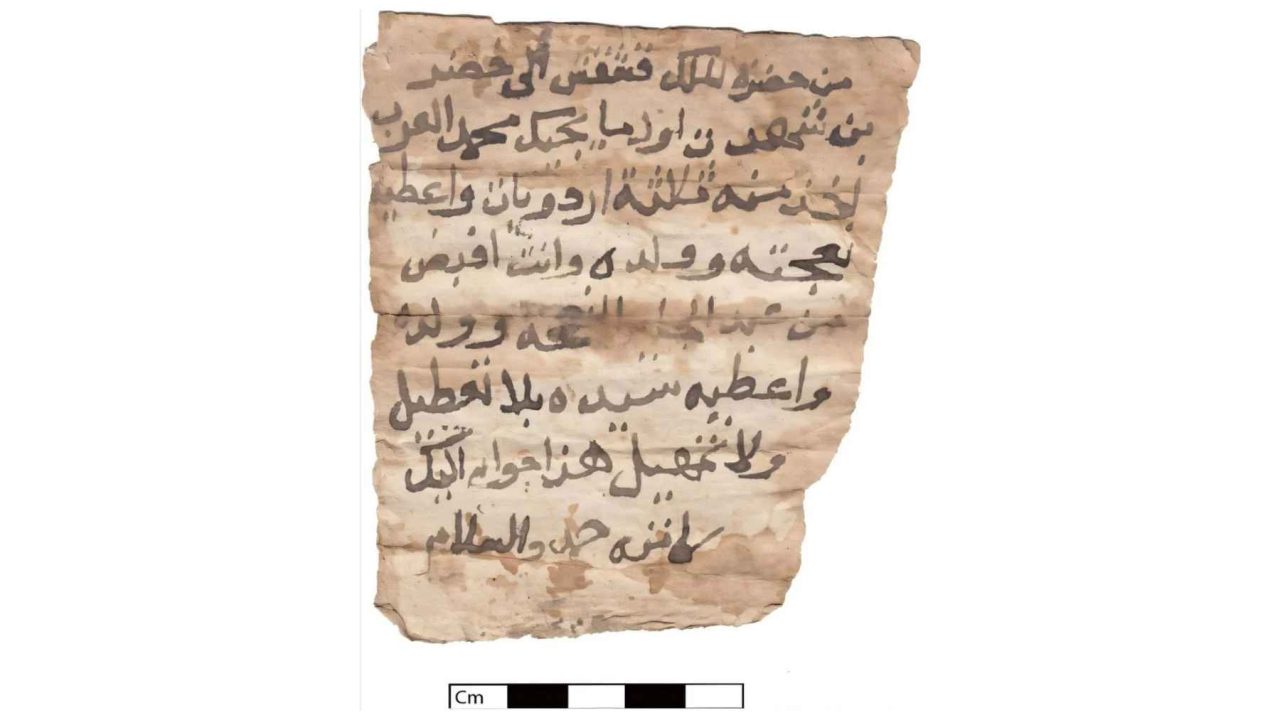
A scrap of paper pulled from a trash heap in northern Sudan has just rewritten part of what historians thought they knew about medieval Nubia. The document — a small, handwritten Arabic text recovered from Old Dongola — is not a royal proclamation or a carved monument. It is something far more useful: an everyday order, the kind of routine administrative note that powerful people wrote without much ceremony, because they had the authority to do so.
That ordinariness is exactly what makes it significant. The letter provides direct, physical evidence that King Qashqash — a Nubian ruler long treated as a semi-legendary figure — was a real political authority with control over people, goods, and court officials. For a ruler whose existence was previously known mostly through later oral traditions and 19th-century compilations of stories about Sudanese holy men, that is a considerable shift.
And the implications reach further than one king’s biography. The document opens a rare window into a period of Nubian history that official records have largely left dark: the years after Old Dongola lost its role as the capital of Makuria, the powerful Christian Nubian kingdom that once dominated the region.
The Kingdom That History Almost Forgot
Makuria was one of the most significant Christian kingdoms in African history, centered on Old Dongola in what is now northern Sudan. For centuries it held off Arab expansion and maintained its own distinct culture, administration, and religious identity. But as Makuria’s political power declined, the historical record grew thin. The conventional narrative suggested a relatively sharp collapse — a kingdom that fell and left little behind.
The newly discovered Arabic document challenges that picture. Rather than pointing to a sudden end, the letter suggests a slower, more complicated transformation. Arabic writing was being used. Royal patronage continued. Local memory persisted. Religious life was changing, but it was changing gradually, not vanishing overnight.
That messier, more human story is harder to tell from stone inscriptions and formal chronicles. But a discarded piece of administrative paper, the kind that nobody thought worth preserving, turns out to carry exactly the kind of evidence historians need.
Why a Trash Heap Tells Us More Than a Palace Wall
There is a long tradition in archaeology of learning the most from what people threw away. Grand inscriptions are designed to project power and permanence — they tell you what rulers wanted posterity to believe. Everyday documents tell you what was actually happening on a given afternoon.
The Qashqash letter fits that pattern. It is not ceremonial. It is functional — an order written on paper, likely directing someone to deliver, collect, or settle something on the king’s behalf. That kind of document implies a working administrative system: officials who could read Arabic, a court structure capable of issuing written directives, and a ruler with enough practical authority to make those directives mean something.
It also implies continuity. The use of Arabic script does not mean Nubian culture had been replaced. It suggests adaptation — a society absorbing new tools while maintaining older structures of power and identity.
What the Document Reveals: Key Facts at a Glance
| Detail | What the Source Confirms |
|---|---|
| Location of discovery | Old Dongola, northern Sudan |
| Type of document | Small Arabic-language administrative order, written on paper |
| Approximate period | 17th century |
| Subject of the document | King Qashqash, a Nubian ruler |
| Previous historical status of Qashqash | Treated as semi-legendary; known mainly from 19th-century oral tradition compilations |
| What the document establishes | Qashqash was a real political figure with authority over people, goods, and court officials |
| Broader historical significance | Challenges the narrative of sudden collapse after Old Dongola lost its role as Makuria’s capital |
- The document involves Arabic writing, suggesting the adoption of Arabic script in local administration
- It points to ongoing royal patronage in the region after Makuria’s political decline
- It reflects changing but continuing religious and cultural life in the area
- The previous main source for Qashqash was a 19th-century work based on stories about Sudanese holy men
The Part of This Story Most Reports Are Missing
It is easy to focus on the king — and the confirmation of Qashqash as a historical figure is genuinely important. But the deeper story here is about how history gets written in the first place, and what gets left out.
Official narratives of this period in Nubian history have tended to treat the post-Makuria era as a kind of blank space — a time of collapse and fragmentation that left little worth documenting. That framing is partly a result of what survived: stone monuments and formal inscriptions endure, while paper rots, gets repurposed, or ends up in refuse heaps.
When a document like this one does survive, it does not just add a single data point. It suggests that the blank space was never actually blank. There were kings issuing orders, officials carrying them out, scribes writing in Arabic, and communities maintaining enough stability to support a functioning court. The absence of evidence was never quite the same as evidence of absence.
That realization has practical consequences for how researchers approach the region’s history going forward. Excavations that might previously have focused on monumental architecture now have reason to look more carefully at organic materials — paper, leather, textile — that could carry the kind of everyday records this discovery represents.
What Comes Next for Research at Old Dongola
The discovery raises more questions than it answers, which is exactly what a good historical find should do. Researchers will want to know more about the broader context of Qashqash’s reign — when exactly he ruled, the extent of his territory, and how his court related to the religious and political changes reshaping the region during the 17th century.
Old Dongola has been the subject of ongoing archaeological work, and finds like this one suggest the site still has much to offer. The fact that this document came from what was essentially a garbage deposit means similar materials could be waiting elsewhere on the site, or at comparable locations across the former Makurian region.
For now, the letter stands as a reminder that history’s most revealing documents are not always the ones that were meant to last.
Frequently Asked Questions
Who was King Qashqash?
Qashqash was a Nubian ruler previously known mainly from later oral traditions and a 19th-century compilation of stories about Sudanese holy men. The newly discovered document confirms he was a real political figure with authority over people, goods, and court officials.
Where was the document found?
The Arabic document was recovered from a trash heap in Old Dongola, located in northern Sudan.
What does the document actually say?
Specific contents beyond this have not been detailed in the available source material.
Why does this discovery matter for our understanding of Nubian history?
It challenges the narrative that Old Dongola and the Makurian kingdom experienced a sudden collapse. Instead, the document points to a slower transformation involving continued royal authority, Arabic writing, and evolving religious life.
What was Makuria?
Makuria was a powerful Christian Nubian kingdom centered on Old Dongola. It was one of the most significant Christian kingdoms in African history before its political decline.
Could similar documents be found at the same site?
However, no specific future finds have been confirmed.




Leave a Reply