
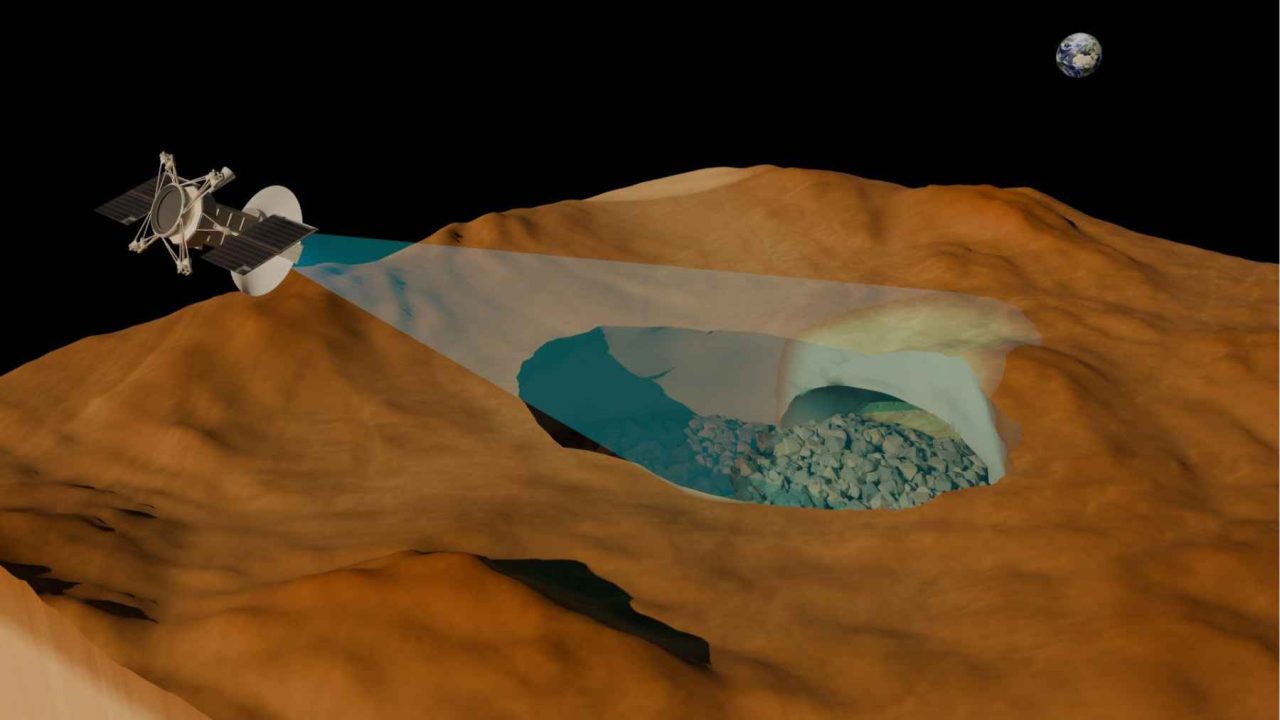
Thirty years after NASA’s Magellan spacecraft began mapping Venus through thick clouds of sulfuric acid, scientists have pulled something extraordinary from its archived radar data: what appears to be the first confirmed evidence of a massive empty tunnel running beneath the planet’s surface, roughly one kilometer wide.
The discovery didn’t come from a new mission or cutting-edge sensor. It came from researchers taking a second, much closer look at data most of the scientific community had already moved past. What they found near a volcanic region called Nyx Mons has now been published in one of the world’s leading scientific journals — and it’s changing how researchers think about what lies beneath Venus.
For a planet that has long resisted easy study, this is a significant moment. Venus hides almost everything behind an impenetrable cloud layer, making radar the only practical tool for seeing its surface and subsurface structures. And what this particular radar image revealed is unlike anything previously confirmed on Venus.
What Scientists Actually Found Near Nyx Mons
The research, led by the University of Trento and funded by the Italian Space Agency, focused on synthetic aperture radar images originally collected by Magellan after the spacecraft arrived at Venus in 1990. Those images reshaped scientific understanding of Venus at the time, but decades later, they still had more to give.
Near Nyx Mons — a volcanic structure on Venus — researchers identified what appears to be a skylight: a collapsed opening in the surface that leads down into a large underground void. The conduit beneath it is estimated to be approximately one kilometer wide, making it an enormous hollow space by any measure.
This type of feature, known as a lava tube on Earth, forms when flowing lava creates a hardened outer shell while molten rock continues moving through the interior. When the lava eventually drains away, it leaves behind a hollow tunnel. On Earth, these tubes are typically much smaller. A confirmed one-kilometer-wide version on another planet would be in an entirely different category.
The paper was published in Nature Communications on February 9, 2026, giving the finding the kind of peer-reviewed credibility that moves a discovery from speculation to scientific record.
Why Venus Is So Hard to Study — and Why This Find Matters
Most people picture planetary exploration as a matter of pointing cameras at a surface and photographing what’s there. Venus makes that impossible. Its dense, toxic atmosphere — layered with clouds that reflect light rather than transmit it — blocks conventional imaging entirely.
Radar works differently. It sends out pulses of energy that penetrate the cloud cover, bounce off surfaces, and return data that scientists can use to reconstruct what the terrain looks like. Magellan spent years doing exactly that, and the resulting maps revealed a geologically active world with volcanoes, highlands, and plains stretching across its surface.
But subsurface features are harder. Detecting an underground void from orbit, through a hostile atmosphere, using data collected three decades ago, is a different challenge entirely. The fact that researchers were able to identify this structure from archived Magellan imagery speaks both to the quality of the original data and to how much analytical techniques have improved since the 1990s.
Subsurface tunnels on Venus matter for several reasons. They offer potential shelter from the planet’s brutal surface conditions — temperatures hot enough to melt lead, atmospheric pressure roughly 90 times that of Earth. For future exploration concepts, that’s not a trivial detail.
Key Facts About the Discovery at a Glance
| Detail | Information |
|---|---|
| Spacecraft | NASA’s Magellan probe |
| Launch year | 1990 |
| Feature type | Underground subsurface conduit (lava tube) |
| Estimated width | Approximately 1 kilometer |
| Location on Venus | Near Nyx Mons |
| Entry point | Collapsed skylight (surface opening) |
| Lead institution | University of Trento |
| Funding body | Italian Space Agency |
| Published | Nature Communications, February 9, 2026 |
- The discovery relied entirely on reanalysis of existing Magellan radar data — no new mission was required
- The skylight opening is visible in radar imagery as a collapsed surface feature
- This is described as the first evidence of a giant empty subsurface conduit on Venus
- The find turns what had been a long-debated theoretical possibility into something researchers can now measure and study
The Part Most Coverage Is Getting Wrong
It’s tempting to frame this as a story about old data finally being dusted off and yielding a lucky find. But that undersells what actually happened. Researchers didn’t stumble across this feature by accident. They went back to Magellan’s archives with specific questions about subsurface structures, applied modern analytical methods, and found something that earlier examinations had not confirmed.
That distinction matters because it reflects a broader shift in planetary science. The idea that Venus might host large underground lava tubes had been discussed theoretically for years. What was missing was evidence — something measurable, something in the data. This study provides exactly that, which is why it landed in Nature Communications rather than remaining a conference presentation.
It also raises an obvious question about what else might be sitting in Magellan’s archives, waiting for someone to look again with better tools and sharper questions.
What Comes Next for Venus Exploration
The timing of this discovery is worth noting. Interest in Venus has been building within the planetary science community for years, and several missions are in various stages of planning and development. A confirmed subsurface tunnel of this scale gives those future missions a concrete target — a specific, scientifically compelling feature to investigate.
For now, researchers have a structure they can analyze from existing data. The next steps would involve refining the measurements, modeling how such a tunnel could have formed, and determining what it might reveal about Venus’s volcanic history and interior dynamics.
Whether any spacecraft will be sent specifically to investigate the Nyx Mons feature has not been confirmed. But the discovery has given the scientific community something it rarely gets with Venus: a precise, documented mystery with a known location.
Frequently Asked Questions
What is the underground tunnel found on Venus?
Scientists identified what appears to be a large empty subsurface conduit — similar to a lava tube — near Nyx Mons on Venus, with an estimated width of approximately one kilometer.
How was the tunnel discovered?
Researchers at the University of Trento reanalyzed synthetic aperture radar images originally collected by NASA’s Magellan spacecraft, which arrived at Venus in 1990.
Where exactly is the feature located on Venus?
The collapsed skylight and underground void are located near Nyx Mons, a volcanic region on Venus.
Who funded and led this research?
The study was led by the University of Trento and funded by the Italian Space Agency, with the findings published in Nature Communications on February 9, 2026.
Is this the first time a structure like this has been found on Venus?
According to the researchers, this is the first confirmed evidence of a giant empty subsurface conduit on Venus, turning a long-debated theoretical idea into something measurable.
Will a new mission be sent to investigate the tunnel?
This has not yet been confirmed. The current findings are based entirely on reanalysis of existing Magellan data, and no specific follow-up mission to this feature has been announced.



Leave a Reply