
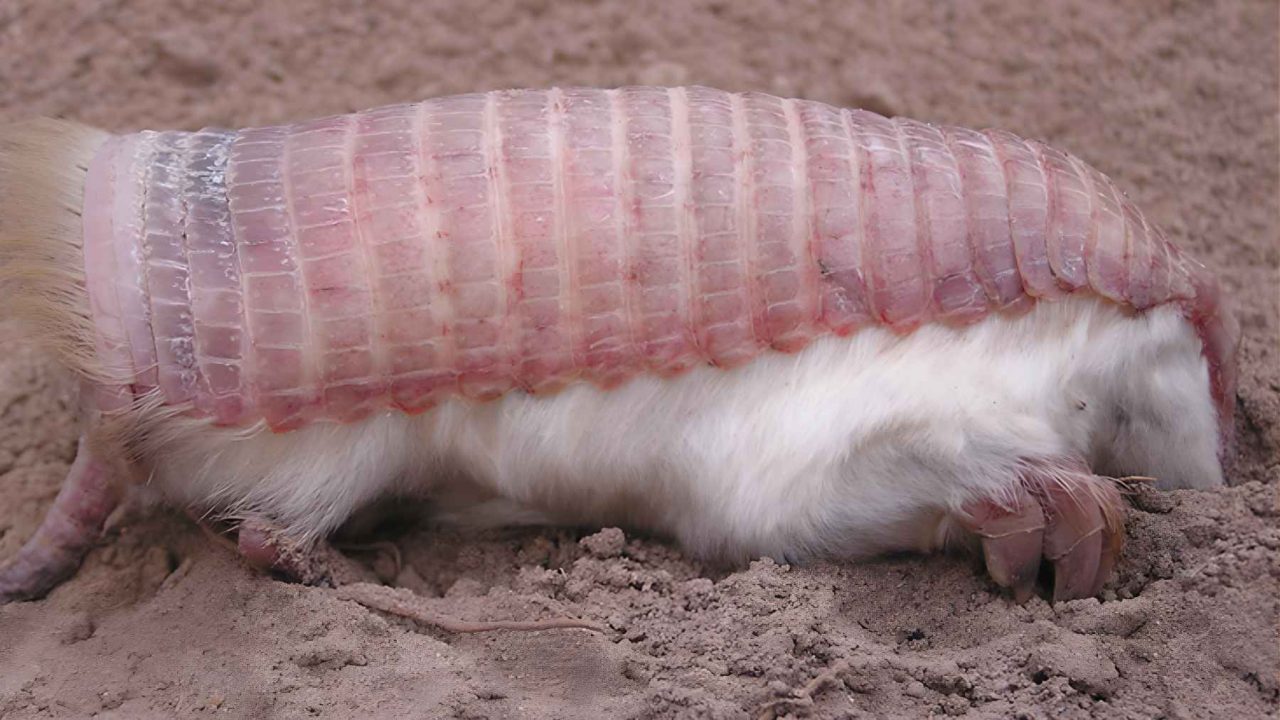
One of the world’s smallest and most elusive armadillos has been spotted again in the Argentine wilderness — and the sighting is being treated as far more than a curiosity. The reappearance of the pink fairy armadillo inside the Ñacuñán Biosphere Reserve in Mendoza province, Argentina, has prompted conservation officials to speak openly about what a single animal’s presence can reveal about the health of an entire ecosystem.
This tiny burrowing mammal, nicknamed the “pink fairy” for its pale rose-colored shell, is notoriously difficult to find. It moves underground quickly, rarely surfaces in daylight, and is so sensitive to environmental disturbance that its presence — or absence — functions almost like a living gauge of ecosystem quality. When it shows up, something is going right.
Park rangers and local residents both confirmed this latest observation, making it a credible record that conservation authorities are now using to draw broader conclusions about what Ñacuñán has been quietly protecting.
Why the Pink Fairy Armadillo Is So Hard to Find
The pink fairy armadillo is one of the most rarely observed mammals in South America. It spends most of its life underground, using powerful claws to burrow through sandy soil in search of insects, larvae, and plant roots. It can vanish beneath the surface in seconds, which is part of why confirmed sightings are so uncommon even in areas where the species is believed to live.
Its sensitivity is the other reason researchers pay close attention when it does appear. The species depends on a very specific set of conditions: stable, undisturbed soil structure, native vegetation cover, and a functioning food web from the ground up. Disruptions that might seem minor to the human eye — repeated land disturbance, fragmented habitat, soil compaction — can quietly make an area uninhabitable for this animal long before those changes become visible.
That’s what makes a confirmed sighting meaningful. It isn’t just a pleasant wildlife moment. It’s evidence that the underlying ecological machinery is still running.
What Officials Said About the Ñacuñán Sighting
Argentina’s biodiversity director, Ignacio Haudet, responded to the confirmed record with a statement that framed the sighting in explicitly ecological terms. According to Haudet, each confirmed record of the pink fairy armadillo is
“a concrete sign that the ecosystem works.”
That framing matters. Officials aren’t just celebrating a rare animal being spotted — they’re pointing to what the sighting represents about the reserve’s condition. The species depends on a chain of conditions that, as Haudet noted, can break easily. Finding it intact suggests that chain is holding.
Protected areas director Iván Funes Pinter added another layer to the significance of the observation. He emphasized that Ñacuñán does not only conserve landscapes — it conserves what he described as “complete ecological dynamics” that allow unique species like this one to survive. That distinction is worth pausing on. Many protected areas are valued for what they look like. Funes Pinter is arguing that Ñacuñán’s real value is in how it functions.
The Reserve Doing More Than Preserving Scenery
The Ñacuñán Biosphere Reserve sits in Mendoza province and forms part of Argentina’s network of protected natural areas. Biosphere reserves, by design, are meant to protect not just species in isolation but the full ecological systems those species depend on. The pink fairy armadillo sighting appears to validate that approach in a very direct way.
Conservation officials pointed out that many of the threats facing ecosystems like this one are slow and ordinary rather than dramatic. Land disturbance that seems small in isolation can accumulate year after year until habitat that once supported sensitive species no longer can. Ñacuñán’s protected status appears to have buffered against exactly that kind of gradual erosion.
| Detail | Confirmed Information |
|---|---|
| Species spotted | Pink fairy armadillo |
| Location | Ñacuñán Biosphere Reserve, Mendoza, Argentina |
| Who confirmed the sighting | Park rangers and local residents |
| Biodiversity director quoted | Ignacio Haudet |
| Protected areas director quoted | Iván Funes Pinter |
| Key ecological indicator noted | Stable soil, native plant cover, functioning food web |
What a Single Sighting Can Actually Tell Us
It’s easy to dismiss a wildlife sighting as anecdotal. One animal, seen once, doesn’t tell you everything about a habitat. But conservation science has long used so-called “indicator species” — animals whose presence or absence reflects broader environmental conditions — as practical tools for assessing ecosystem health without conducting exhaustive surveys of every species present.
The pink fairy armadillo fits that role almost perfectly. Its requirements are specific enough that its presence rules out a wide range of problems. If the soil is too compacted, it can’t burrow. If native vegetation has been cleared and replaced, the insect communities it feeds on collapse. If the landscape has been fragmented, populations can’t sustain themselves. A confirmed sighting, in that context, carries real diagnostic weight.
Officials in Mendoza appear to understand this. Their response to the sighting wasn’t simply to announce a feel-good conservation win — it was to use the moment to make a broader argument about why protecting entire ecosystems, not just the most visually striking parts of them, produces results that matter.
What Happens Next for Ñacuñán and Its Hidden Residents
What officials have signaled, however, is that records like this one strengthen the case for maintaining and expanding the kind of holistic habitat protection that Ñacuñán represents.
The broader implication is that ecosystems which appear quiet or unremarkable on the surface can still harbor extraordinary species — if the underlying conditions remain intact. The pink fairy armadillo’s return is a reminder that conservation success doesn’t always announce itself loudly. Sometimes it shows up as a small, pale creature emerging briefly from the sand, then disappearing again before most people even know it was there.
Frequently Asked Questions
Where was the pink fairy armadillo spotted?
The animal was recorded inside the Ñacuñán Biosphere Reserve in Mendoza province, Argentina.
Who confirmed the sighting?
Park rangers and local residents both confirmed the presence of the pink fairy armadillo in the reserve.
Why is this sighting considered significant?
Conservation officials say each confirmed record is a sign that the ecosystem is functioning properly, because the species depends on a specific chain of ecological conditions that can break easily.
What did Argentina’s biodiversity director say about the sighting?
Biodiversity director Ignacio Haudet described each confirmed record as “a concrete sign that the ecosystem works.”
What makes the pink fairy armadillo so difficult to observe?
The species is a fast burrower that spends most of its life underground and is highly sensitive to environmental disturbance, making confirmed sightings rare even in areas where it is believed to live.
Will there be follow-up conservation action after this sighting?



Leave a Reply