
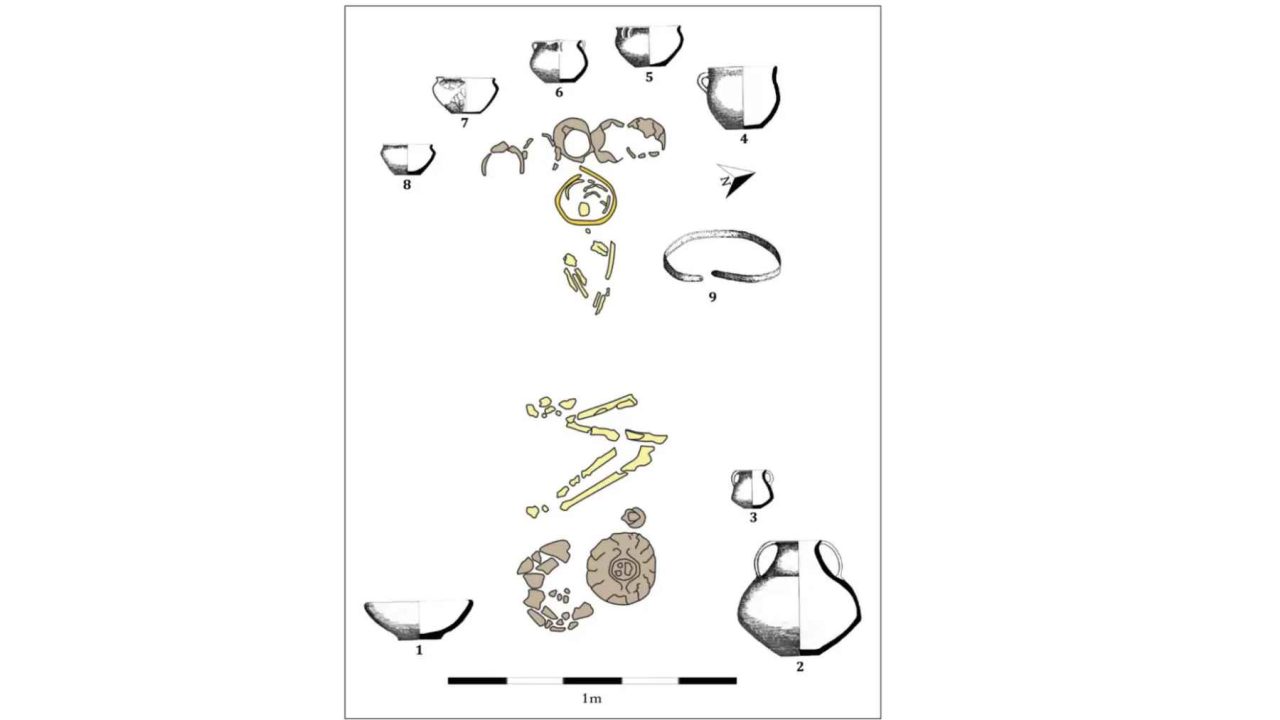
Three teeth pulled from ancient graves along the Serbian Danube are quietly rewriting what archaeologists thought they knew about the Bronze Age. Not the gold diadem — though that shimmering band is hard to ignore — but the biological material locked inside those teeth, which carried enough organic information to give scientists something they have rarely had for this region: precise calendar dates.
New radiocarbon dating tied to burials at three sites in Serbia — Vajuga-Pesak, Golokut-Vizić, and Šljunkara-Zemun — is tightening the timeline of the Early and Middle Bronze Age in ways that are forcing researchers to rethink how they compare communities across the Serbian Danube, the Carpathian Basin, and the Central Balkans. This is not a minor adjustment. It changes the foundation of how these cultures are understood.
The study was conducted by Ognjen Mladenović and Aleksandar Bulatović, both from the Institute of Archaeology, National Institute of the Republic of Serbia in Belgrade. Their work centers on what happens when you stop relying on educated guesswork and start letting biology do the talking.
Why a Gold Diadem Was Never the Real Story
A gold diadem discovered in one of these graves is the kind of object that stops people in their tracks. A decorative band from roughly 4,600 years ago, likely worn on the head, it signals wealth, status, and a level of metalworking sophistication that most people don’t associate with Bronze Age Serbia.
But archaeologists have long known that beautiful objects can be misleading time markers. A gold band can be passed down through generations, traded across vast distances, or copied by craftspeople in different eras. The diadem tells you something about the person buried with it. It does not reliably tell you exactly when they lived.
The teeth are different. Tooth enamel forms during childhood and does not remodel over time. It locks in isotopic and organic signals from the moment it develops — making it one of the most reliable materials available for radiocarbon dating of ancient human remains. When Mladenović and Bulatović chose teeth as their dating material, they were going straight to the most honest record available.
The Problem With Dating by Pottery Shape
For decades, burials at sites like Vajuga-Pesak, Golokut-Vizić, and Šljunkara-Zemun were placed in time primarily through typology. That means researchers looked at the shape of ceramic vessels, the style of metal objects, and the posture of the buried body, then compared those features to objects from other sites where dates were better established.
The method has genuine value. It can identify cultural connections, trade networks, and shared traditions across regions. But it also carries a fundamental weakness: it assumes that similar-looking objects were made and used at the same time. That assumption does not always hold.
Think of it as trying to date an old photograph purely by the style of clothing the subjects are wearing. You might get the decade right. You might not. And in archaeology, a margin of error measured in centuries can completely change the story of who influenced whom, which culture came first, and how ideas spread across a landscape.
Radiocarbon dating of the teeth removes that uncertainty. It gives the burials a firmer position on an actual calendar — one that does not depend on what the pottery looked like.
What the Three Sites Reveal About Bronze Age Serbia
The three burial sites at the center of this study each contribute something distinct to the emerging picture of Bronze Age life along the Serbian Danube and into the Central Balkans.
- Vajuga-Pesak — one of the burial sites providing new radiocarbon data through tooth samples
- Golokut-Vizić — a second site contributing to the revised Early and Middle Bronze Age timeline
- Šljunkara-Zemun — the third site in the study, with burials now more firmly anchored in calendar time
Together, these sites sit at a crossroads. The Serbian Danube connects the Carpathian Basin to the north with the Central Balkans to the south. Metal objects, pottery styles, and funeral customs moved through these corridors long before anyone was writing anything down. Getting the dates right matters because it determines the direction of cultural flow — who was borrowing from whom, and when.
| Site Name | Region | Dating Method Used | Approximate Period |
|---|---|---|---|
| Vajuga-Pesak | Serbian Danube | Radiocarbon (tooth samples) | Early / Middle Bronze Age (~4,600 years ago) |
| Golokut-Vizić | Serbian Danube | Radiocarbon (tooth samples) | Early / Middle Bronze Age |
| Šljunkara-Zemun | Central Balkans region | Radiocarbon (tooth samples) | Early / Middle Bronze Age |
Why This Disrupts the Bronze Age Timeline
The phrase “disrupting the Bronze Age timeline” is not dramatic overstatement. When new, more precise dates are applied to burials that were previously placed in time through typology alone, the relationships between cultures can shift significantly.
If Site A was previously thought to predate Site B by two centuries — based on pottery comparisons — but radiocarbon dating shows they were actually contemporary, the entire model of cultural influence between those two communities changes. Researchers studying networks across the Carpathian Basin and the Central Balkans are now working with a more accurate foundation, which means some long-held conclusions about which Bronze Age communities were leading and which were following may need to be revisited.
The work by Mladenović and Bulatović does not simply add one more grave to the record. It recalibrates the reference points that other researchers rely on when building their own interpretations of this period.
What Comes Next for Bronze Age Research in the Region
The immediate value of this study is methodological as much as it is historical. By demonstrating what tooth-based radiocarbon dating can achieve at these specific sites, the researchers are making a case for applying the same approach more broadly across the region.
There are many more graves in Serbia, the Carpathian Basin, and the Central Balkans that were dated primarily through typology. Each one is a candidate for the kind of recalibration that Vajuga-Pesak, Golokut-Vizić, and Šljunkara-Zemun have now undergone. As that work continues, the picture of Bronze Age life in southeastern Europe will almost certainly keep shifting — becoming sharper, more accurate, and more surprising.
The gold diadem will stay in the museum case, catching the light. But the real work of understanding the person who wore it is happening in the laboratory, one ancient tooth at a time.
Frequently Asked Questions
Where were the Bronze Age burial sites discovered?
The burials are located at three sites in Serbia: Vajuga-Pesak, Golokut-Vizić, and Šljunkara-Zemun, in the region of the Serbian Danube and Central Balkans.
How old are the graves?
The burials date to approximately 4,600 years ago, placing them in the Early and Middle Bronze Age period.
Why were teeth used for dating instead of other materials?
Tooth enamel forms during childhood and does not change over time, making it one of the most reliable materials available for radiocarbon dating of ancient human remains.
Who conducted the research?
The study was carried out by Ognjen Mladenović and Aleksandar Bulatović, both from the Institute of Archaeology, National Institute of the Republic of Serbia in Belgrade.
What was found in the tomb alongside the teeth?
A gold diadem — a decorative band likely worn on the head — was among the objects recovered from one of the burials, pointing to the high status of the individual interred there.
Why does this change the Bronze Age timeline?
Previous dating of these burials relied on typology — comparing pottery and object styles — which is less precise. The new radiocarbon dates give firmer calendar positions, potentially altering how archaeologists understand cultural relationships across the Carpathian Basin and Central Balkans.



Leave a Reply