
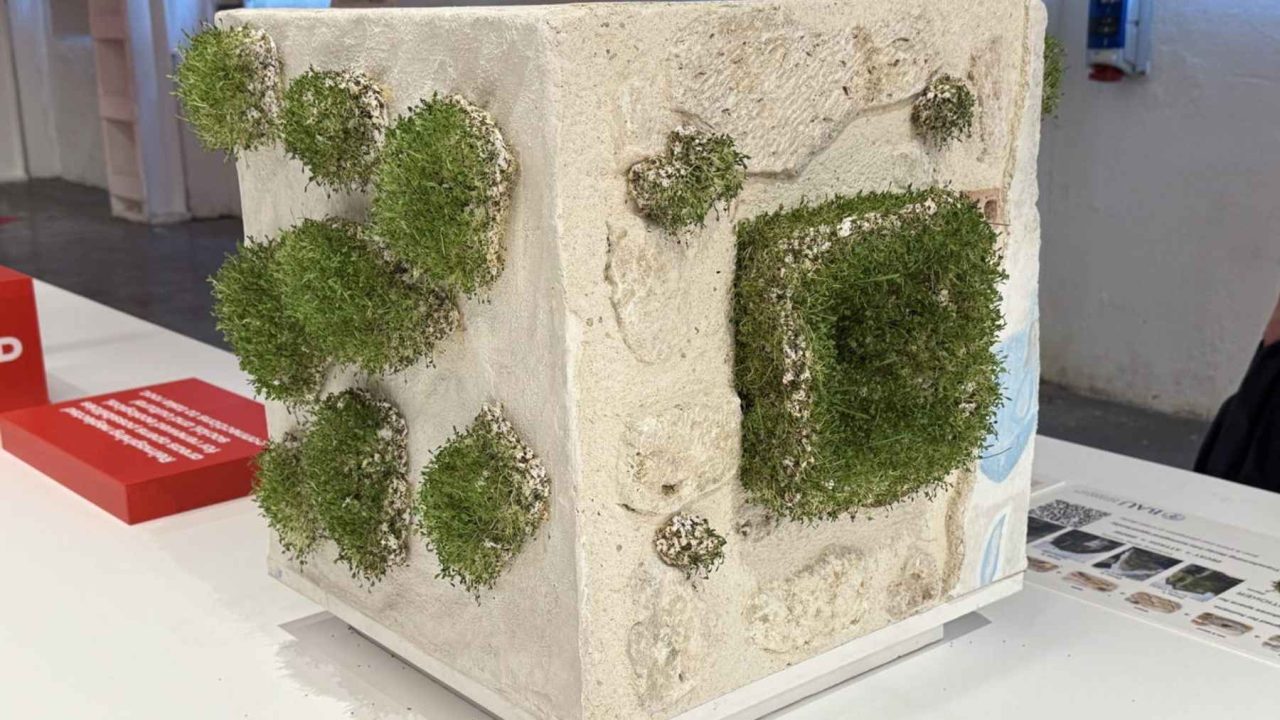
What if the cracked, weathered walls of a city weren’t problems to be patched over — but surfaces waiting to become gardens? That’s the question at the heart of a design project coming out of Istanbul, and the answer it proposes fits in the palm of your hand.
A Turkish design student has developed a seed-filled, biodegradable adhesive patch that sticks directly onto damaged walls and allows plants to grow from the cracks. The concept is called Green Anarchy, and while it’s still an academic proposal rather than a commercial product, it’s drawing attention for how elegantly simple the idea actually is.
Cities spend enormous resources managing aging infrastructure. Green Anarchy doesn’t ask them to fix every wall — it asks what could happen if some of those surfaces were allowed to grow something instead.
What Green Anarchy Actually Is
The project was developed by Yasemin Keyif at Bahçeşehir University in Istanbul. At its core, it’s a small adhesive patch — described by design publication Yanko Design as behaving more like a living starter kit than a conventional sticker.
The patch is pressed onto cracked or damaged building facades. Over time, the biodegradable body of the patch breaks down naturally, releasing seeds into the crevices of the wall and allowing vegetation to take root. The goal is to transform neglected urban surfaces into small vertical habitats without requiring any construction, planning permission, or maintenance infrastructure.
It’s worth being clear about what this project is and isn’t. Green Anarchy is not a Turkish government program. It is not a finished product available for purchase. It is an academic design proposal — but one that has attracted genuine interest precisely because the concept is so low-friction and accessible.
What the Patch Is Made Of
The materials chosen for the patch reflect a deliberate effort to avoid synthetic components. According to Yanko Design’s reporting on the project, the composition breaks down into two distinct parts: the body of the patch and the adhesive layer that holds it to a surface.
| Component | Materials Used |
|---|---|
| Patch body | Paper pulp, coco peat, perlite, seeds |
| Adhesive layer | Gum arabic, methyl cellulose, glycerin |
Each of these materials was selected because it breaks down naturally rather than persisting as plastic waste. Coco peat — a byproduct of coconut processing — is widely used in horticulture as a lightweight growing medium. Perlite is a volcanic mineral that improves aeration and drainage in soil. Gum arabic and methyl cellulose are both plant-derived binders commonly used in food and pharmaceutical applications.
The result is a patch that functions as a temporary delivery system: it adheres to a surface long enough for seeds to establish contact with the wall, then gradually disappears as the plant begins to grow.
Why This Idea Is Getting Attention Right Now
Urban greening has become one of the more urgent conversations in city planning circles. Dense cities face rising surface temperatures, reduced biodiversity, and limited space for traditional parks or green infrastructure. Vertical gardens and living walls have been proposed as partial solutions, but most existing approaches are expensive, require structural support, and demand ongoing maintenance.
Green Anarchy takes a different approach entirely. Rather than building new green infrastructure from scratch, it works with what’s already there — specifically, the damaged and overlooked surfaces that exist in virtually every urban neighborhood. The project was reportedly tested around dense historic areas, where conventional greening projects would face the most logistical difficulty.
Supporters of concepts like this argue that democratizing urban greening — making it something individuals can participate in rather than waiting for city governments to act — could accelerate the pace at which cities become more livable. Critics might reasonably ask about long-term plant viability, structural impact on walls, or whether vegetation on building facades could cause further damage over time. Those questions have not yet been publicly addressed in detail by the project’s published materials.
The Bigger Picture for Green Cities
What makes Green Anarchy interesting beyond its materials is its philosophy. The name itself signals something intentional: the idea that urban nature doesn’t have to be planned, permitted, and professionally installed to be valuable.
Walls crack in every city. Facades peel. Old buildings develop fissures that no one repairs for years. The conventional response is to view this as decay. Green Anarchy reframes it as opportunity — not to restore the wall to its original condition, but to let something living take hold in the gap.
That shift in perspective is arguably as significant as the patch itself. If the concept were ever scaled or commercialized, it could allow residents, community groups, or even individual passersby to contribute to urban biodiversity in a way that requires no expertise, no budget, and no coordination with city authorities.
What Happens Next for This Project
As of the project’s publication, Green Anarchy remains an academic design proposal developed at Bahçeşehir University. There is no confirmed timeline for commercial development, no announced partnerships with municipalities, and no public rollout plan.
That’s not unusual for design-stage concepts. Academic projects of this kind often serve as proofs of concept — demonstrating that a problem can be approached differently and inviting further development from manufacturers, urban planners, or environmental organizations.
Whether Green Anarchy moves beyond the university setting will likely depend on interest from outside partners and on whether further testing confirms that the patches perform reliably across different wall materials, climates, and plant species. For now, it stands as one of the more imaginative responses to the question of what cities could look like if their damaged surfaces were treated as potential rather than problems.
Frequently Asked Questions
What is Green Anarchy?
Green Anarchy is an academic design project developed by Yasemin Keyif at Bahçeşehir University in Istanbul. It proposes a biodegradable, seed-filled adhesive patch that can be applied to cracked or damaged walls to encourage plant growth.
Is this a real product you can buy?
No. As of its publication, Green Anarchy is an academic design proposal and not a finished commercial product available for purchase.
What materials are used in the patch?
The patch body contains paper pulp, coco peat, perlite, and seeds. The adhesive layer uses gum arabic, methyl cellulose, and glycerin — all natural, biodegradable materials.
Is this a Turkish government initiative?
No. The project is not a government program or public works plan. It was developed as an individual academic design project at a university in Istanbul.
Where was the patch tested?
According to available reporting, the project was tested around dense historic areas, though detailed results from that testing have not been publicly confirmed.
Could the patches damage building walls over time?
This has not yet been confirmed or addressed in the publicly available project materials. It remains an open question for further development and testing.


Leave a Reply