
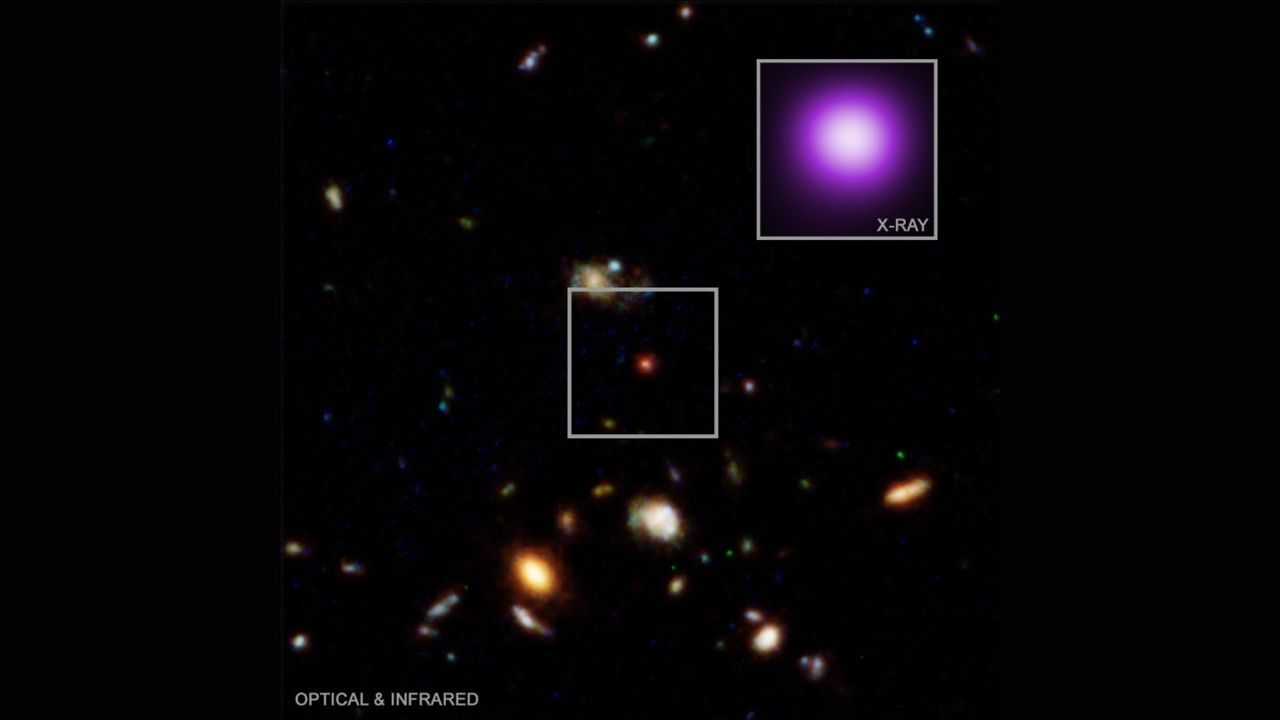
Somewhere in the ancient universe, roughly 12 billion light-years away, a peculiar class of objects has been quietly baffling astronomers since 2022. They’re called “little red dots,” and despite hundreds of confirmed sightings by the James Webb Space Telescope, no one has been entirely sure what they actually are — until now, a newly studied black hole may finally offer some answers.
A paper published on March 16 in The Astrophysical Journal Letters describes a unique, X-ray-emitting object formally designated 3DHST-AEGIS-12014 — nicknamed the “X-ray dot” — that researchers believe could unlock the mystery behind little red dots and confirm their true nature once and for all.
It’s the kind of discovery that sounds abstract until you realize it touches on one of the biggest open questions in modern cosmology: how the earliest structures in our universe formed, and why some of them seem to have simply vanished.
What Are Little Red Dots — and Why Do They Matter?
When the James Webb Space Telescope began science operations in 2022, it almost immediately started returning images of something astronomers hadn’t quite seen before. Compact, ancient, and visually reddish, these objects were quickly dubbed “little red dots,” or LRDs.
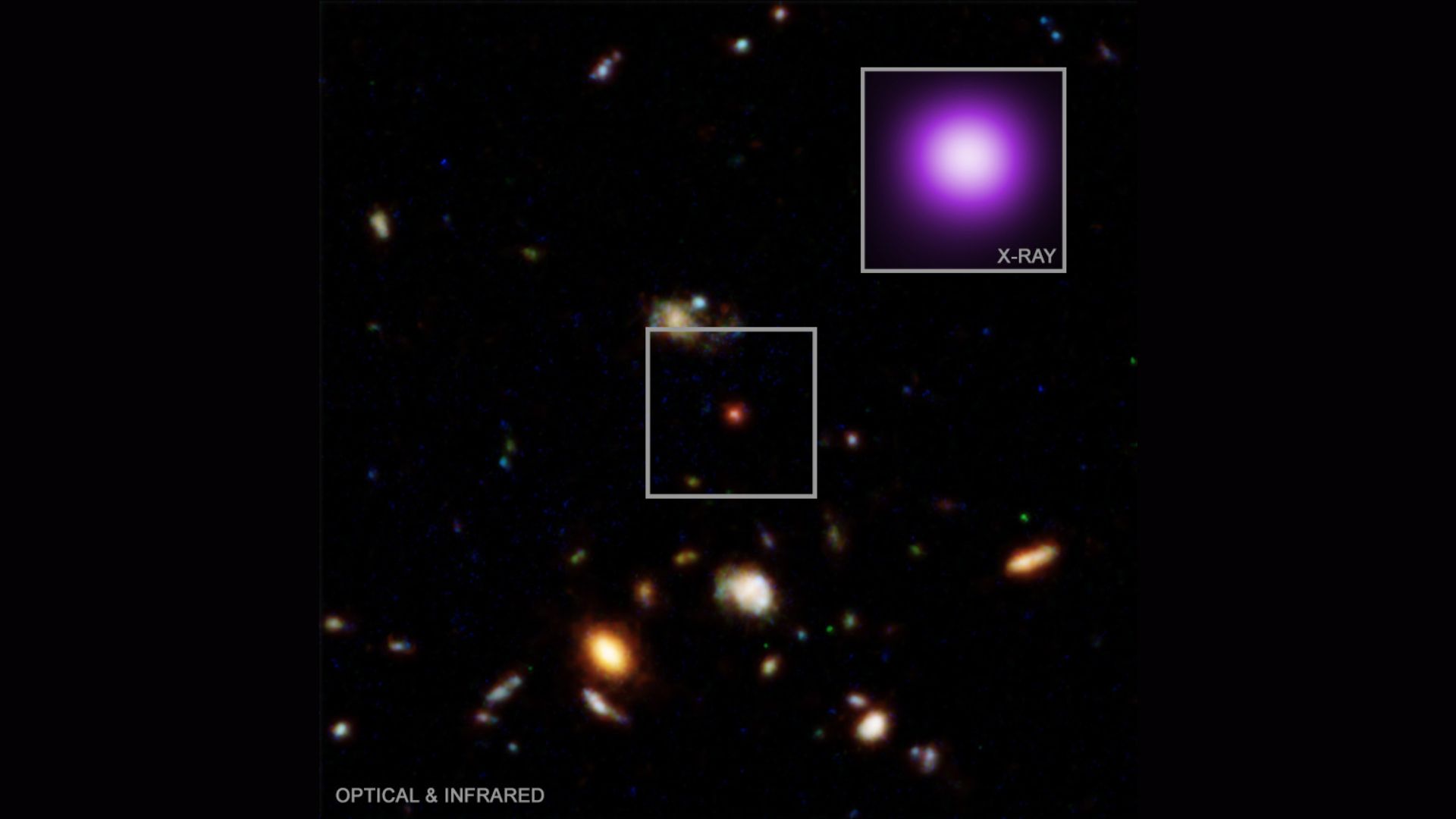
Their reddish appearance isn’t just an aesthetic quirk. It’s the result of redshifting — a process where light stretches into longer, redder wavelengths as it travels across billions of light-years through an expanding universe. By the time that light reaches our telescopes, it has been on a journey of roughly 12 billion years.
What makes LRDs especially puzzling isn’t just their appearance. It’s their timeline. These objects appear to have emerged around 600 million years after the Big Bang, then largely disappeared over the following billion years. They blinked into existence in the early cosmos and then, for reasons still not fully understood, mostly vanished.
Over the years following their initial discovery, JWST found hundreds more of these ancient compact objects — enough to confirm they weren’t flukes, but not enough to definitively explain what they were.
The X-Ray Dot: A Black Hole With a Story to Tell
That’s where 3DHST-AEGIS-12014 comes in. This object — the so-called X-ray dot — is unique because it emits X-rays, a property that sets it apart from the broader population of little red dots and gives astronomers a new way to study it.
NASA’s Chandra X-ray Observatory has been instrumental in capturing data from this object. Because X-ray emissions are closely associated with the intense energetic activity of black holes — particularly supermassive ones actively consuming surrounding material — the X-ray dot’s behavior offers a direct window into the physics driving these early cosmic structures.
The working hypothesis among researchers is that little red dots are powered by actively accreting supermassive black holes in the very early universe. If confirmed, this would fundamentally shape our understanding of how black holes and galaxies co-evolved in the first billion years after the Big Bang.
Key Facts About Little Red Dots and the X-Ray Dot Discovery
| Feature | Detail |
|---|---|
| First detected by | James Webb Space Telescope (JWST), 2022 |
| Distance from Earth | Approximately 12 billion light-years |
| Estimated emergence | Around 600 million years after the Big Bang |
| Duration of prevalence | Approximately 1 billion years before mostly disappearing |
| Number discovered by JWST | Hundreds of confirmed objects |
| X-ray dot formal designation | 3DHST-AEGIS-12014 |
| Research published | March 16, The Astrophysical Journal Letters |
| X-ray data source | NASA’s Chandra X-ray Observatory |
- LRDs appear red due to cosmological redshifting of their light over billions of light-years
- They are described as “compact” — meaning they occupy a relatively small physical region of space
- Their ephemeral nature — appearing and then largely vanishing — is one of the central mysteries researchers are trying to solve
- The X-ray dot is notable specifically because X-ray emissions are rare among the broader LRD population, making it a valuable case study
Why This Discovery Could Rewrite Early Universe History
The implications here extend well beyond cataloguing one unusual black hole. If the X-ray dot confirms that little red dots are indeed early supermassive black holes caught in an active feeding phase, it raises profound questions about how such massive objects could have formed so quickly after the Big Bang.
Current cosmological models struggle to fully account for the existence of supermassive black holes in the very early universe. They simply shouldn’t have had enough time to grow that large through conventional processes. LRDs — if they are confirmed as active black holes — could point toward exotic formation pathways that scientists are only beginning to theorize about.
The fact that LRDs mostly disappear after roughly a billion years also demands an explanation. Did they exhaust their fuel supply? Did they merge with surrounding structures? Did their host galaxies grow large enough to obscure them? The X-ray dot, with its detectable X-ray signature, gives researchers a rare chance to probe those questions with real observational data rather than theoretical models alone.
What Comes Next for This Research
The paper published in March 2025 represents a significant step, but researchers are clear that this is the beginning of a deeper investigation rather than a final answer. The X-ray dot provides a testable, observable example that can guide future studies of the broader LRD population.
JWST continues to operate and accumulate data, and astronomers expect that further observations — combined with X-ray data from Chandra and other observatories — will gradually build a clearer picture of what little red dots truly are and why they behaved the way they did in the early cosmos.
For now, the universe’s earliest billion years remain one of astronomy’s most fascinating open chapters — and a single X-ray-spewing black hole, 12 billion light-years away, may be the key that finally starts to crack it open.
Frequently Asked Questions
What are little red dots in astronomy?
Little red dots are a class of compact, ancient objects observed mostly in the very early universe, approximately 12 billion light-years away, first spotted by the James Webb Space Telescope in 2022.
Why do little red dots appear red?
Their light has been redshifted — stretched into longer, redder wavelengths — as it traveled across billions of light-years through an expanding universe to reach us.
What is the X-ray dot and why is it significant?
The X-ray dot, formally known as 3DHST-AEGIS-12014, is a unique black hole that emits X-rays — a rare property among little red dots — making it a valuable object for understanding what LRDs actually are.
When did little red dots first appear in the universe?
According to current research, they emerged around 600 million years after the Big Bang and mostly disappeared over the following billion years.
Where was the research on the X-ray dot published?
The paper was published on March 16 in The Astrophysical Journal Letters.
Does this discovery confirm what little red dots are?
Not definitively — the X-ray dot offers important new evidence, but researchers indicate this is an early step in a longer investigation rather than a final conclusion.




Leave a Reply